
We are rapidly approaching an intersection of 2 generational technology shifts: The explosive adoption of generative artificial intelligence (AI), and the looming reality of cryptographically relevant quantum computers (CRQCs). While AI is transforming how we extract value from data, quantum computing is quietly threatening the very foundation of how we secure it.
If your organization is building its AI strategies on Red Hat AI Enterprise, then the models you train, the proprietary data you process, and the inference endpoints you expose represent your most valuable intellectual property. Should a malicious actor intercept this traffic today, they cannot read it thanks to standard encryption (like RSA and ECC). However, under a "harvest now, decrypt later" (HNDL) attack, they can store this encrypted data until a quantum computer capable of breaking it becomes available.
To counter this, the industry is transitioning to post-quantum cryptography (PQC). Red Hat has been actively preparing for this transition — often referred to as Q-Day — by integrating National Institute of Standards and Technology (NIST) standardized quantum-resistant algorithms into the core of its platform ecosystem.
But how exactly does this foundational cryptographic shift impact the MLOps / GenAIOps lifecycle? In this post, we'll explore what PQC means for the architecture of Red Hat AI Enterprise, component by component, and how Red Hat is engineering a quantum-safe future for production AI.
The quantum threat and Red Hat's post-quantum cryptography strategy
Before diving into the AI components, it is critical to understand the tools at our disposal. In August 2024, NIST released the first finalized standards for post-quantum cryptography, which Red Hat is actively building into its hybrid cloud foundations:
- FIPS 203 (ML-KEM): A lattice-based key encapsulation mechanism (formerly CRYSTALS-Kyber) used for secure key exchange, primarily protecting data in transit (like TLS connections). https://nvlpubs.nist.gov/nistpubs/FIPS/NIST.FIPS.203.pdf
- FIPS 204 (ML-DSA): A digital signature algorithm (formerly CRYSTALS-Dilithium) used for authentication and ensuring data integrity. https://nvlpubs.nist.gov/nistpubs/fips/nist.fips.204.pdf
- FIPS 205 (SLH-DSA): A stateless hash-based signature scheme (formerly SPHINCS+) used as a conservative backup for digital signatures. https://nvlpubs.nist.gov/nistpubs/fips/nist.fips.205.pdf
Red Hat's strategy for adopting these standards relies on cryptographic agility and PQC modernization. Rather than flipping a switch and disabling classical encryption, platforms like Red Hat Enterprise Linux 10 (RHEL) and Red Hat OpenShift introduce hybrid modes. This means a TLS handshake might use both a classical algorithm (like X25519) and a post-quantum algorithm (like ML-KEM) simultaneously. If a quantum computer breaks the classical algorithm, the PQC algorithm still secures the session.
While Red Hat AI Enterprise inherits its broader security posture from the underlying Red Hat OpenShift platform and Red Hat Enterprise Linux CoreOS, it is specifically the HNDL protection delivered using hybrid TLS that forms the bedrock upon which quantum-safe AI workflows will be built.
Red Hat AI Enterprise: A component architecture perspective
Red Hat AI Enterprise is a modular MLOps / GenAIOps platform designed to manage the complete lifecycle of AI and machine learning projects. It strings together various open source projects (figure 1) — such as vLLM, Jupyter, Kubeflow, MLflow and KServe — into a cohesive, scalable environment backed by Kubernetes.
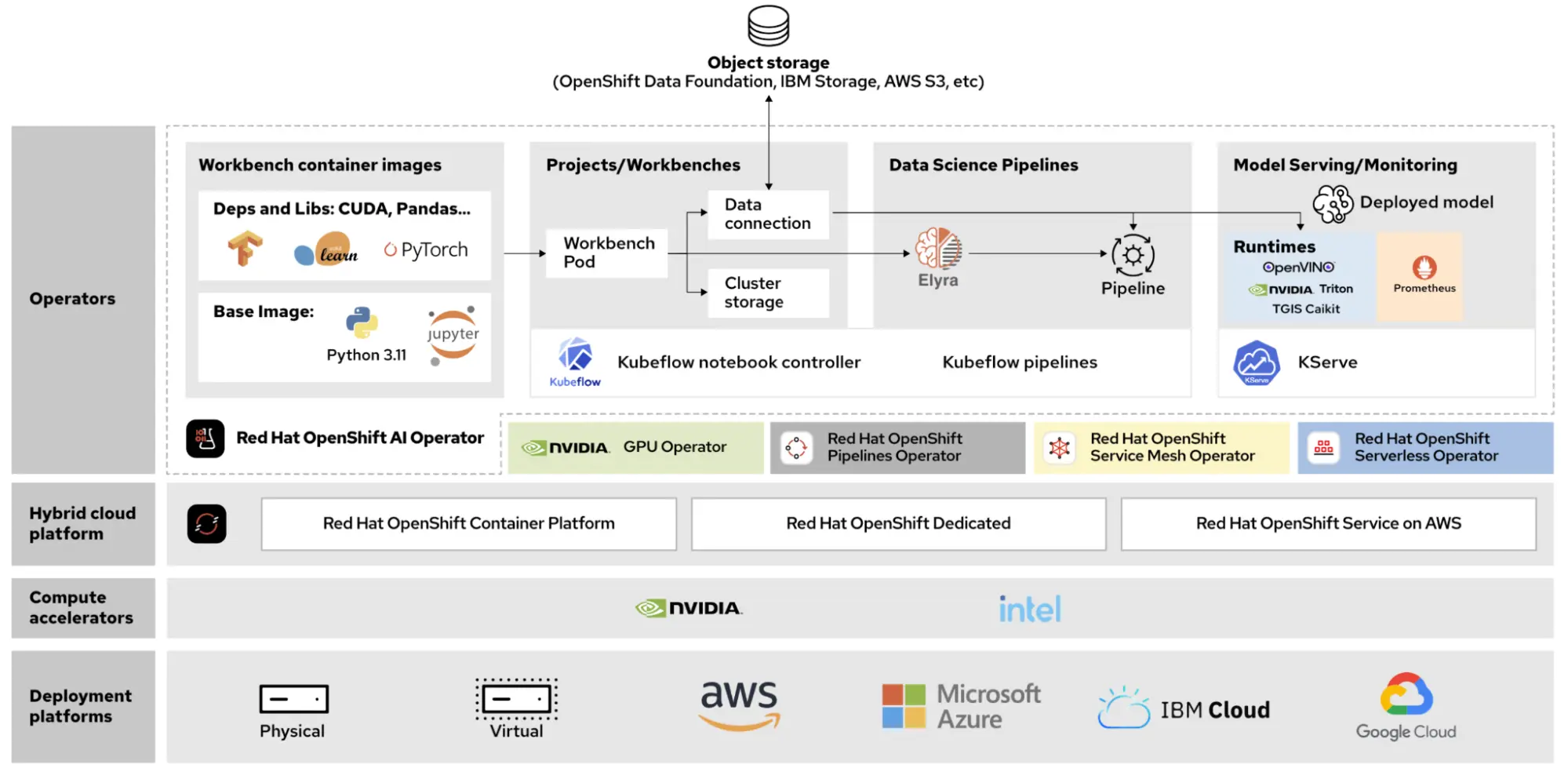
To understand the impact of PQC, we have to look at how data moves through these components. The introduction of ML-KEM and ML-DSA will fundamentally change how these components establish trust, encrypt communication, and verify the integrity of machine learning artifacts.
The workbench and data ingestion
The journey in Red Hat AI Enterprise usually begins in the Workbench.
Component
Workbench is a containerized environment running Jupyter Notebooks or VS Code, preloaded with libraries like PyTorch or TensorFlow. Data scientists connect these workbenches to external object storage (like AWS S3, OpenShift Data Foundation, or MinIO) to pull down massive datasets for exploration.
PQC impact
When a data scientist pulls a proprietary dataset into their Workbench, that data travels over the network with HTTPS/TLS. Previously, this TLS connection was secured by RSA or ECDSA signatures and an elliptic curve Diffie-Hellman (ECDHE) key exchange. With the shift to PQC, the underlying cryptographic libraries (like OpenSSL and NSS provided by Red Hat Enterprise Linux CoreOS) will upgrade these connections to use hybrid ML-KEM for key encapsulation, while authentication will transition to quantum-safe signatures like ML-DSA.
- Performance overhead: PQC algorithms, particularly ML-KEM, have larger key sizes and ciphertext sizes compared to elliptic curves. When Red Hat AI Enterprise spins up hundreds of parallel data-fetching processes across a distributed training cluster, the network stack will experience slightly higher bandwidth overhead during the TLS handshakes.
- Storage drivers: The drivers and operators connecting the Workbench to S3/ODF must be compiled against quantum-safe cryptographic libraries (like PQC-enabled versions of Go used by Kubernetes components) to ensure the data ingestion pipeline is entirely resistant to HNDL surveillance.
AI pipelines (Kubeflow and Tekton)
Once experimentation is complete, workflows are automated using the AI pipelines component. Red Hat AI Enterprise utilizes Kubeflow Pipelines (KFP 2.0) backed by Argo Workflows or Tekton to create modular, repeatable AI pipelines.
Component
These Kubeflow Pipelines handle data preprocessing, model training, evaluation, and optimization across distributed nodes.
PQC impact
The pipeline component is arguably where PQC introduces the most vital changes, specifically regarding software supply chain security and artifact integrity.
- As a pipeline executes, it pulls various container images (for example, custom Python environments, CUDA base images). Currently, these might be signed using classical algorithms. Red Hat Advanced Developer Suite is preparing to deliver PQC for key components of the supply chain, meaning pipeline execution will soon rely on ML-DSA (FIPS 204) to verify the digital signatures of these containers before running them. If an image's quantum-safe signature is invalid, the OpenShift admission controller will block the pipeline from executing.
- Distributed training workloads heavily rely on communication between worker nodes (for example, using MPI or NCCL). While some of this traffic is unencrypted for maximum throughput on secure internal networks, control plane traffic managed by the OpenShift Service Mesh will need to utilize PQC-enabled mutual TLS (mTLS). The certificate authority (cert-manager) issuing these internal certificates will transition to generating pure PQC (ML-DSA) certificates.
- Red Hat's strategy includes the generation of CBOMs — an inventory of all cryptographic assets and dependencies within an application. For AI pipelines, this means data scientists and DevSecOps teams will be able to audit a deployed ML pipeline to ensure all its Python dependencies and underlying C-bindings are utilizing quantum-safe encryption. Red Hat is working through scanner availability for CBOM validation in pipelines.
Model registry and storage
After a model is trained and evaluated, it is versioned and stored in the model registry.
Component
The model registry tracks model metadata, parameters, and metrics. The actual model weights (the .pt, .onnx, or .safetensors files) are pushed to object storage.
PQC impact
A trained machine learning model — especially a fine-tuned large language model (LLM) — can cost millions of dollars in compute to generate. It is a highly sensitive asset.
- How do you prove that the model weights retrieved from storage haven't been tampered with? Using ML-DSA, RHOAI workflows will eventually sign the model artifacts themselves. When the model registry tracks a model, it will also track its post-quantum digital signature. Model-transparency would be considered another sigstore client. Baseline PQC signing strategy is in process.
- By enforcing quantum-safe signature verification before a model is allowed to be promoted from the registry to production, organizations can cryptographically guarantee that they are resistant to advanced supply-chain data poisoning attacks.
Model serving (KServe, vLLM, Triton)
The final stage of the MLOps lifecycle is serving the model to users or applications.
Component
Red Hat OpenShift AI uses KServe, which abstracts away the complexities of serverless inferencing and routes traffic to runtimes like vLLM, NVIDIA Triton, or OpenVINO.
PQC impact
Model serving represents the edge of your AI infrastructure — the API endpoint where users send prompts and receive inferences. This is the highest-risk attack vector for HNDL adversaries.
- When an enterprise application sends a prompt to a Red Hat AI Enterprise KServe endpoint (for example, "Summarize the Q3 financial results for Project X"), that prompt is highly confidential. The OpenShift ingress controller routing traffic to the KServe pod must be configured to negotiate quantum-safe TLS.
- While Red Hat Enterprise Linux (RHEL) 9 treated post-quantum cryptography (PQC) as an opt-in Technology Preview with the
DEFAULT:PQsubpolicy, RHEL 10.1 enables it by default as a standard, production-ready feature. Because PQC is now active by default,DEFAULT:PQis no longer needed as a blanket enabler. This seamless integration makes it easier for OpenShift administrators to test ML-KEM key exchanges for model serving endpoints, allowing them to verify that edge load balancers, client applications, and KServe ingress controllers can safely handle the larger PQC certificate sizes without timing out or dropping connections during inference requests. - Accessing the model requires authentication. Red Hat is actively accelerating PQC for its identity platforms (like Red Hat Directory Server and Identity Management). Consequently, the OAuth/OIDC tokens exchanged to authorize access to the AI model will be backed by a quantum-ready trust basis.
Navigating the architectural transition
Bringing PQC to an environment as complex as Red Hat AI Enterprise is not a simple configuration change — it is a deeply layered architectural transition (figure 2). It touches the host operating system kernel, the OpenShift userspace, the Go language runtime that powers Kubernetes, and the Python ecosystems that drive machine learning.
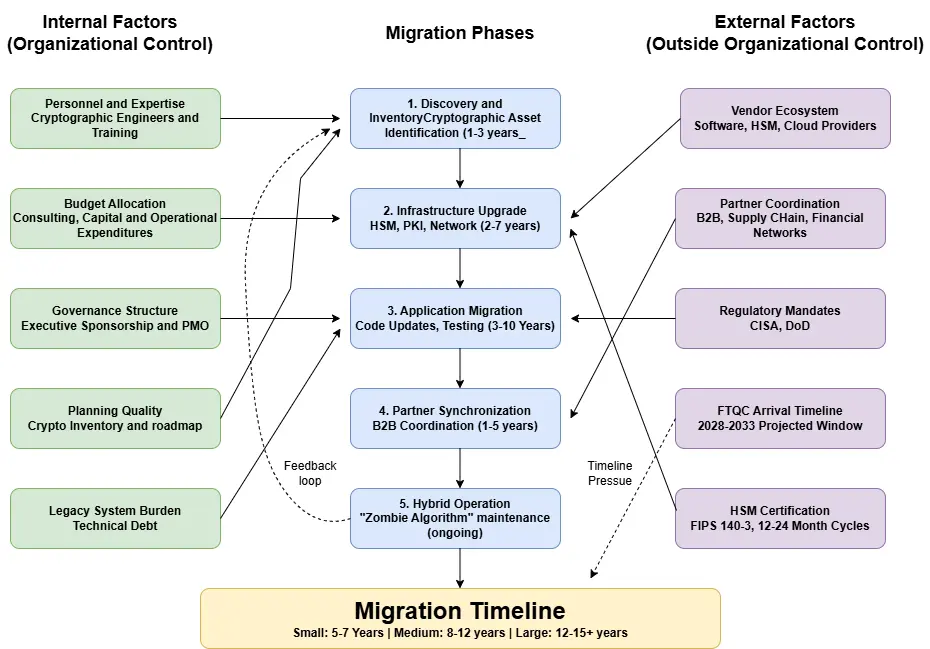
Organizations running Red Hat AI Enterprise should view this transition through the lens of Red Hat's cryptographic agility framework. You do not need to rewrite your AI pipelines today, but you do need to start preparing your infrastructure:
- Utilize tools like Red Hat Lightspeed telemetry and Red Hat Ansible Automation Platform to map out how your current AI platforms exchange cryptographic keys. Understand where your models are stored, how your Workbenches connect to data, and what certificates secure your KServe endpoints.
- As OpenShift incorporates RHEL 10's quantum-safe capabilities, begin planning cluster upgrades. While the shift to ML-KEM for key encapsulation will initially be offered in a hybrid mode to maintain compatibility with older client applications, ML-DSA for signatures will be deployed using pure PQC certificates.
- For the foreseeable future, your Red Hat AI Enterprise environments will operate in a mixed mode. A client querying your AI model might negotiate a classical X25519 key exchange, while an updated internal microservice querying the same model might negotiate a quantum-safe ML-KEM exchange. RHEL and OpenShift are designed to accommodate this complex transition seamlessly.
To safely integrate the ML-KEM and ML-DSA algorithms finalized by NIST in August 2024, organizations must prioritize backward compatibility and infrastructure stability. Red Hat's strategy relies on a controlled, phased approach to implement these NIST-standard quantum-resistant algorithms (QRAs) directly into the core of its platform ecosystem.
Cryptographic agility across RHEL and OpenShift
At the OS level, Red Hat achieves agility through system-wide cryptographic policies. Instead of requiring administrators or developers to manually configure cipher suites across individual libraries (like OpenSSL, GnuTLS, NSS, or OpenSSH), RHEL abstracts these settings into centralized profiles.
- RHEL 10.0 technology preview (TEST-PQ): Intended specifically as a preview path for our current capabilities, this subpolicy allowed organizations to pilot PQC safely. By executing a simple command (
update-crypto-policies --set DEFAULT:TEST-PQ), administrators could instantly inject quantum-safe algorithms into the operating system's core libraries for testing, requiring no modifications to application code. - RHEL 10.1+ secure by default: Demonstrating the power of policy-driven agility, Red Hat transitioned PQC from this opt-in preview to a default standard. The
DEFAULTpolicy is now updated to automatically prefer post-quantum key exchange for widely used protocols like TLS and SSH.
Hybrid key exchange strategy
To ensure a smooth transition to lattice-based PQC algorithms like ML-KEM, adopting a hybrid strategy helps enterprises manage operational risks by providing necessary controls and governance throughout their cryptographic modernization efforts. If a traditional mathematical vulnerability (not a quantum attack) is discovered in ML-KEM, pure PQC encryption would fail. To prevent this, Red Hat utilizes a hybrid cryptographic approach.
When a TLS 1.3 handshake occurs in these modernized systems, it negotiates a hybrid key exchange, such as X25519MLKEM768:
- X25519: Provides classical Elliptic Curve Diffie-Hellman (ECDHE) security.
- ML-KEM-768: Simultaneously provides post-quantum key encapsulation to defend against HNDL attacks.
The final shared secret is derived from both mechanisms combined. The resulting session remains secure as long as at least 1 of the component algorithms remains unbroken, offering a robust and forward-compatible defense.
Inherited agility in Red Hat OpenShift
Red Hat OpenShift is built upon RHEL CoreOS, meaning it automatically inherits the system-wide cryptographic policies of the underlying operating system. However, OpenShift adds another layer of agility through its integration with the Go programming language runtime.
- Securing the control plane: Kubernetes is written in Go. With OpenShift 4.20, Red Hat integrated the Go 1.24 runtime, which introduced native support for the X25519MLKEM768 hybrid key exchange.
- Zero-configuration rollout: This allows OpenShift to secure the internal communication between central control plane components (such as the API server, kubelet, and scheduler) with PQC-enabled mutual TLS. Crucially, this upgrade does not require administrators to configure specific PQC flags on individual Kubernetes components; the agility is provided entirely by the underlying version of Go and its updated cryptographic libraries.
Cryptographic bills of materials (CBOM)
Agility requires visibility. As Red Hat rolls out PQC support across its Python, Go, and Java application ecosystems, we're informing customers through product and component tagging, as well as the generation of cryptographic bills of materials (CBOM).
A CBOM is an inventory of every cryptographic asset and dependency within an application. By utilizing CBOMs, DevSecOps teams can audit their AI pipelines and software supply chains, clearly track which components are still relying on deprecated classical algorithms, and proactively manage their migration to a quantum-ready trust basis.
What a CBOM tracks
Instead of merely noting that an application uses a generic library like OpenSSL, a CBOM goes deeper to record specific cryptographic properties:
- Algorithms: The specific mathematical primitives in use (for example, RSA, AES-256, SHA-256, or post-quantum algorithms like ML-KEM)
- Key Sizes and curves: The exact strength of the cryptography (for example, 2048-bit keys, Curve25519)
- Libraries and implementations: The underlying cryptographic modules and their exact versions (for example, OpenSSL 3.0.8, Mozilla NSS)
- Certificates: Expiration dates, key usage constraints, and issuing certificate authorities
This visibility is the foundational step for migrating to post-quantum cryptography. An organization cannot reliably upgrade to quantum-safe algorithms if they do not know exactly where their legacy classical algorithms are deployed across millions of lines of code.
The release of CycloneDX version 1.5 introduced the formal schema required to track cryptographic assets. Instead of just listing software libraries, a CBOM defines the exact mathematical functions, key sizes, and security levels those libraries execute.
Here is an example of a CycloneDX 1.5 JSON file detailing 2 cryptographic assets: A classical encryption algorithm (AES-256-GCM) and a post-quantum key encapsulation mechanism (ML-KEM-768):
{
  "bomFormat": "CycloneDX",
  "specVersion": "1.5",
  "serialNumber": "urn:uuid:3e671687-395b-41f5-a30f-a58921a69b79",
  "version": 1,
  "components": [
    {
      "type": "cryptographic-asset",
      "bom-ref": "asset-ml-kem-768",
      "name": "ML-KEM-768",
      "cryptoProperties": {
        "assetType": "algorithm",
        "algorithmProperties": {
          "primitive": "kem",
          "parameterSetIdentifier": "768",
          "cryptoFunctions": [
            "keygen",
            "encapsulate",
            "decapsulate"
          ],
          "nistQuantumSecurityLevel": 3
        }
      }
    },
    {
      "type": "cryptographic-asset",
      "bom-ref": "asset-aes-256-gcm",
      "name": "AES-256-GCM",
      "cryptoProperties": {
        "assetType": "algorithm",
        "algorithmProperties": {
          "primitive": "ae",
          "parameterSetIdentifier": "256",
          "cryptoFunctions": [
            "encrypt",
            "decrypt"
          ],
          "classicalSecurityLevel": 256
        }
      }
    }
  ]
}
Anatomy of the CBOM
To read this file programmatically or manually, you look at a few specific extensions unique to the CBOM specification:
"specVersion": "1.5": Cryptographic tracking requires at least CycloneDX 1.5. Older parsers reject or ignore the crypto-specific fields."type": "cryptographic-asset": Tells the vulnerability scanner that the component is not a software library (like annpmorpippackage), but a distinct cryptographic mechanism.cryptoProperties: This object is the heart of the CBOM. It categorizes the asset (an algorithm, certificate, or protocol) and holds its specific attributes.primitive: Defines the mathematical role of the algorithm. In the example above,kemstands for key encapsulation mechanism (used for securely exchanging keys), andaestands for authenticated encryption (used for securing the actual data payload).cryptoFunctions: Explicitly states what operations the asset is authorized to perform, such as generating keys (keygen), encapsulating them (encapsulate), or standard encryption (encrypt).SecurityLevelfields: The schema separates classicalSecurityLevel (measured in bits, like 256 for AES) from nistQuantumSecurityLevel (NIST's 1-5 scale for post-quantum strength, where ML-KEM-768 is a level 3).
By parsing this structure, an automated DevSecOps pipeline can instantly detect whether an application is trying to deploy a deprecated algorithm (like SHA-1) or verify that a post-quantum algorithm is correctly implemented before pushing to production.
Conclusion
The integration of post-quantum cryptography into Red Hat AI Enterprise ensures that the platform doing the heavy lifting of enterprise machine learning is shielded against the next major evolution in computing. By embedding NIST-standard algorithms (FIPS 203, 204, and 205) directly into the Red Hat Enterprise Linux CoreOS and OpenShift layers, Red Hat allows data scientists and AI engineers to focus on what they do best: building innovative, modular AI pipelines.
The threat of quantum decryption is real, but so is the defense. By adopting a crypto-agile mindset today, organizations can help the AI assets they build on Red Hat OpenShift AI remain secure, sovereign, and entirely their own — long after Q-Day arrives.
Ready to secure your AI future?
- Experience the platform: Start building, deploying, and securing your models firsthand with a 60-day trial of Red Hat Enterprise AI.
- See the vision in action: Join industry experts and explore the latest innovations across our portfolio at the Red Hat AI Elevate Virtual Tech Showcase.
Product trial
Red Hat OpenShift AI (Self-Managed) | Product Trial
About the author
More like this
Introducing Red Hat Advanced Cluster Security for Kubernetes 5: Bring Red Hat Enterprise Linux virtual machines into vulnerability management
The next era of hybrid cloud: Introducing Red Hat OpenShift 5
Can Compliance Be A Piece Of Cake? | Compiler
Collaboration In Product Security | Compiler
Browse by channel

Automation
The latest on IT automation for tech, teams, and environments

Artificial intelligence
Updates on the platforms that free customers to run AI workloads anywhere

Open hybrid cloud
Explore how we build a more flexible future with hybrid cloud

Security
The latest on how we reduce risks across environments and technologies

Edge computing
Updates on the platforms that simplify operations at the edge

Infrastructure
The latest on the world’s leading enterprise Linux platform

Applications
Inside our solutions to the toughest application challenges

Virtualization
The future of enterprise virtualization for your workloads on-premise or across clouds
