




Red Hat is proud to announce our results from the industry-standard MLPerf Inference v6.1 benchmark. This submission builds on our track record across recent rounds: In v5.1, we demonstrated cost-effective Llama-3.1-8B-FP8 inference with vLLM on NVIDIA H100 and L40S GPUs, and in v6.0 we delivered results across Qwen3-VL, Whisper, and gpt-oss-120b on NVIDIA H200 and B200 and AMD Instinct MI350 GPUs, including the first Kubernetes-based submission.
Our v6.1 results highlight 3 things: peak performance on Kubernetes, 1 inference engine (vLLM) spanning graphics processing units (GPUs) and central processing units (CPUs), and the viability of CPU-only serving for small models. Our submissions span 4 open-weight models—gpt-oss-120b, Qwen3-VL-235B-A22B, Llama-3.1-8B, and Whisper-Large-v3—across NVIDIA GB200 NVL4 systems and CPU-only Intel® Xeon 6 servers.
We participate in MLPerf because it’s the industry's standardized, peer-reviewed measure of inference performance: It lets enterprises compare hardware and software stacks on equal footing, and it holds our open source stack accountable to the same bar as proprietary alternatives.
Highlights from this round
- Highest per-GPU GPT-OSS-120B offline throughput of any GB200 submission at any scale, from 4-GPU nodes to full NVL72 racks, running on Red Hat OpenShift with vLLM, the only Kubernetes-based GB200 submission this round
- Top server-scenario Qwen3-VL result among GB200 NVL4 systems, in partnership with Supermicro and NVIDIA
- CPU-only LLM and speech inference, highest per-core Llama-3.1-8B and Whisper throughput of all 2-socket CPU-only submissions, in a joint submission with Intel on Xeon 6
These results illustrate Red Hat AI's ability to deliver competitive inference on Kubernetes infrastructure, across GPU and CPU architectures, using a consistent software layer. Notably, 22 of 32 datacenter submitters in this round used vLLM somewhere in their stack, confirming its position as the industry-standard open source inference engine.
Our results
Model | Hardware | Scenario | Result | Software stack | Notes |
| GB200 NVL4 (4x GB200, Supermicro) | Offline | 61,205.6 tok/s | OpenShift 4.21, vLLM 0.24.0 | 20% higher than the only other 4-GPU GB200 submission |
GB200 NVL4 (4x GB200, Supermicro) | Server | 51,095.2 tok/s | OpenShift 4.21, vLLM 0.24.0 | The highest among 4-GPU GB200 submissions | |
| GB200 NVL4 (4x GB200, Supermicro) | Server | 50.68 queries/s | vLLM 0.20, NVIDIA Dynamo, RHEL | The top server result among 4-GPU GB200 submissions |
GB200 NVL4 (4x GB200, Supermicro) | Offline | 58.08 samples/s | vLLM 0.20, NVIDIA Dynamo, RHEL | On par with the best 4-GPU GB200 result | |
| 2S Intel Xeon 6972P (CPU-only) | Offline | 1,507.21 tok/s | RHEL 9.9, vLLM | The highest per-core throughput of all 2-socket CPU submissions |
2S Intel Xeon 6972P (CPU-only) | Server | 644.79 tok/s | RHEL 9.9, vLLM | ||
Whisper-Large-v3 | 2S Intel Xeon 6972P (CPU-only) | Offline | 1,966.11 samples/s | RHEL 9.9, vLLM | The highest per-core throughput of all 2-socket CPU submissions |
Figure 1: Red Hat MLPerf Inference v6.1 results, closed division, datacenter.
GPT-OSS-120B on GB200 NVL4 with Red Hat OpenShift (reasoning model)
GPT-OSS-120B is a 117-billion-parameter mixture-of-experts model for reasoning, agentic workflows, and code generation, with highly variable input lengths and strict server-scenario latency requirements.
In partnership with Supermicro, we submitted on an NVIDIA GB200 NVL4 system, 2x Grace CPUs (72 ARM cores each) and 4x GB200 GPUs (189 GB HBM3e each), running OpenShift 4.21, Red Hat Enterprise Linux CoreOS 9.6, and vLLM 0.24.0. The full specifications of the Supermicro server can be found here.This was the only submission in the closed datacenter division running on Kubernetes infrastructure.
Offline: 61,206 tokens per second — 20% higher than the only other 4-GPU GB200 submission)
Server: 51,095 tokens per second — the highest among 4-GPU GB200 submissions)
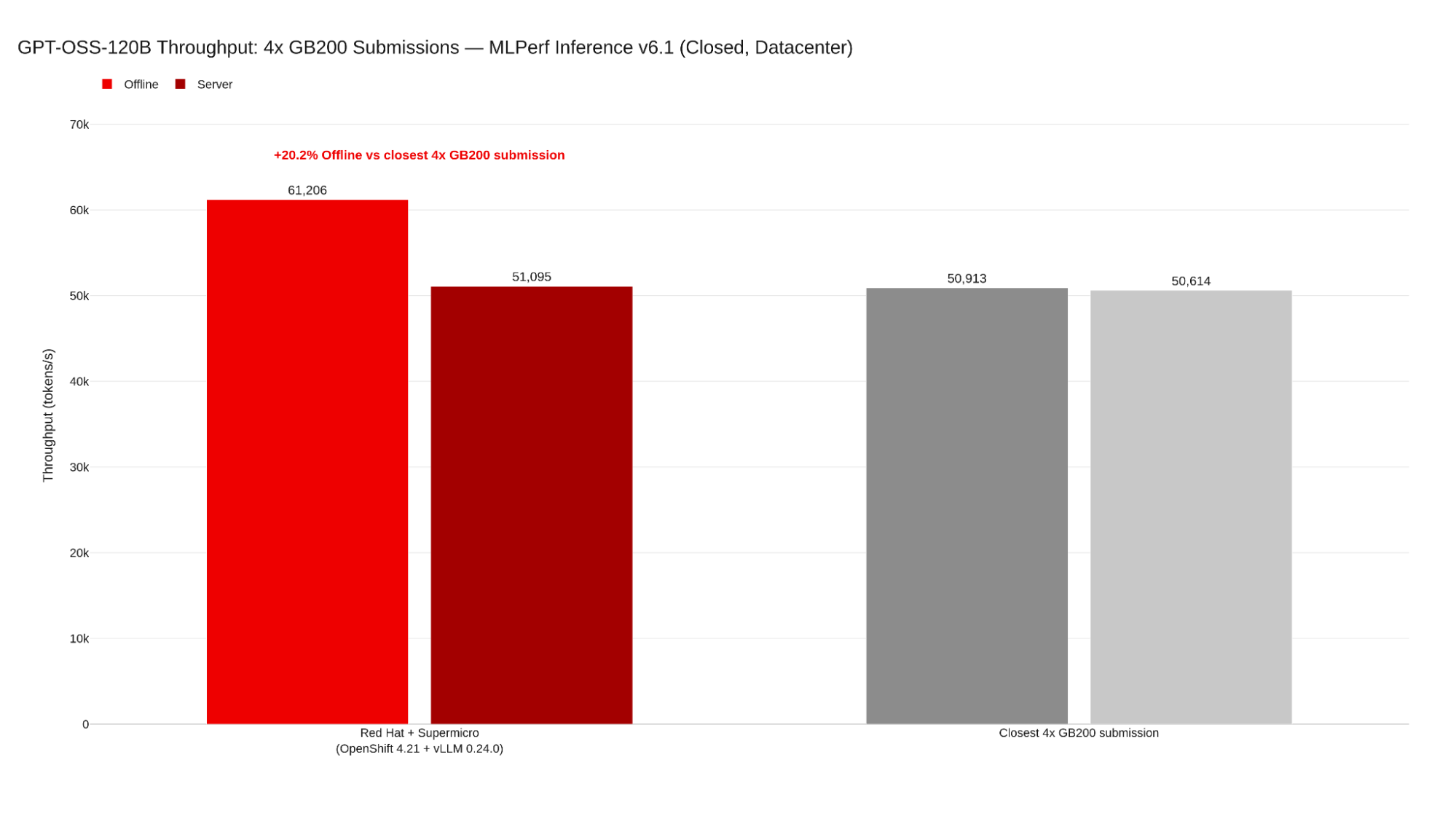
Figure 2: GPT-OSS-120B Throughput: 4x GB200 submissions — MLPerf Inference v6.1 (closed, datacenter)
Normalized per GPU, our offline result of about 15,300 tokens per second per GPU is the highest of any GB200 submission this round at any scale, including the 72-GPU NVL72 rack-scale systems, which landed in the 12,300–12,700 tokens per second per GPU range. Our result shows that a Kubernetes-orchestrated 4-GPU node with vLLM extracts more from each GPU, and that OpenShift adds no performance penalty over bare-metal serving stacks.
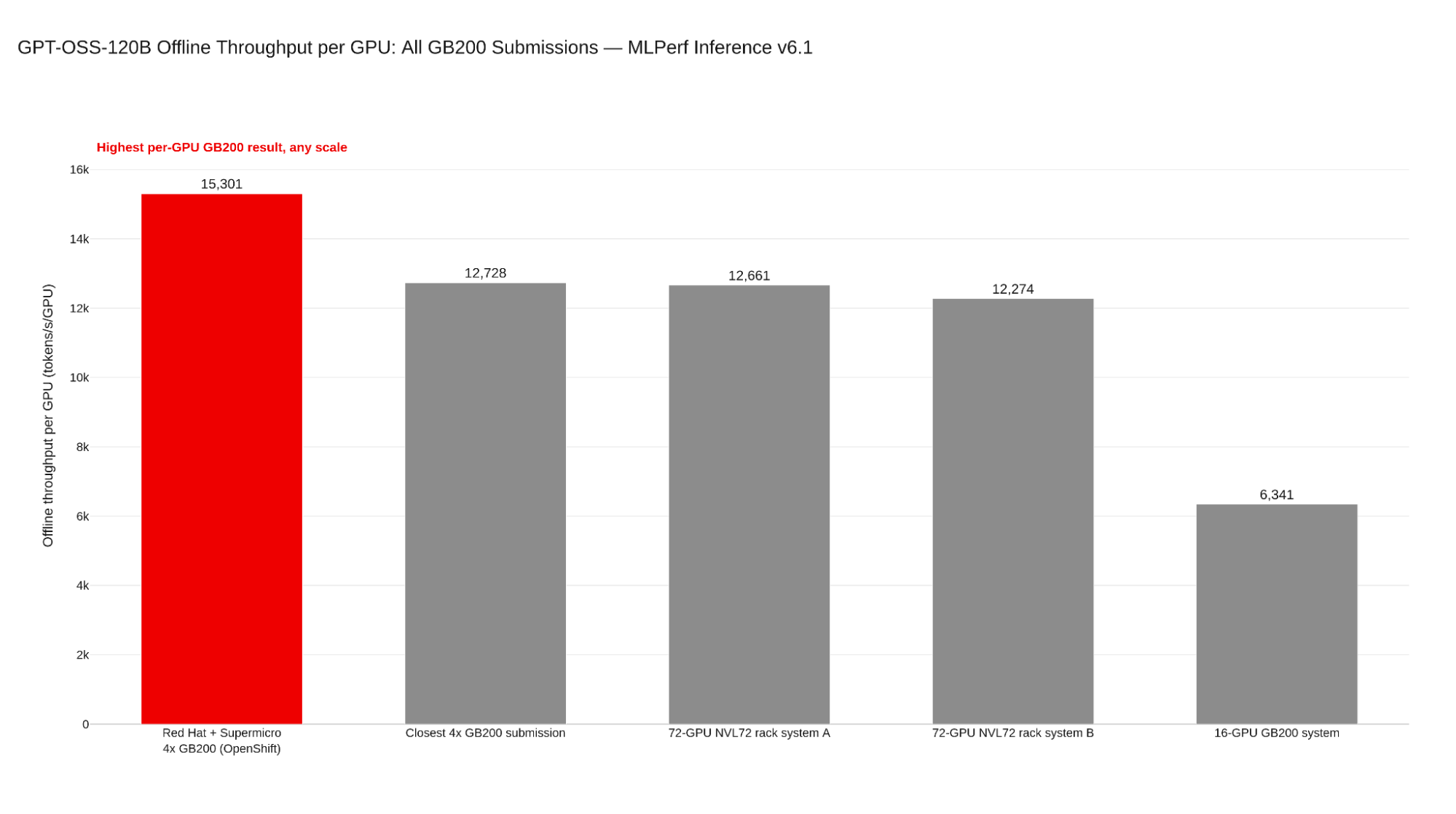
Figure 3: Offline throughput per GPU across all GB200 submissions.
Qwen3-VL-235B-A22B on GB200 NVL4 (multimodal vision)
Qwen3-VL-235B-A22B is a 235-billion-parameter Mixture of Experts (MoE) vision-language model with 22 billion active parameters, benchmarked on a Shopify product catalog dataset of 48,289 multimodal samples where image resolution varies by up to 20x—stressing the vision encoder and creating highly uneven request sizes.
In partnership with NVIDIA and Supermicro, we submitted on GB200 NVL4 with vLLM and NVIDIA Dynamo:
Server: 50.68 queries per second — the top server result among 4-GPU GB200 submissions
Offline: 58.08 samples per second — on par with the best 4-GPU GB200 result
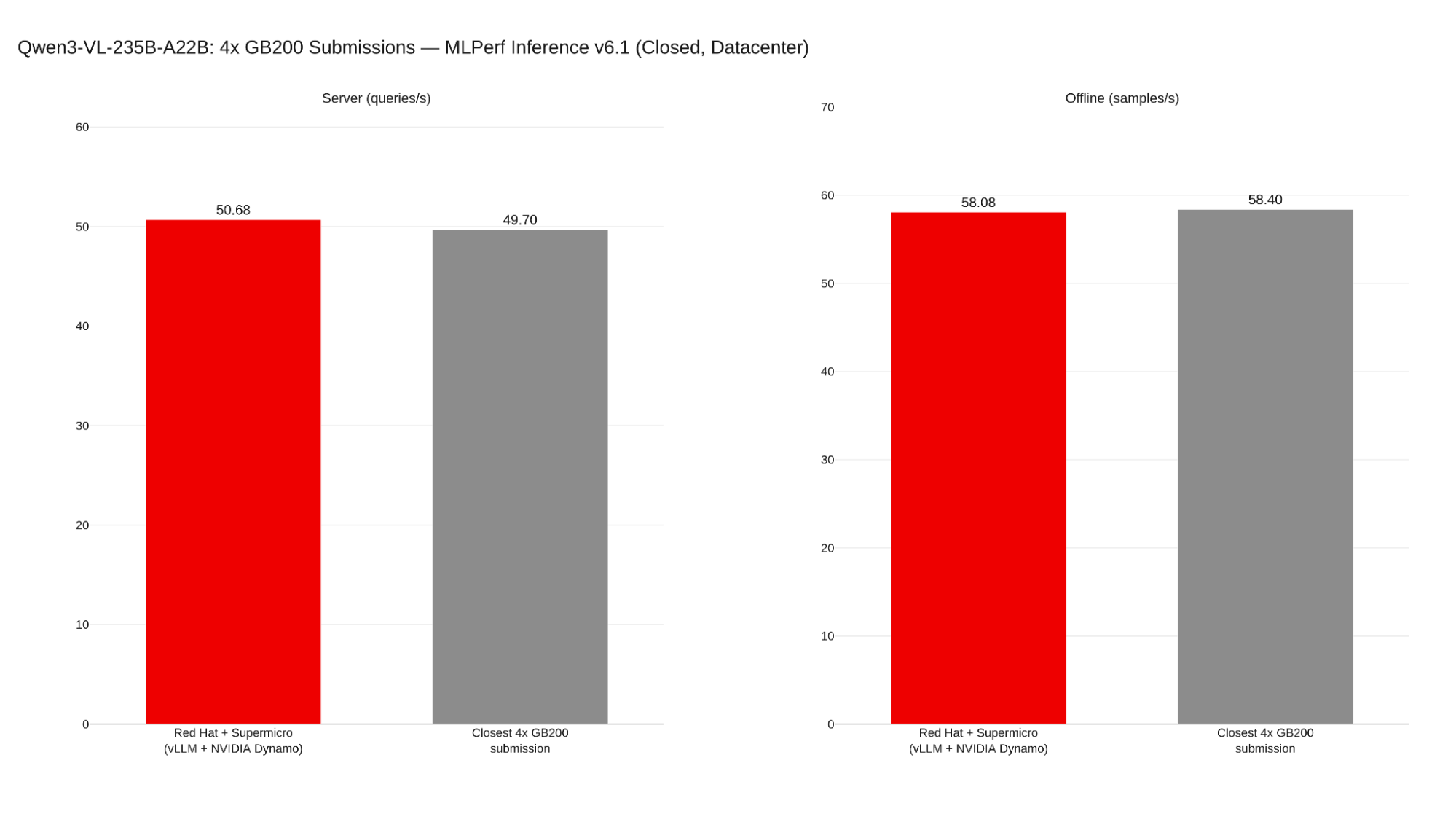
Figure 4: Qwen3-VL Server and Offline results across 4x GB200 submissions (Note: different units per scenario).
The dominant systems-level finding this round was NUMA topology. On GB200 NVL4, leaving vLLM workers unpinned allowed 61–89% of worker memory to land on the remote socket, and host-to-device bandwidth collapsed roughly 3.3 times (from about 166 GB/s to about 50 GB/s). Root-cause analysis showed the bottleneck was socket-0 memory-bandwidth congestion, not per-page remote-access latency. Pinning workers per socket with numactl restored bandwidth and delivered roughly 9% higher end-to-end throughput.
A second finding: Tail latency on this workload is prefill-bound—dominated by the vision encoder and image-token prefill—not KV-cache capacity, which stayed under 3% utilization. For multimodal serving, optimization effort pays off in encoder throughput and prefill scheduling, not memory headroom.
Llama-3.1-8B and Whisper (CPU-only inference)
Llama 3.1-8B is an 8-billion-parameter dense transformer benchmarked on summarization, with the server scenario holding it to strict time-to-first-token and time-per-output-token constraints. It represents the class of model most enterprises actually deploy—small enough to serve economically, capable enough to do real work.
In partnership with Intel, we submitted a 2-socket Intel Xeon 6972P system, 192 Granite Rapids cores, no accelerators, running Red Hat Enterprise Linux 9.9. This delivered the highest per-core throughput of any 2-socket CPU submission in the round.
Whisper-large-v3 is a 1.5-billion-parameter encoder-decoder speech recognition model, scored on word error rate against a transcription corpus. Speech-to-text is among the most common production inference workloads that never needs an accelerator.
On the same 2-socket Xeon 6972P system, we recorded 1,966.11 samples per second.
Llama-3.1-8B Offline: the highest per-core throughput of all 2-socket CPU submissions (7.85 tokens/s/core)
Whisper-Large-v3: the highest per-core throughput of all 2-socket CPU submissions (10.24 samples/s/core, 13% above the next best result)
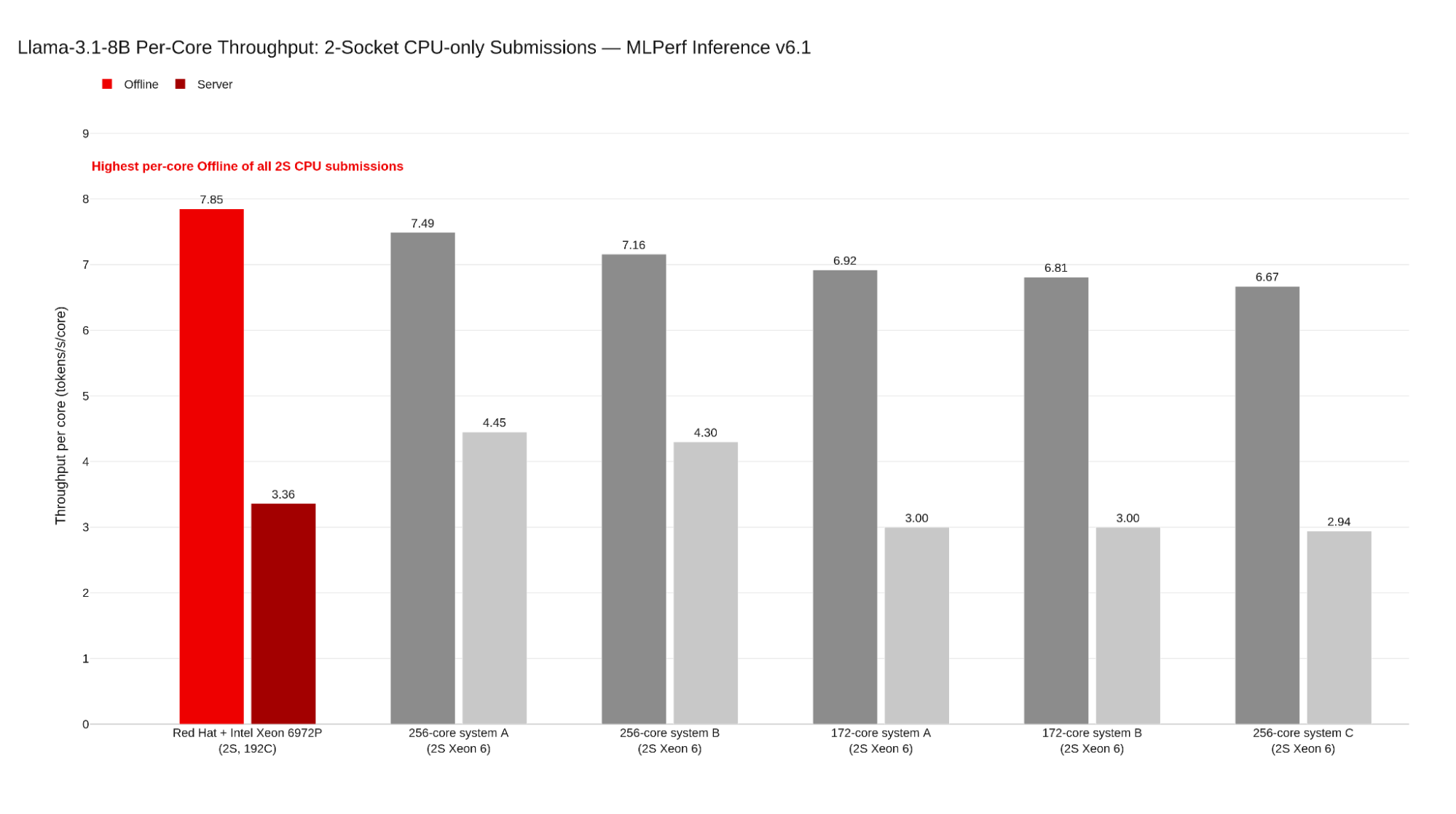
Figure 5: Llama-3.1-8B per core throughput 2S CPU-only submissions
Why does CPU inference matter? Many enterprises already own large fleets of general-purpose servers. This round, 9 CPU-only Llama-3.1-8B results were posted across 7 submitters, a clear signal that the industry sees CPU inference as a deployable option for latency-tolerant batch workloads and moderate-throughput serving of small models. These results also show that smaller models, such as those fine-tuned for guardrails or for embedding generation, can run on CPUs alongside the larger models being served on accelerators, freeing accelerator capacity for the workloads that need it.
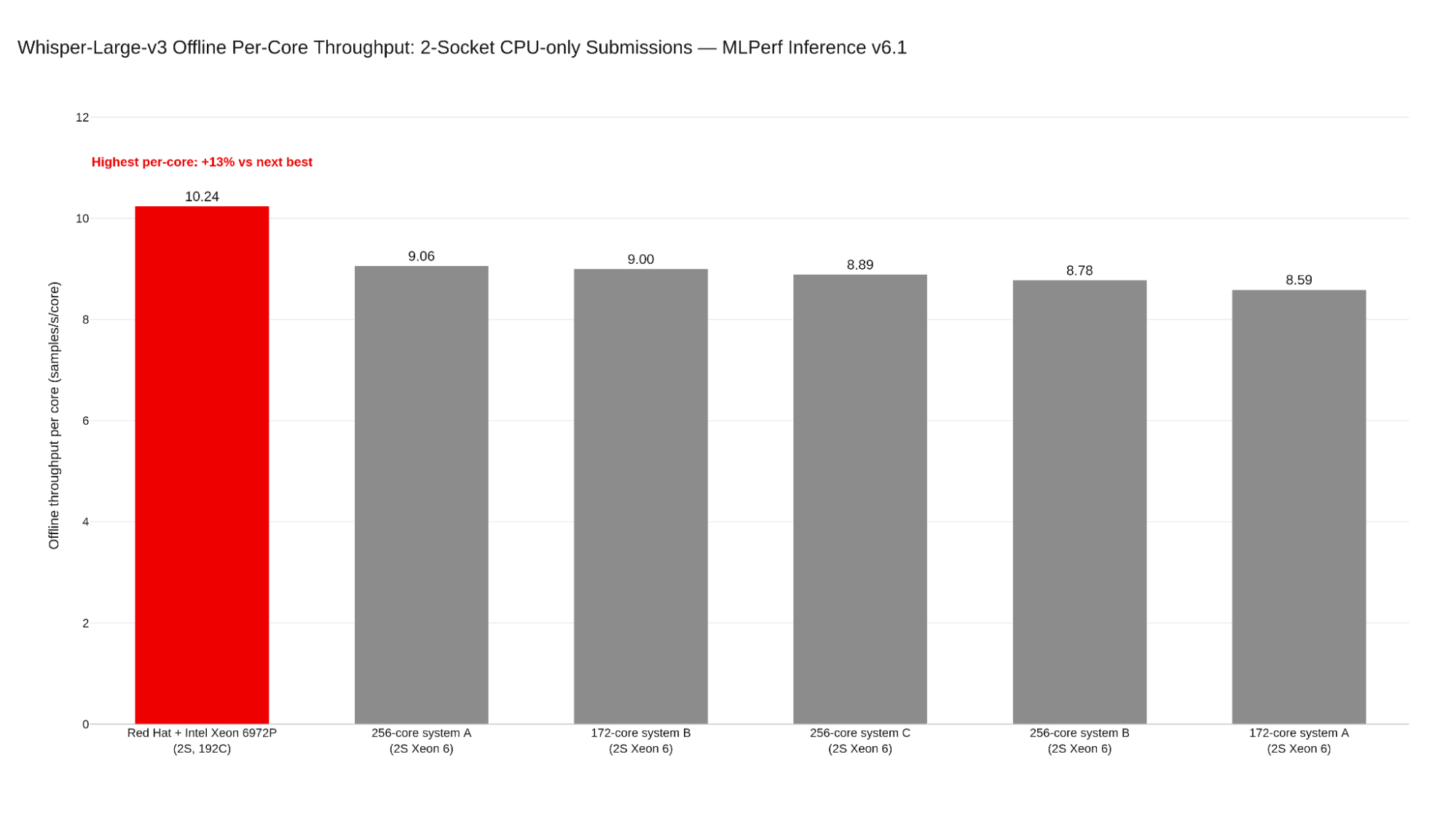
Figure 6: Whisper-Large-v3 Offline throughput across CPU-only submissions (Red Hat highlighted).
On a CPU, the inference bottleneck is almost never raw compute: its memory bandwidth, scheduler interference, and idle-state latency. Our tuning targeted all 3.
- Core reservation: Setting
VLLM_CPU_NUM_OF_RESERVED_CPU=1reserves 1 core per rank, 1 per NUMA node in our configuration. Everything that’s not model compute needs somewhere to run: vLLM's serving frontend, and in an MLPerf submission the benchmark harness itself, including LoadGen. Without reserved cores, those threads steal cycles from inference workers at unpredictable moments, which shows up directly as latency jitter. A few cores out of 192 is negligible capacity; the scheduling stability they buy is what makes the server-scenario latency constraints achievable. - C-state tuning: Modern CPUs aggressively enter idle states between work, and the C1E state carries a wake-up penalty that lands directly on time-to-first-token when requests arrive at a partially idle machine. For a persistent configuration, limit C-states through kernel boot parameters, for example intel_idle.max_cstate=1, or apply a tuned profile such as latency-performance. Disabling C1E at runtime via sysfs also works for testing, but doesn’t survive a reboot: an easy setting to lose and a hard regression to spot, since everything still works, just slower.
- The bandwidth ceiling: Our profiling with Intel's PerfSpect telemetry pointed to memory-bandwidth saturation, not core count, as the first-order limit on this workload consistent with the per-core results above, where a 96-core-per-socket part delivered higher per-core throughput than 128-core parts sharing a similar memory subsystem.
Key takeaways
Kubernetes is ready for peak-performance inference. Our GPT-OSS-120B submission is the only one in the division running on Kubernetes that posted the highest per-GPU GB200 throughput of the round.
vLLM is 1 engine across CPUs and GPUs. The same inference engine delivered valid MLPerf results on Intel Xeon CPUs and NVIDIA GB200 GPUs and appeared in 22 submitters stacks this round. The software investment carries across not just GPU vendors but entire hardware classes.
Topology awareness is table stakes at this scale. On tightly coupled platforms like GB200 NVL4, NUMA placement alone was worth about 9% throughput. Memory bandwidth, not raw compute, was the limiter in both our CPU and GPU tuning stories.
What comes next
With MLPerf launching a multiturn task force for agentic workloads, benchmarks are moving closer to real-world, interactive AI systems. Red Hat is equipped for this shift, with an inference stack built for such scenarios. We plan to showcase llm-d, featuring prefix-aware scoring and distributed inference across replicas to efficiently support multiturn, agentic workloads.
If you want to replicate our results, see our GitHub repository containing our MLPerf Inference v6.1 benchmark results and setup documentation. Check out the full MLPerf Inference v6.1 results and learn more about Red Hat AI.
Product trial
Red Hat AI Inference | Product Trial
About the authors
Alberto Perdomo is a AI Systems Performance Engineer on the PSAP team at Red Hat, working at the intersection of distributed systems, AI inference, and open source. Main focus is on optimizing distributed LLM inference with vLLM and llm-d for high-performance production deployments, among other interesting work in distributed AI systems.
Ashish Kamra is an accomplished engineering leader with over 15 years of experience managing high-performing teams in AI, machine learning, and cloud computing. He joined Red Hat in March 2017, where he currently serves as the Senior Manager of AI Performance at Red Hat. In this role, Ashish heads up initiatives to optimize performance and scale of Red Hat OpenShift AI - an end to end platform for MLOps, specifically focusing on large language model inference and training performance.
Prior to Red Hat, Ashish held leadership positions at Dell EMC, where he drove the development and integration of enterprise and cloud storage solutions and containerized data services. He also has a strong academic background, having earned a Ph.D. in Computer Engineering from Purdue University in 2010. His research focused on database intrusion detection and response, and he has published several papers in renowned journals and conferences.
Passionate about leveraging technology to drive business impact, Ashish is pursuing a Part-time Global Online MBA at Warwick Business School to complement his technical expertise. In his free time, he enjoys playing table tennis, exploring global cuisines, and traveling the world.
Diane Feddema is a Principal Software Engineer at Red Hat Inc in the Performance and Scale Team with a focus on AI/ML applications. She has submitted official results in multiple rounds of MLCommons MLPerf Inference and Training, dating back to the initial MLPerf rounds. Diane Leads performance analysis and visualization for MLPerf benchmark submissions and collaborates with Red Hat Hardware Partners in creating joint MLPerf benchmark submissions.
Diane has a BS and MS in Computer Science and is presently co-chair of the Best Practices group of the MLPerf consortium.
Harika Pothina is an AI Systems Performance Engineer on the PSAP team at Red Hat, working at the intersection of distributed systems, AI inference, and performance engineering. Her work focuses on optimizing large-scale VLM inference with vLLM, MLPerf, and OpenShift for high-performance production deployments, while also driving benchmarking, profiling, and system-level tuning across modern GPU platforms.
Michael Goin is a lead maintainer of vLLM, the high-performance open-source engine for LLM inference. His contributions span core areas including kernel optimization, system scheduling, new model architectures, and hardware efficiency across GPUs and emerging accelerators. Michael led performance engineering at Neural Magic, which was acquired by Red Hat, and brings experience in inference systems to the open source AI community.
Michey is a member of the Red Hat Performance Engineering team, and works on bare metal/virtualization performance and machine learning performance.. His areas of expertise include storage performance, Linux kernel performance, and performance tooling.
Performance engineer working on MLPerf, LLM Inference performance and profiling . Previous experience in hardware performance modelling
Nikhil Palaskar is a senior software engineer and a member of Performance and Scale Engineering at Red Hat. Nikhil's current focus is primarily on serving LLMs for inference and performance optimizing their deployments in Red Hat Openshift AI and Red Hat Enterprise Linux AI environments. Nikhil is also actively engaged in performance experimentation and tuning of running large language models on AMD hardware with the ROCm software stack. Previously he has also worked on building a Benchmarking and Performance Analysis Framework (Pbench).
Nikhil's professional interests revolve around AI/ML and deep learning, statistics, performance engineering, and application profiling. When he is not working he likes to go on hikes.
I am a software engineer in the PSAP team focusing on AI/ML performance on Redhat Products primarily on vLLM/llm-d
Browse by channel

Automation
The latest on IT automation for tech, teams, and environments

Artificial intelligence
Updates on the platforms that free customers to run AI workloads anywhere

Open hybrid cloud
Explore how we build a more flexible future with hybrid cloud

Security
The latest on how we reduce risks across environments and technologies

Edge computing
Updates on the platforms that simplify operations at the edge

Infrastructure
The latest on the world’s leading enterprise Linux platform

Applications
Inside our solutions to the toughest application challenges

Virtualization
The future of enterprise virtualization for your workloads on-premise or across clouds
