From here, every direction is open
You know where you want to go—and nothing about your technology should stop you from getting there. That’s our promise.
/Keep your options open





Featured
Your customized Red Hat Summit 2026 experience awaits
Choose from keynotes, breakouts, labs, product spotlights, and more–now available in this year’s session catalog.

Navigate virtual machine (VM) migration and modernization with Red Hat
Red Hat is the leading provider of enterprise open source software solutions
Enterprises around the world trust our broad portfolio of hybrid cloud infrastructure, application services, cloud-native application development, automation, and artificial intelligence solutions to deliver IT services on any infrastructure quickly and cost effectively.
Build on a reliable foundation. Take your apps anywhere.

Red Hat AI
Expand your AI capabilities with optimized models and efficient inference on a platform built for agentic workflows.
Products available on


Red Hat Enterprise Linux
Support application deployments—from on premise to the cloud to the edge—in a flexible operating environment.
Available on


Red Hat OpenShift
Quickly build and deploy applications at scale, while you modernize the ones you already have.
Available on

Red Hat Ansible Automation Platform
Create, manage, and dynamically scale automation across your entire enterprise.
Available on
Featured product
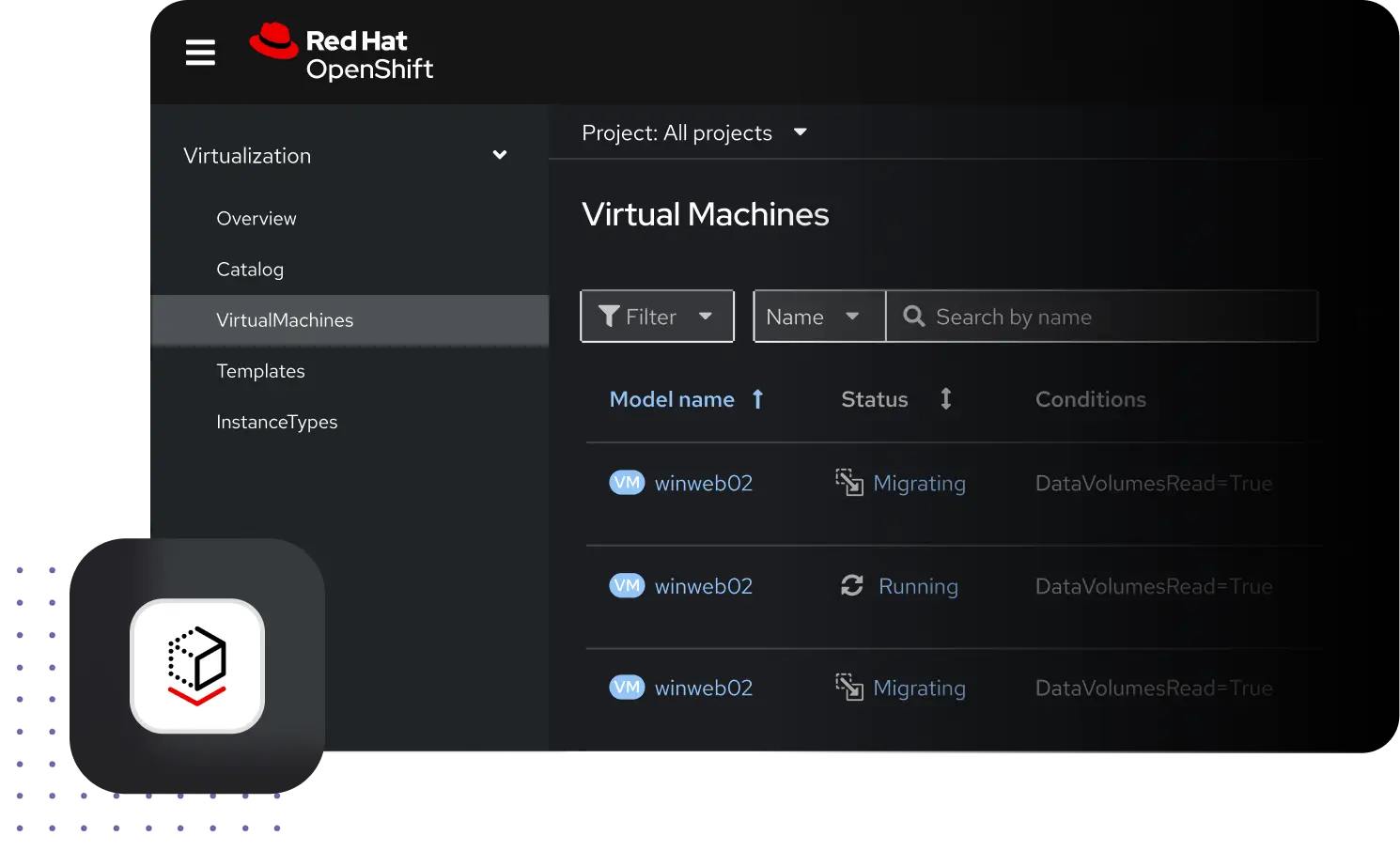
Red Hat OpenShift Virtualization Engine
Deploy, manage, and scale virtual machines with a cost-effective platform that uses the virtualization functionality of Red Hat OpenShift®.


Building enterprise-ready solutions with open source
We believe using an open development model helps create more secure, stable, and innovative technologies. By collaborating with open source communities, we’re developing software that pushes the boundaries of technological ability.

Understanding AI
Artificial intelligence (AI) refers to systems that can acquire and apply knowledge, and carry out behavior based on that knowledge.

The bank cut verification times from days to minutes with an AI-based natural language processing solution.
Understanding APIs
Application programming interfaces (APIs) let your products and services communicate with other products and services without having to constantly build new connectivity infrastructure.

API management helped Lufthansa Technik optimize airline operations.
Understanding automation
Automation is the use of technology to perform tasks without human assistance. In tech, automation is found in IT systems and business decision software.

The British Army sped up service delivery by automating management.
Understanding cloud computing
Clouds are IT environments that abstract, pool, and share scalable resources across a network.

The airline improved customer service by implementing a modern hybrid cloud.
What are cloud services?
Cloud services are infrastructure, platforms, or software hosted by third-party providers and made available to users through the internet.

The software company consolidated its legacy foundation onto a single platform with Red Hat OpenShift Service on AWS.
Understanding Linux containers
Containers let you package and isolate applications with their entire runtime environment, making it easier to move the contained app between environments.

The workers’ compensation insurance provider increased new sales by 40% by adopting a responsive cloud and container environment.
Understanding DevOps
DevOps is an approach to culture, automation, and platform design intended to deliver increased business value and responsiveness through rapid service delivery.
Articles

BP coupled a container platform with DevOps to speed provisioning.
Understanding edge computing
Edge computing places compute resources at or near users or data sources—outside of traditional, centralized datacenters or clouds.

The telecommunications provider built a standalone 5G core to enable robust connectivity and edge computing solutions.
Understanding enterprise integration
Enterprise integration has evolved from a centralized model with an enterprise service bus (ESB) to a distributed architecture with many reusable endpoints.

Integrating apps and data on a private cloud let the bank launch innovative services.
Understanding Linux
Linux® is the stable foundation for all IT workloads and deployments—whether traditional or innovative—from bare metal to virtual, cloud, and containers.

Elo cut time to market with agile, on-demand infrastructure built on Red Hat Enterprise Linux.
Understanding microservices
Microservices are an architecture and an approach to writing software where apps are broken down into their smallest components, independent from each other.

This bank used microservices to modernize its IT environment.
Understanding middleware
Middleware is any software between the kernel and user applications that provides services to apps outside of what’s offered by the operating system.

Middleware helps the Dutch airport provide seamless journeys to customers.
Understanding IT security
IT security protects the integrity of information technologies like computer systems, networks, and data from attack, damage, or unauthorized access.

The government agency built a data-sharing ecosystem that maintains security and compliance.
Understanding virtualization
Virtualization makes a single physical machine act like multiple—saving you the cost of more servers and workstations.

Virtualization trimmed deployment times from weeks to hours for this provider.
Welcome, [Name]
Access your product trials, support cases, training and certification recommendations, and more in the My Red Hat dashboard.

Get more with a Red Hat account
Sign in or create an account to start product trials, access training tools, register for events, get world-class support, and more. A subscription may be required for some services.

