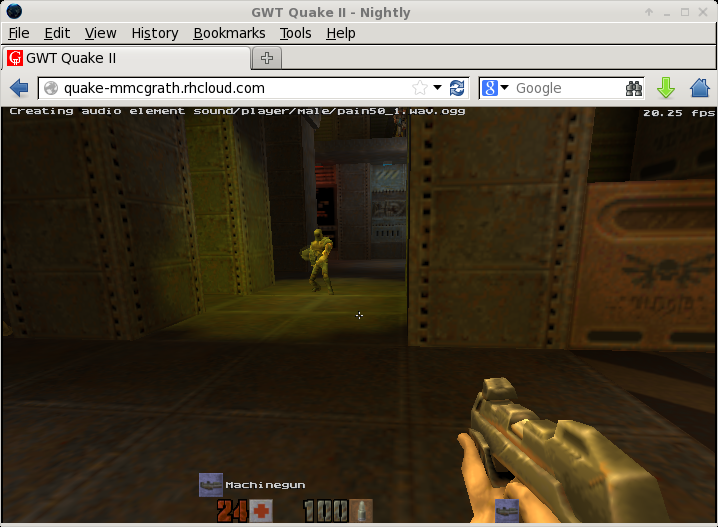
We've been adding a lot of great features to OpenShift lately but we've also been working on some cool demos behind the scenes. The OpenShift operations team loves this cloud stuff and we love pushing it to its limits. We've also got a few gamers on hand, so with that in mind we worked to get quake2-gwt up and running and hosted on OpenShift. This version of Quake 2 runs in your web browser.
This is one of those ah-hah moments for some people who haven't seen much HTML5 content before. Everything in the demo is running either on OpenShift or in your browser.
Let's get started!
To get started the first thing you need is to get an OpenShift account at http://openshift.redhat.com/.
We've been adding a lot of great features to OpenShift lately but we've also been working on some cool demos behind the scenes. The OpenShift operations team loves this cloud stuff and we love pushing it to its limits. We've also got a few gamers on hand, so with that in mind we worked to get quake2-gwt up and running and hosted on OpenShift. This version of Quake 2 runs in your web browser.
This is one of those ah-hah moments for some people who haven't seen much HTML5 content before. Everything in the demo is running either on OpenShift or in your browser.
Let's get started!
To get started the first thing you need is to get an OpenShift account at http://openshift.redhat.com/. Then create a jbossas-7 app either in the web interface or via the command-line tools:
$ rhc app create quake2 jbossas-7
This will have created a simple "hello-world" jbossas-7 application. These next steps will override that repo with the quake2 quickstart repo that has already been prepared.
$ cd quake2

$ git remote add upstream -m master \

git://github.com/wshearn/openshift-quickstart-quake2.git

$ git pull -s recursive -X theirs upstream master
Last to do is a push:
$ git push
After that, all the source code and build requirements are uploaded to OpenShift and built there. One problem we ran into is that ogg and lame are not installed by default and since quake is more fun with sound, we needed to add them. So, in our build script we download the lame source and install it, if you watch the git push closely you'll see those steps happen in realtime.
From there it's a matter of compiling our war and deploying it in the JBoss container. This is a great demo to get you thinking differently about what a web application can be. It's also fun to watch the game start-up as it downloads the different texture packs it needs.
Troubleshooting
If you're having problems getting Quake2 to load in your browser make sure you have webgl enabled and the latest version of Chrome or Firefox, on a desktop that has 3d acceleration enabled we've seen up to 90fps, not bad for a webpage! If your browser is crashing try disabling the sound bits and re-pushing, not all browsers deal with the sound correctly. You can edit the .openshift/action_hooks/build script and comment out the first block. git commit, then git push.
Alternatively, try downloading the latest version of Firefox:
http://ftp.mozilla.org/pub/mozilla.org/firefox/nightly/latest-trunk/
Then browse to about:config, search for webgl and set webgl.force-enabled
to true.
For more info on the Quake II GWT port take a look at
http://code.google.com/p/quake2-gwt-port/
What's Next?
- Sign up for OpenShift Online
- Interested in a private Platform As a Service (PaaS)? Register for
an evaluation of OpenShift Enterprise - Need Help? Post your questions in the forums
- Follow us on Twitter
关于作者

Mike McGrath is vice president, Core Platforms, at Red Hat where he leads the development of Red Hat Enterprise Linux and related platforms.


