Last November, we announced that Red Hat Insights is now Red Hat Lightspeed, the next evolution of our predictive analytics service. While the name is new, the mission is the same: Provide you with powerful, AI-powered insights that help you work faster, smarter, and with an enhanced security profile.
If you're already using Red Hat Insights, all the features you rely on—like the advisor, vulnerability, and compliance services—are staying exactly the same. They're just getting a new name that better captures the speed and power they bring to your work.
In addition to this update, we released new integration options in image builder that make it easier to incorporate image creation and maintenance into your existing automation, security, and management workflows. This speeds your provisioning process while confirming systems are hardened from the start. Plus, the new model context protocol (MCP) server for Red Hat Lightspeed allows you to connect AI models to programs and knowledge sources to perform management actions, simplifying your daily operations.
Integrate image builder into your existing workflows
Creating and maintaining golden images of an operating system (OS) is a fundamental part of being a system administrator. A golden image is the best way to drive rapid, more consistent deployments that meet your organization’s standard operating environment (SOE) requirements across the hybrid cloud. But the process of moving an image from the build process to a fully managed, compliant system can be a time-consuming, manual, and repetitive process across fragmented tooling.
Now, you can build images that fit into your world, not the other way around.
New enhancements to image builder seamlessly integrate with the management tools you already rely on: The compliance service, Red Hat Satellite and Red Hat Ansible Automation Platform. This means you can build images that flow directly into your compliance workflow, your Satellite inventory, and your Ansible Automation Platform automation pipeline.
Automate management and inventory for speed and control
When you provision new systems, two things matter most: Speed and adherence to your organizational SOE requirements. Image builder eliminates the administrative gap between deployment and management by adding new instances immediately to your inventory and bringing them under your management control.
Image builder can now automate registration to Satellite upon deployment, building on the existing ability to auto-register to the Red Hat Hybrid Cloud Console. This eliminates a manual step in your provisioning process, connecting and managing your new systems from the moment it goes live.
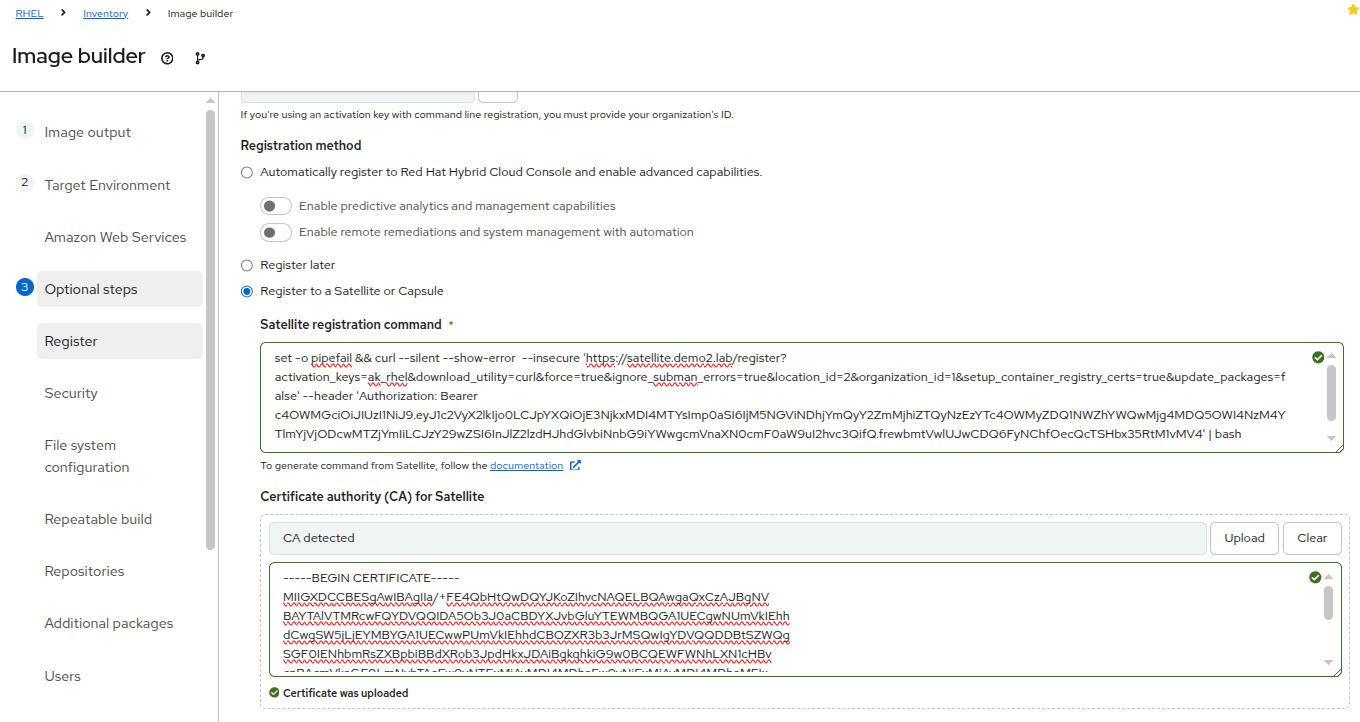
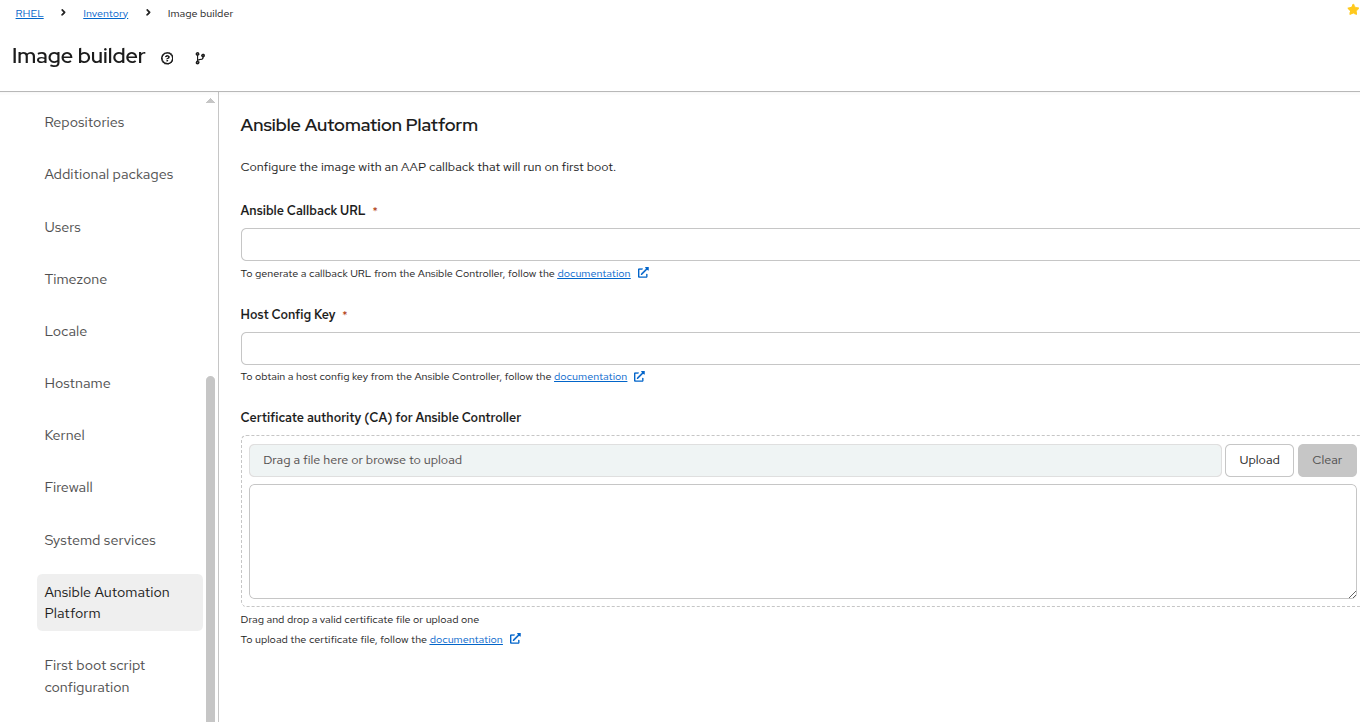
Image builder also enables registration to Ansible Automation Platform with provisioning callbacks. This automatically connects your new system to automation or hardening playbooks.
Shifting left: Security starts at build time
The foundation of a security-enhanced environment is a security-hardened image. Why wait until deployment to focus on compliance? With image builder's integration with the compliance service, you can now build, customize, and harden images directly in the image builder wizard by assigning compliance profiles. This automatically registers the system and keeps them managed under the compliance service throughout their lifecycle. Gain confidence knowing your compliance posture is locked in from the start, and that your environment is configured to your requirements from Day 0.
Unify management with MCP
The MCP server for Red Hat Lightspeed, available in Developer Preview, serves as a connection point from your favorite AI client to your Red Hat Enterprise Linux (RHEL) estate. You can improve visibility and management across your fleet by connecting AI models with programs and knowledge sources that allow it to perform actions towards a goal.
This single MCP server supports multiple Red Hat Lightspeed-powered services, including advisor, vulnerability, inventory management, and image builder, by enabling better tool integration.
For example, the MCP server works with the vulnerability service to not only find CVEs, but also provides the option to automate their remediation. The MCP server's remediation steps can be used to create an Ansible playbook to automate this fix for future CVEs, as identified by the vulnerability service. By using the MCP server for tasks like this, you reduce manual and time-consuming processes while improving security and compliance.
Are you ready to simplify image creation and accelerate your path to a fully managed, compliant environment?
- Learn about RHEL and Red Hat Lightspeed image builders at redhat.com/image-builder
- Explore new image builder integrations
- Learn more about Red Hat Lightspeed
关于作者

Mary is a Product Marketing Manager for Red Hat Enterprise Linux. Her focus is RHEL management, and she is a subject matter expert on both Red Hat Insights for RHEL and Red Hat Satellite. Prior to Red Hat, Mary worked as a Product Marketing Manager in the startup world.


