

Scott and I talk to a lot of customers, and one theme that comes up over and over is that it’s difficult to plan for future releases of Linux. Sometimes, support drops for a feature or capability on which they rely. Other times, it’s that they can’t wait for a new feature, bug fix, and so on. Planning for Red Hat Enterprise Linux (RHEL) with its built-in digital roadmap, powered by Red Hat Lightspeed, is changing that. Product managers within RHEL now communicate directly with you about upcoming changes in the code base. This gives you more time to plan for changes, as well as clearer information about what’s changing. This simplifies upgrades and helps inform the automation your teams are building for the platform.
Executing on this vision, we are eager to announce our first planned change to the next major version of RHEL: Removal of support for modularity in RHEL 11! This update excites RHEL product managers, who work tirelessly to keep feature roadmaps perfectly updated for customers, partners, and Red Hat engineers alike, but many readers may find this a curious announcement. Read on to better understand why it's so exciting.
What does "removal of support for modularity" mean?
Since the launch of RHEL in 2002, there has been an ongoing challenge to enable the multitude of developer applications, languages, and tools, as well as their differing versions function seamlessly together on a stable, enterprise-grade operating system. Initial workarounds include providing one-version-only support at each major OS release, or in 2013 introducing Red Hat Software Collections to allow for newer versioned applications to be installed in isolated directories. Given a developer's need for modern software versions before a major OS upgrade, on top of the tediousness of hard-isolating every newly updated application, a core versioning strategy was needed for RHEL to succeed.
The 2019 launch of RHEL 8 showcased a new game plan: Application streams (AppStreams) and the modularity framework. AppStreams introduced worthwhile logic for delivering modern, supported application versions in an enterprise setting. However, modularity had complex metadata requirements, difficult maintenance, and general overhead. Red Hat began phasing out the creation of new modules by RHEL 9, ultimately halting their production entirely by RHEL 10.
So what is replacing modularity for providing different versions of software? We are returning to a simpler, more robust method: Delivering application streams as traditional, versioned RPM packages.
TL;DR: Given modularity's complexity to understand and manage, its removal of support in the next major RHEL release—in favor of simpler, versioned RPMs—makes complete sense.
For a product manager, this future-looking change may be top of mind. However, the hundreds of new features and capabilities to be announced in the future are reasonably forgotten by a developer trying to best administer their systems right now.
Why should a 3-year-early feature announcement even matter?
It’s a fair question, and the answer reaches into the heart of our commitment to you. We believe major changes shouldn't be surprises you read about in a blog post. That's why RHEL 10 launched with a digital roadmap that gives you a clear, accessible, and centralized view of the future, transforming announcements like this one into actionable information for your own IT system management and planning.
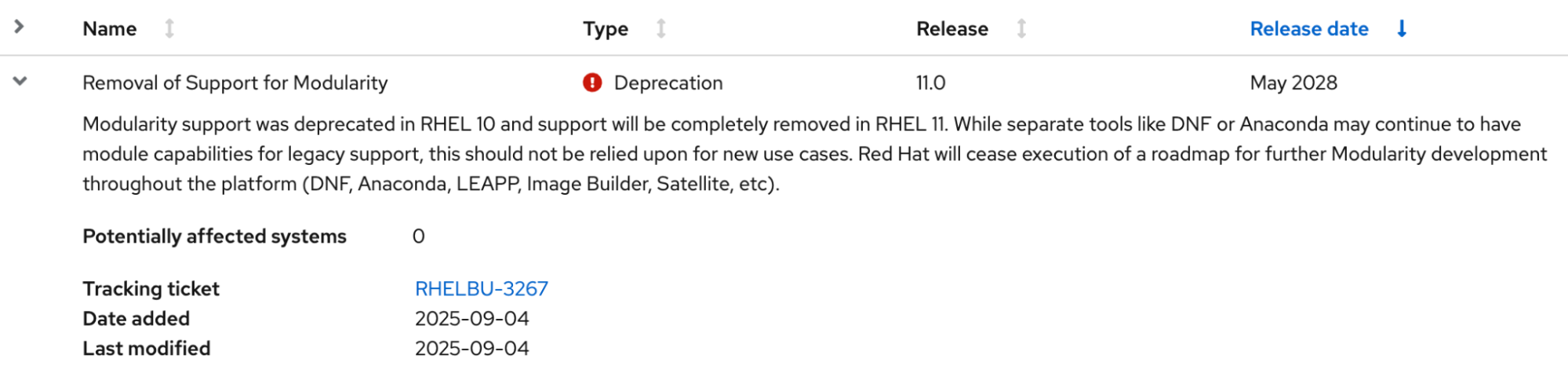
What is the digital roadmap?
As a webpage existing under console.redhat.com/Lightspeed, the digital roadmap is the authoritative place for our product managers to share transparent information about the tentative RHEL roadmap, including upcoming additions, changes, and deprecations. It provides a direct line of sight into the evolution of RHEL, with every item curated for customer relevance and described in clear, straightforward language. Instead of a one-time headline you have to remember for three years, the digital roadmap provides a living plan you can always access.

The other primary section of Red Hat Lightspeed planning provides insights into product lifecycle, directly tackling the confusing package management capabilities. IT professionals are better off tracking the package versions on their fleet of systems, but it's easier said than done. The Life Cycle tool provides a single, centralized view for all your RHEL package and application stream lifecycles. Instead of manually tracking support dates for every component, you can immediately see which packages like Node.js or Nginx are nearing their end-of-life across your systems.
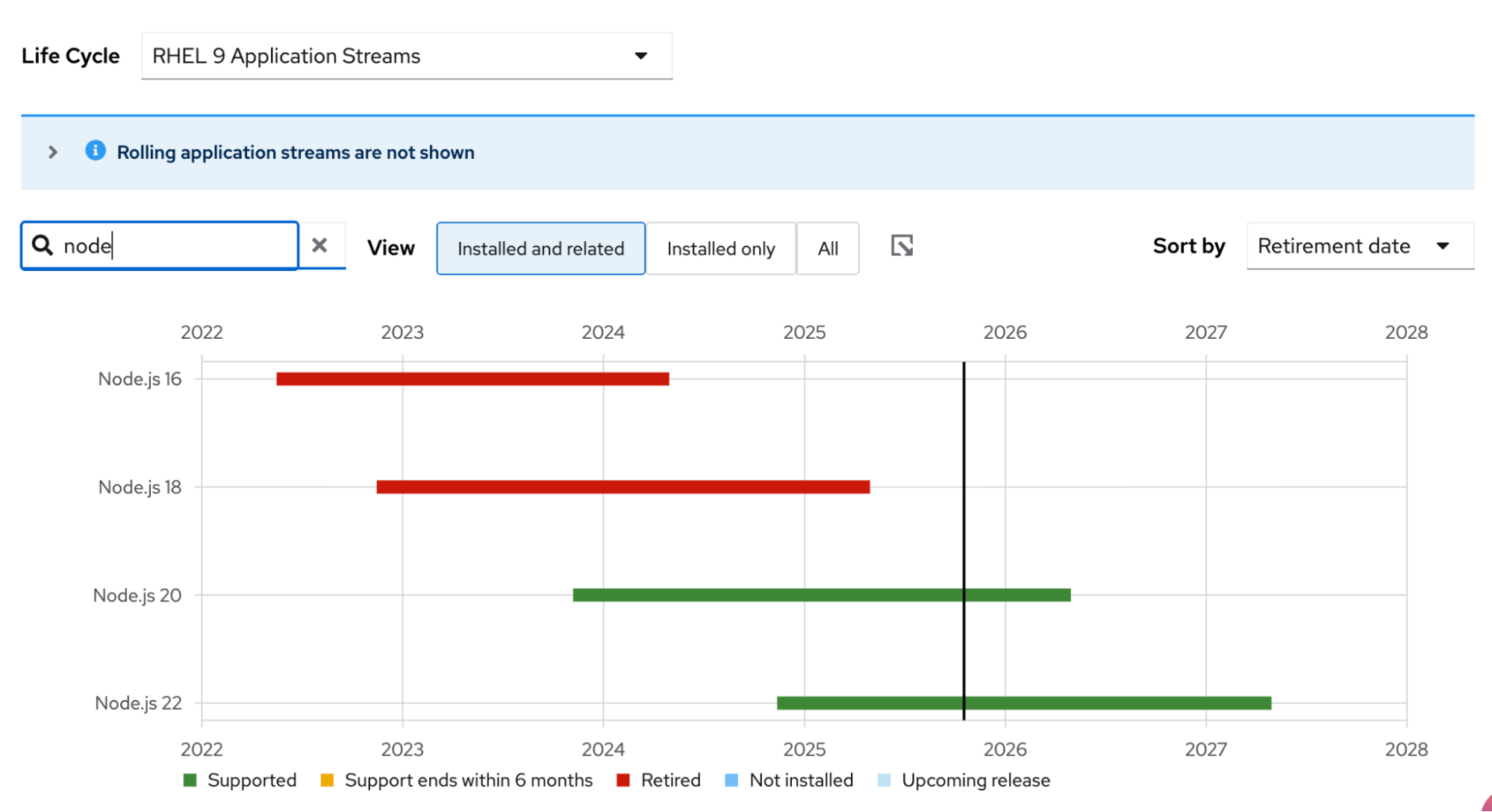
The best part? Both the digital roadmap and Life Cycle pages can be tailored to your systems with the click of a button.
Where is Red Hat Lightspeed planning headed?
Our commitment to simplifying your experience doesn't stop here. We're actively developing new features to make IT system planning even easier, including:
- MCP server integration for Red Hat Lightspeed: We have just published our first tool for the MCP (model context protocol) server for Red Hat Lightspeed, which launched in developer preview in October 2025. You can now use AI tools like Cursor and Claude to query a list of upcoming package changes, deprecations, additions, and enhancements. This has been redefining how developers interact with RHEL lifecycle and digital roadmap data. Learn how to download and use our MCP toolset.
- Proactive notifications: Soon you'll be able to subscribe to notifications for the digital roadmap and package lifecycle changes, ensuring you are always aware of significant updates that could impact your environment.
Planning a RHEL future with confidence?
The announcement of the deprecation of modularity in RHEL 11 is a strategic move to simplify your RHEL experience and boost operational efficiency. More importantly, it helps you plan your future roll-outs of the platform in your environment. It also highlights our commitment to transparent, long-term planning in partnership with our customers and partners. Red Hat Lightspeed planning, with both its lifecycle and digital roadmap views, is your essential resource for managing the present while simultaneously preparing for the future.
Want to see what RHEL product managers are adding today? Visit the planning for RHEL page here.
关于作者
Technical Product Manager for Lightspeed (Insights) Planning + RHEL File Systems and Storage; AI leverage of customer sentiment analysis for future product improvements.


