Digital sovereignty is the ultimate strategic lever for innovation. It propels organizations beyond compliance into true operational freedom where you, not your cloud provider, dictates your business continuity.
Red Hat believes that sovereignty shouldn't be a wall but a foundation for the freedom to choose where and how you run your workloads. To accelerate this push towards sovereign independence, we are introducing the Red Hat Digital Sovereignty Readiness Assessment tool.
Global regulations have raised the stakes for operational resilience and data jurisdictional control. But for many organizations, the path to independence is obscured by ‘black box’ stacks, limited optionality, and fragmented data silos.
The path towards a sovereign foundation starts by understanding where your organization currently sits, and this is where the Red Hat Digital Sovereignty Readiness Assessment tool comes into play.
Establishing a baseline for control: The readiness assessment
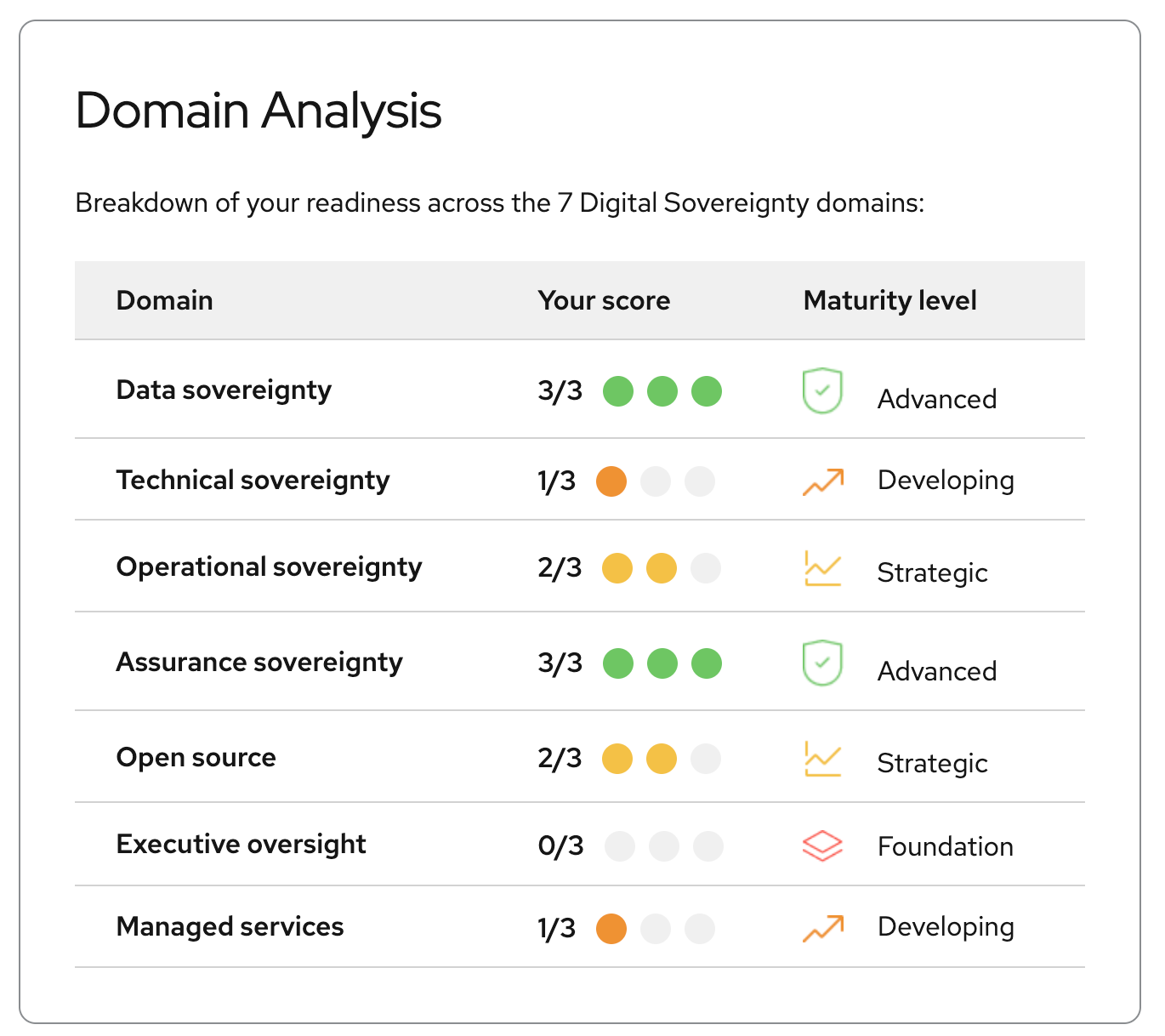
You cannot govern an IT estate you don’t fully understand. This self-service assessment provides a clear, objective baseline of your organization’s digital control across seven critical domains:
- Data Sovereignty: The physical and jurisdictional control of your data throughout its lifecycle.
- Technical Sovereignty: The composition of the underlying software stack.
- Operational Sovereignty: Your team's capacity to maintain and recover systems without external reliance.
- Assurance Sovereignty: The ability to independently audit and validate the integrity of your systems.
- Open Source Awareness: The use of community-driven innovation to neutralize vendor lock-in.
- Executive Oversight: The alignment of sovereignty goals with leadership-level governance.
- Managed Services: The flexibility of cloud deployments across specific regions and datacenters.
Understanding the results: Red Hat’s sovereignty maturity scale
Upon completion, the tool provides a maturity score that categorizes your current capabilities into four stages:
- Foundation: The early stages of identifying sovereignty requirements.
- Developing: Actively building capabilities and addressing initial gaps.
- Strategic: Strong, repeatable capabilities exist across most domains.
- Advanced: Broad, proactive control is exercised over its entire digital estate.
The assessment provides a practical roadmap of improvement actions and critical research questions for stakeholders.
An open standard for sovereignty
Red Hat’s approach to sovereignty is rooted in open innovation and the open hybrid cloud. We believe that a sovereign strategy is only as strong as the transparency of its foundation. When assessment tools are proprietary, they risk becoming the “black boxes” that they are meant to audit. True independence cannot be secretly verified.
In support of this needed transparency, Red Hat is establishing the open standard for assessing digital sovereignty. We are making the source code criteria for the Digital Sovereignty Readiness Assessment tool - originally developed by Red Hat’s Chris Jenkins - freely available to the global ecosystem.
By open sourcing this framework, we move the industry from “blind trust” to a model based on objective verification. Red Hat provides the logical blueprints that go beyond simply being a tool. This methodology empowers customers, partners and other organizations to map their own path to autonomous infrastructure across dozens of critical technical vectors.
For sovereignty to be real and obtainable, the behind-the-scenes math must be accountable and open for inspection. Red Hat is providing the transparent standard to give our customers the confidence that their sovereign strategy is exactly that.
Ready to see where your organization stands? Use the Digital Sovereignty Readiness Assessment tool to establish your baseline today and explore how Red Hat can support your journey toward a more resilient, independent digital future.