
Today, Red Hat released the latest version of our enterprise Kubernetes platform, OpenShift Container Platform 3.11. In OpenShift Container Platform, we’ve built a comprehensive, enterprise-ready platform to unite developers and IT operations teams to more securely, quickly, and reliably deliver containerized applications across enterprise infrastructures.
To help teams meet their goals, OpenShift Container Platform extends Kubernetes with advanced features. We’ve kept the platform pluggable to enable integration with third-party services to give our customers choice throughout the container stack. OpenShift is validated to work with hundreds of technologies, so our customers can take advantage of optimized container solutions from both Red Hat and our growing ecosystem of ISV partners.
As our customer base has expanded, we’re heartened to see an increasing number of partners build integrated solutions with OpenShift in support of our hybrid-cloud approach to delivering enterprise Kubernetes. Simultaneously, we’ve learned from our CoreOS teammates that there is a segment of users who strongly prefer to use their existing infrastructure and developer tooling investments, which have often already been made through our ISV partners. These customers may not require all of the advanced capabilities that ship with OpenShift Container Platform, and to address their needs, today we’re announcing the availability of OpenShift Container Engine.
About OpenShift Container Engine
OpenShift Container Engine is a minimal configuration of OpenShift Container Platform. Both Engine and Platform are built on the same enterprise Kubernetes core platform, and contain crucial Linux, container runtime, networking, management and security capabilities. While Engine and Platform are fundamentally the same product, OpenShift Container Platform users have access to a broader set of features, including advanced networking, management, and DevOps services capabilities.
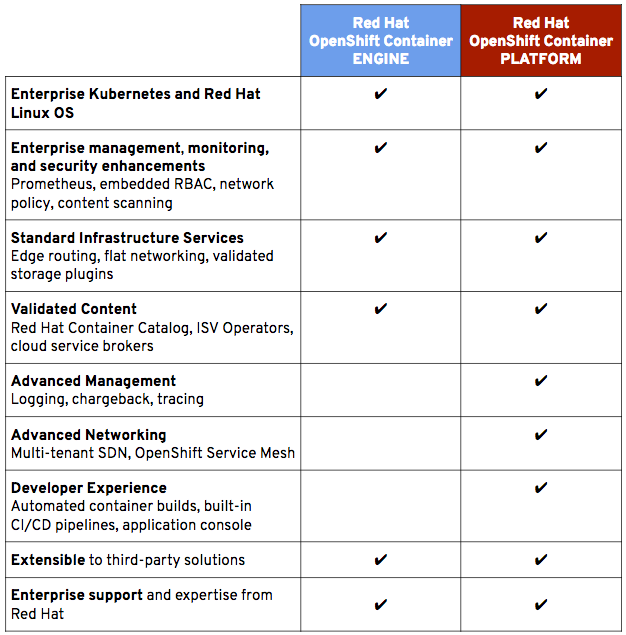
Table 1: Comparing OpenShift Container Engine and OpenShift Container Platform.
To cover the differences in a bit more detail:
- Networking: OpenShift Container Engine includes basic, flat networking capabilities. Users interested in more advanced capabilities such as multi-tenant SDN and OpenShift Service Mesh (including Istio and tracing) are advised to invest in OpenShift Container Platform.
- Management: OpenShift Container Engine includes basic management capabilities through Prometheus monitoring and console logs. Users who require more advanced log management with Elasticsearch and Kibana, or built-in charge-back capabilities should consider OpenShift Container Platform.
- Developer services:OpenShift Container Engine does not provide integrated DevOps services like source-to-image (S2I) for automated container builds, or the Jenkins CI / CD pipelines that are part of OpenShift Container Platform.
OpenShift Container Engine customers can bring their existing networking, management and DevOps services to OpenShift and continue to work with one of our many OpenShift partners providing solutions in these areas. Additionally, OpenShift Container Engine customers can upgrade to Openshift Container Platform if they decide to leverage more of these capabilities over time.
Continuing Kubernetes innovation
OpenShift Container Engine and OpenShift Container Platform deliver the same, trusted Red Hat enterprise Kubernetes experience, differentiated only by their extended feature set. Both provide a consistent, reliable, and CNCF-certified platform to power containerized workloads across hybrid cloud environments. Both are extensible to an expanded set of leading container solutions from our partners, and both are backed with the enterprise support and expertise Red Hat provides.
Ultimately, successful OpenShift deployments should integrate tightly with a customer’s chosen application lifecycle management processes and tools, whether those tools are part of OpenShift or they bring their own.
As more customers adopt OpenShift and look to extend it to a growing number of workloads, we plan to continue innovating both in and around Kubernetes. We will work with both the community and our customers to deliver the same great enterprise Kubernetes solutions, with greater choice and flexibility through OpenShift.
To learn more about OpenShift Container Engine contact your Red Hat sales rep, join our community at OpenShift Commons, or follow us on Twitter @openshift
关于作者
Joe Fernandes is Vice President and General Manager of the Artificial Intelligence (AI) Business Unit at Red Hat, where he leads product management, product marketing, and technical marketing for Red Hat's AI platforms, including Red Hat Enterprise Linux AI (RHEL AI) and Red Hat OpenShift AI.


