


For the telecommunications (telco) industry, the time to modernize is now. Telco service providers face intense pressure to deliver new digital services faster, while improving agility and cutting cost. By modernizing with advanced network systems and automation, telcos can remain competitive while increasing revenue, optimizing costs, and enhancing security and resilience.
However, every telco service provider’s cloud journey is unique, with workload requirements like latency, throughput, and data locality dictating whether an application should run on premise or in the cloud. The collaboration between Red Hat, AWS, and Nokia creates a powerful solution to support these unique requirements. Together, they provide a clear framework to help service providers decide which workloads belong in the public cloud and which should remain on premise.
Red Hat OpenShift Service on AWS delivers a managed application platform, tailored for the diverse and demanding telco industry, making it easier to shift applications to the cloud and support continuous innovation. Additionally, it provides the flexibility and consistency telcos need to manage workloads across diverse hybrid environments, significantly reducing their total cost of ownership (TCO) and accelerating innovation.
This blog explores the primary motivators for cloud adoption, the benefits of Red Hat OpenShift Service on AWS, and a real-world success story that demonstrates its impact on achieving a clear path for infrastructure modernization and strategic goals, including improved cost savings, agility, and resilience.
Current landscape of public cloud adoption for service providers
Service providers are using public cloud solutions to meet critical goals, including:
- Cost optimization: Shifting from capital-heavy hardware to an operational expenditure model cuts infrastructure and maintenance costs.
- Scalability and elasticity: Dynamic resource scaling handles demand spikes.
- Agility and speed: Quick deployment of services accelerates innovation and market responsiveness.
- High availability and resilience: Public cloud platforms support service continuity and disaster recovery (DR), vital for customer trust and compliance.
- Datacenter evacuation: Migrating workloads from on-premise infrastructure to the public cloud.
- Security: Comprehensive, scalable security features, compliance certifications, and robust infrastructure protection.
Like with any new technology adoption, public cloud adoption has its challenges. Deploying and managing Kubernetes platforms and cloud infrastructure demands substantial expertise and resources, often exposing a skills gap within many organizations. Although public cloud providers offer robust infrastructure, it's the responsibility of the service provider to architect, integrate, and manage the complexities of cloud-native environments, including the integration with various native services. Migrating legacy on-premise workloads to the public cloud further adds to the complexity, requiring significant technical effort and resources.
Currently, service providers adopt the public cloud in a phased approach. They start with development platforms to accelerate innovation, followed by operational and business support systems (OSS/BSS) to enhance efficiency and scalability. Testing and staging are also being shifted to the public cloud to optimize resource utilization. DR solutions are increasingly public cloud-based, providing additional resilience. Red Hat OpenShift Service on AWS addresses these needs, simplifying management, enhancing security, and supporting comprehensive hybrid cloud strategies.
The strategic imperative of Red Hat OpenShift Service on AWS
To navigate today’s complex networks, telco service providers are increasingly adopting a “lowest common denominator” platform strategy—standardizing on a unified, automated foundation that abstracts underlying infrastructure diversity. This approach, often referred to as platform rationalization or horizontal platform strategy, automates repetitive, non-differentiating tasks, freeing up skilled talent to focus on business-critical initiatives that increase revenue and add customer value.
Using automation and a standardized platform, telcos can:
- Reduce operational expenditure (OpEx).
- Minimize integration overhead.
- Accelerate time to market for new digital services.
Most organizations already use the public cloud; the question is how much. What sets telcos apart is how they manage workloads across hybrid or multicloud environments to maximize agility, scalability, and compliance. By deploying Red Hat OpenShift Service on AWS, alongside OpenShift on premise, telco service providers gain a true hybrid cloud architecture that supports a consistent OpenShift experience across both cloud and on-premise environments.
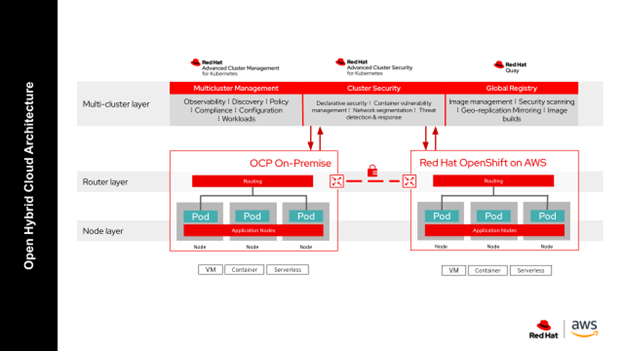
Red Hat OpenShift Service on AWS delivers a managed application platform designed to meet the unique needs of service providers and ease the transition from on-premise environments to the public cloud. The powerful advantages of using Red Hat OpenShift Service on AWS include:
- Fully managed service: Red Hat, in collaboration with AWS, manages critical functions such as patching, upgrades, monitoring, logging, and scaling. This significantly reduces the operational burden on service provider teams, allowing them to focus on core, innovative business priorities.
- Hybrid cloud consistency: Red Hat OpenShift Service on AWS provides an extensive, consistent OpenShift experience, spanning public clouds and on-premise environments. Enable consistent management of workloads across the hybrid cloud with tools like Red Hat Advanced Cluster Management.
- Support for virtualized workloads: Through Red Hat OpenShift Virtualization, Red Hat OpenShift Service on AWS helps service providers to run and manage virtual machines (VMs) alongside containers within the same cloud-native environment. This facilitates the migration and operation of both Linux and Windows VMs on Red Hat OpenShift Service on AWS, taking advantage of Kubernetes-based management and automation.
- Accelerated deployment and agility: The platform supports rapid deployment, with pre-configured environments ready in days rather than weeks, significantly speeding up time to market for new services. Integration with AWS-native services further increases agility.
- Robust migration support: Tools such as Red Hat’s migration toolkit for virtualization (MTV) and migration toolkit for containers (MTC) streamline the movement of both container and virtualized workloads from on premise to Red Hat OpenShift Service on AWS.
- Predictable and reduced TCO: Flexible pricing models and managed services contribute to a lower TCO. Managed services reduce overhead, freeing service provider teams up to focus on strategic initiatives rather than platform management. Multi-availability zone (AZ) resilience supports high availability, guaranteeing uptime and rapid recovery, and allowing applications to be deployed once for greater efficiency.
How an APJ service provider cut estimated TCO by 26% and deployed in just 2 days
A leading service provider in the Asia Pacific region faced challenges including scalability limitations, management complexity, skills shortages, high availability demands, and rising cost for their service orchestration and fulfillment deployments. To streamline operations and get new services to market faster, the provider partnered with Nokia and Red Hat.
They deployed Nokia’s Unified Inventory and Nokia Orchestration Center on Red Hat OpenShift Service on AWS, supported by Red Hat for consulting and training, and deployment best practices.
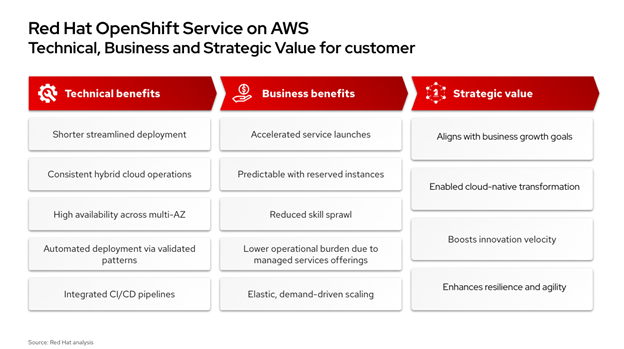
Technical value: The technical benefits of this solution were immediate. Deployment time decreased from weeks to just 2 days. The solution provided consistent hybrid cloud operations across environments and ensured multi-AZ resilience for high availability. Deployment was simplified through validated platform and application deployment patterns, and the company was able to implement unified continuous integration and continuous delivery (CI/CD) workflows.
Business value: The service provider could now launch new services faster, achieve cost predictability with three-year reserved instances, and run lean operations with managed services that required minimal staff training. The platform also provided the flexibility to scale in response to demand.
Strategic value: The move boosted the service provider’s innovation velocity, resilience, and agility, accelerating their cloud-native transformation and supporting their long-term business goals.
A detailed TCO analysis revealed an estimated 26% savings with Red Hat OpenShift Service on AWS compared to on-premise deployments. The analysis was based on these key assumptions for the on-premise environment:
- The control and management plane servers, storage and networking equipment would be reused by the service provider instead of investing into a new setup. The cost of these equipment is considered as sunk and only the cost of the new worker nodes were included in the TCO analysis.
- A shared site reliability engineer (SRE) was factored in to manage the on-premise OpenShift deployment at 75% of their cost.
- To match the service provider’s availability and resilience targets, the Nokia solution was deployed across multiple-AZ.
- A five-year hardware asset lifecycle was assumed and apportioned for 3-year TCO, with comparable services and deployment costs for on-premise deployment.
- Costs for datacenter, utility (including PUE), and utilities were included.
- Services and deployment costs for Red Hat OpenShift Service on AWS were assumed to be comparable for both environments.
- FX, inflation and SKU price adjustments are not considered during the modeling period.
Key use cases for service providers on Red Hat OpenShift Service on AWS
Red Hat OpenShift Service on AWS is a comprehensive application platform that helps service providers modernize their infrastructure and accelerate innovation. Here are some of the most impactful use cases:
- Run VMs and containers together: Use Red Hat OpenShift Service on AWS, through Red Hat OpenShift Virtualization, to run and manage VMs alongside containerized workloads within the same environment. This allows you to consolidate and modernize traditional virtualized applications, while taking advantage of Kubernetes-based automation and cloud scalability
- Accelerate cloud-native application development: Give development teams a powerful platform to rapidly build, test, and deploy new applications, significantly reducing the time it takes to bring new services to market.
- Modernize OSS/BSS workloads: Run OSS/BSS with greater efficiency and scalability. The platform’s elastic resources automatically scale to handle fluctuating demand, ensuring performance and eliminating bottlenecks.
- Create efficient testing and staging environments: Set up testing and staging environments in the public cloud. This improves agility and cuts costs by making it easy to provision, scale, and tear down environments as needed.
- Implement cloud-based DR: Support business continuity by using the public cloud for strong DR. Workloads can be backed up and restored quickly, minimizing downtime during unexpected events.
- Enhance internal and customer-facing applications: Improve the performance and reliability of both internal and customer-facing applications, delivering an efficient and user-friendly experience for employees and customers alike.
- Integrate third-party services: Take advantage of the AWS Marketplace to easily access and deploy a wide range of third-party services, increasing flexibility and reducing reliance on legacy on-premise solutions.
Conclusion
For telco service providers, the path to growing revenue and optimizing costs runs through modernization. Adopting Red Hat OpenShift Service on AWS is the application platform for that transformation.
It provides a fully managed application platform to run both virtualized and containerized workloads, delivering the scalability and resilience of the AWS cloud while simplifying operations across all environments. The result is a direct impact on the bottom line—as shown by the Asia Pacific region provider who cut their TCO by 26%—and a significant boost in agility.
The comprehensive migration toolkits and managed services reduce the technical and operational burdens on service provider teams so they can focus on innovation and strategic growth. The collaboration between Red Hat and AWS, and ecosystem leaders like Nokia, provides a powerful combination for telcos to unlock their full transformation potential.
Red Hat OpenShift Service on AWS positions service providers the tools they need to not just compete, but to lead in a fast-changing digital world.
关于作者
Vishal Jagtap is a seasoned business professional with extensive experience in the telecommunications and cloud industries across the Asia-Pacific and Japan region. Currently at Red Hat, Vishal is leading Telco Partnerships for OEM and CCSP partners in the APJ region. In the past Vishal has worked in leadership roles at Broadcom, VMware, Singtel, and Ericsson, where he led initiatives in building cloud transformations, selling telco solutions, and developing and scaling business with new partners.
Vishal holds an EMBA from SP Jain Center of Management, a Master’s in Technological Design from the National University of Singapore, and a B.Tech from NIT Warangal. He is certified as a PMP.
Subrat leads the Business Value Practice for Ecosystem Partners and Telco in the APAC region, guiding them in positioning the business value of Red Hat solutions. With extensive experience as a management consultant, he leverages his expertise to align Red Hat’s solutions with the strategic needs of partners and customers, demonstrating how investing in Red Hat drives their business outcomes
Manu is a Cloud Services Black Belt with Red Hat. He is an experienced architect & GTM strategist for Public & Private cloud business. His primary area of expertise is to help FSI, Telco & IT/ITES customers be successful with cloud adoption.


