One of the things we often assume with the Red Hat OpenShift platform, and with Kubernetes in general, is that our users have computing needs that always fit inside a standard cloud node. While this is definitely the case for most cloud-based applications, there are plenty of non-JavaScript-and-Redis style applications out there that still need to move into the cloud. Some enterprise applications were written before the cloud existed, and still others were created before JavaScript, C#, and Python even existed. Older systems written in languages, like PL/I and COBOL, can also benefit from the move to cloud, and from the use of containers, they just need a little extra attention to make the transition. Sometimes, they might need more specifically tailored environments than are available in the commodity-hardware-based clouds.
Or maybe, those systems need to also run extremely large, mission-critical databases, like IBM DB2. In order to unlock the true potential of a multi-cloud compute environment, that cloud software needs to run on a diverse array of hardware similar to what is already in place in some of the world's largest enterprises and governments offices. Spreading cloud capabilities into these larger systems enables containers to exist in the same environment as the company's central database, and to embrace and modernize those older applications that may still run the most the basic aspects of a business' day-to-day operations.
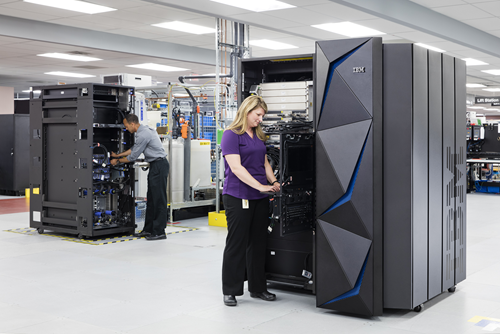
To that end, IBM has announced that Red Hat OpenShift is now available to run on IBM Z and IBM LinuxONE systems. From their announcement:
The availability of OpenShift for Z and LinuxONE is a major milestone for both hybrid multicloud and for enterprise computing. OpenShift supports cloud-native applications being built once and deployed anywhere - and now extends this to on premises enterprise servers such as IBM Z and LinuxONE. This offering has been the result of the collaboration between the IBM and Red Hat development teams, and co-creation with early adopter clients. But this is just the beginning, as we are also bringing IBM Cloud Paks to IBM Z and LinuxONE, packaging containerized enterprise and open source software with Red Hat OpenShift.
OpenShift then brings together the core open source technologies of Linux, containers and Kubernetes, adds additional open source capabilities such developer tools and a registry, and hardens, tests and optimizes the software for enterprise production use.
Partnering with IBM Hybrid Cloud, we have also developed a robust roadmap for bringing the ecosystem of enterprise software to the OpenShift platform. IBM Cloud Paks containerize key IBM and open source software components to enable faster enterprise application development and delivery. Today we are also announcing that IBM Cloud Pak for Applications is available for IBM Z and LinuxONE – supporting modernization of existing apps and building new cloud-native apps. In the future, we intend to deliver additional Cloud Paks for IBM Z and LinuxONE.
There are a lot of moving parts inside to enable this integration. IBM and Red Hat have been working together to enable this usage model. This includes new capabilities for IBM's Cloud Paks.
IBM z/OS Cloud Broker enables OpenShift applications to easily interact with data and applications on IBM Z. IBM z/OS Cloud Broker is the first software product to provide access to z/OS services by the broader development community.
Customers using OpenShift on IBM Z and LinuxONE can also use IBM Cloud Infrastructure Center to manage the underpinning cluster infrastructure. Cloud Infrastructure Center is an Infrastructure-as-a-Service offering which provides simplified infrastructure management in support of z/VM based Linux virtual machines on IBM Z and LinuxONE.
Here are some additional resources to get you up to speed on everything that's happening between IBM Z and Red Hat OpenShift:
- IBM's page on Cloud Native Development.
- IBM's page on Linux Containers.
- Two announcement webcasts, including speakers from IDC, Red Hat and IBM, on March 5 for IBM Z customers, and on March 17 for the wider Linux community.
- A sponsored IDC white paper: Transforming a Corporate Datacenter into a Modern Environment: Kubernetes as a Foundation for Hybrid Cloud.
- An IBM Systems Magazine article: Red Hat OpenShift, IBM Cloud Paks and more facilitate digital transformation.
关于作者

Red Hatter since 2018, technology historian and founder of The Museum of Art and Digital Entertainment. Two decades of journalism mixed with technology expertise, storytelling and oodles of computing experience from inception to ewaste recycling. I have taught or had my work used in classes at USF, SFSU, AAU, UC Law Hastings and Harvard Law.
I have worked with the EFF, Stanford, MIT, and Archive.org to brief the US Copyright Office and change US copyright law. We won multiple exemptions to the DMCA, accepted and implemented by the Librarian of Congress. My writings have appeared in Wired, Bloomberg, Make Magazine, SD Times, The Austin American Statesman, The Atlanta Journal Constitution and many other outlets.
I have been written about by the Wall Street Journal, The Washington Post, Wired and The Atlantic. I have been called "The Gertrude Stein of Video Games," an honor I accept, as I live less than a mile from her childhood home in Oakland, CA. I was project lead on the first successful institutional preservation and rebooting of the first massively multiplayer game, Habitat, for the C64, from 1986: https://neohabitat.org . I've consulted and collaborated with the NY MOMA, the Oakland Museum of California, Cisco, Semtech, Twilio, Game Developers Conference, NGNX, the Anti-Defamation League, the Library of Congress and the Oakland Public Library System on projects, contracts, and exhibitions.


