In the telecommunications industry, the Radio Access Network (RAN) has moved from a set of fixed functions to a dynamic, software-defined environment that is characterized by cloud-native technologies and methodologies that will be fundamental within the AI-native 6G era. By integrating AI with wireless infrastructure, service providers can improve network efficiency, reduce power consumption, and unlock new revenue streams through innovative edge services.
Red Hat has demonstrated another milestone in this evolution, running the recently open sourced version of the NVIDIA Aerial CUDA-Accelerated RAN stack on Red Hat OpenShift. By combining NVIDIA’s high-performance accelerated computing with OpenShift,the leading hybrid cloud application platform powered by Kubernetes, our collaboration shows how our partners can now use open source software to rapidly prototype and develop AI-RAN solutions for today and the future.
The power of open source in 5G and 6G development
Developing 5G and 6G solutions on an open common cloud-native platform offers several critical advantages:
- Transparency and trust: Open source principles mean the foundational code for service provider networks remains transparent and accessible for security auditing.
- Rapid innovation: By providing researchers and vendors with unrestricted access to the Aerial source code, NVIDIA is creating both a framework for next-generation RAN solutions as well as a collaborative environment for building and optimizing them with high flexibility.
- Software-defined agility: A software-defined RAN platform can evolve through software updates rather than costly hardware replacements, reducing time-to-market and enabling innovation at the pace of AI.
- Ecosystem diversity: Red Hat allows service providers to integrate with a broad range of certified and validated partners that will accelerate service innovation and business growth with lower upfront costs, flexibility, and resiliency.
- Hardware enablement: The open nature of this platform, which builds on existing Red Hat Enterprise Linux (RHEL) and OpenShift support for ARM and NVIDIA architectures, accelerates future development, including the commitment to deliver rack-scale AI with NVIDIA on new GPU generations.
Performance at the edge: The technical demonstration
To prove the viability of these components for business-critical service provider environments, Red Hat has verified the Aerial CUDA-accelerated RAN software stack running on a highly optimized edge configuration.
The environment featured:
- Single-node OpenShift: A compact topology ideal for far-edge deployments.
- Zero-touch provisioning (ZTP): Deployed using GitOps-based practices to allow for fully automated, declarative configuration of bare-metal equipment at remote sites.
- Telco RAN distributed unit (DU) reference design: Configured specifically for low-latency, real-time workloads required by DUs.
This demonstration ran on an MGX server with the NVIDIA GH200 Grace Hopper Superchip and equipped with an NVIDIA ConnectX-7 NIC, highlighting the close integration of specialized AI infrastructure and OpenShift.
Validating Aerial CUDA-Accelerated RAN on OpenShift
The following diagram shows the setup used in the demonstration.
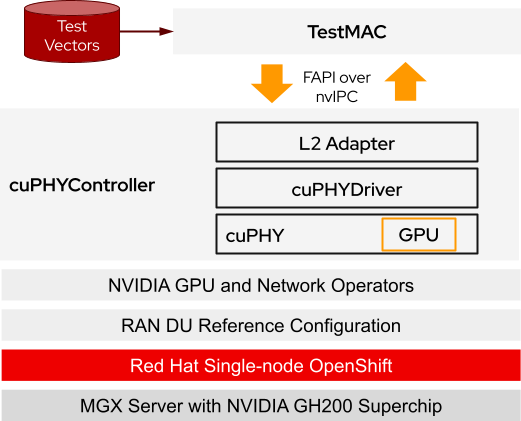
Overview of demonstration components
The following output demonstrates a successful test execution of the cuPHY (GPU-Accelerated PHY layer) component of the Aerial CUDA-accelerated RAN on OpenShift. The test validates the integration of the layer 1 (L1) physical layer using a simulated layer 2 (L2) MAC scheduler.
$
/opt/nvidia/cuBB/cuPHY-CP/testMAC/scripts/run_l2sa.sh 30 F08 1C
cuBB_SDK=/opt/nvidia/cuBB
Test case: 30 seconds F08 1C  BFP=
LOG_PATH=/opt/nvidia/cuBB/logs/latest
...
TestCase: launch_pattern_F08_1C_59c.yaml cell_num=1 channel_mask=0x7FF negative_test=0
Expected thrput: Cell 0: [DL=1544.1432/1600 UL=196.6992/400 ...]
...
Throughput check start ... mac_exist=True ru_exist=False
===============================================
00:00:01 Cell 0: MAC:[21:46:25.560018 DL=1544.14/1600 UL=196.70/400 HARQ=2000] mac_err=0x0
...
00:00:30 Cell 0: MAC:[21:46:54.560018 DL=1544.14/1600 UL=196.70/400 HARQ=2000] mac_err=0x0
Test time: 30 seconds, max continuous fail: 0, total fail: 0
Test PASS
Building the future of AI-RAN
Red Hat’s collaboration with NVIDIA is a blueprint for the future of telecommunications. With the flexibility provided by Red Hat OpenShift and the acceleration of NVIDIA AI Aerial, service providers will be able to deploy multi-tenant infrastructure that concurrently runs CUDA-Accelerated RAN workloads alongside cutting-edge AI applications.
This collaborative approach directly supports key pillars of AI-RAN:
- AI for RAN (using AI to improve RAN performance)
- AI and RAN (integrating AI and RAN services on a common cloud-native platform)
- AI on RAN (deploying AI services at the edge via the RAN)
As service providers move toward the commercialization of AI-RAN, Red Hat and NVIDIA are committed to providing the open tools and platforms necessary to build a faster, more efficient, and more intelligent connected world.
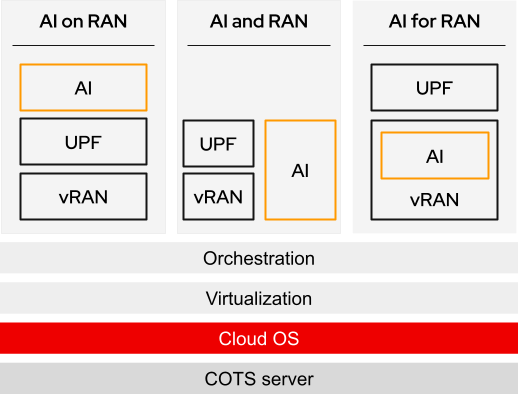
Overview of AI-RAN
Learn more
关于作者

Bart is a Principle Software Engineer in Red Hat's Telco Engineering group. He has over 30 years of experience developing carrier-grade software in the telco domain. Today, he applies that expertise to Red Hat's OpenShift product in the telco 5G RAN domain.



