Partner-led marketing handbook
When Red Hat appears with partners, maintaining neutrality and transparency are critical. It can be tempting to mix elements from both brands together to symbolize our partnership, but this results in muddled branding that’s less credible to customers. Instead, establish a lead brand for each marketing asset.
When a partner is leading the effort, they’re responsible for creating marketing materials and getting the necessary approvals from the Red Hat® partner team. Materials should follow their guidelines—including colors, fonts, imagery, and templates—just like anything other marketing material they create for their brand.
Using the Red Hat logo in a co-brand
The most common way to represent a partner relationship is with a co-branded logo lockup. For partner-led marketing materials, the lockup should follow the partner’s conventions, templates, or guidelines for creating co-brand lockups, which may differ from Red Hat’s. The logo of the partner’s parent brand should appear first, followed by the Red Hat logo. Do not modify the Red Hat logo or create co-brand lockups with product, program, or event logos.
The following are some examples of how a partner might use the Red Hat logo in their own co-branding style. These examples are not exhaustive or prescriptive—use them as a reference for how a co-brand with the Red Hat logo could look.

If the partner does not have their own standards or a template for creating a co-brand logo, they can use this layout to create one.

Add the partner’s logo in the box to the left and align the right side of the logo with the “R” guideline so that both logos are equally spaced around the dividing line. Ensure that the partner’s logo is the same visual weight as the Red Hat logo.

Use the partner’s logo first in the lockup when they’re the lead brand.

Use the Red Hat logo as provided, in full color, and with enough clear space.

Follow the partner’s templates and brand guidelines.

When the logo must be one-color (like on co-branded swag with limited ink colors) use solid black, red, or white.
Things to avoid
Regardless of the co-branding style used, always use the Red Hat logo correctly and avoid the following mistakes.

Not this: Don’t use Red Hat’s logo first when the partner is the lead brand.

Not this: Don’t use an endorsement logo to represent a partnership with Red Hat.

Not this: Don’t add any text or graphics to the Red Hat logo.

Not this: Don’t create a co-brand lockup with logos that represent products, divisions, or events.

Not this: Don’t use an outdated Red Hat Partner Program logo.

Not this: Do not use the hat alone or in a co-brand lockup.

Not this: Don’t use the Red Hat logo in grayscale.

Not this: Don’t crowd logos by using too little clear space.

Not this: Don’t generate co-branded logos using AI.
Questions
If you have questions about how to articulate your partnership with Red Hat, open a support case on Red Hat Partner Connect.
Have feedback on the Brand Standards? Submit it here.
Questions? Red Hatters can reach out via #help-brand on Slack.
Creating visuals for marketing with Red Hat
Make it easy for the customer to tell that marketing is coming from the partner and not from Red Hat. Depending on the asset or the partnership, it might make sense to create two versions of the asset: one led by the partner and one led by Red Hat.

Use the partner’s fonts, colors, design language, and messaging.

Use a co-brand lockup with the partner’s logo first.

Not this: Do not use Red Hat brand assets or try to mimic or reproduce the Red Hat brand.

Not this: Do not use the partner’s branding with a Red Hat logo alone.

Not this: Do not use Red Hat red (other than the logo) if it’s not part of the partner’s brand palette.

Not this: Do not mix elements of the partner’s brand and the Red Hat brand.

Not this: Do not create characters wearing red fedoras to represent Red Hat.

Not this: Do not generate Red Hat logos with AI tools — always use the exact logo files provided.
Writing for marketing with Red Hat
There will be instances when the partnership with Red Hat needs to be communicated beyond logo placement. Any partner-led content that’s written about a partnership with Red Hat should follow these general guidelines:

- Reference the partnership with Red Hat based on who is the lead brand. If the marketing is partner-led, the content should be written in a way that indicates that the partner is leading the marketing effort in collaboration with Red Hat.
- Recognize that there is a distinction between “products” and “solutions” when communicating to customers about a partnership. Red Hat products are just that—products. But combining a Red Hat product with a partner’s offering(s) creates a solution. When referring to what the partner is offering in addition to Red Hat’s product, please use the term “solution.”
- Remember that there are community versions for some Red Hat products, so it’s important to use the full name of the product in the first instance. After the first instance, Red Hat® Ansible® Automation Platform can be shortened to Ansible Automation Platform. Learn more on our naming and trademarks page. Learn more on our naming and trademarks page.
- Follow Red Hat trademark guidelines. The registered trademark symbol is only required on the first use of “Red Hat” as an adjective. The symbol is not necessary when using “Red Hat” to describe the company.

- Do not refer to IBM when talking about Red Hat partnerships. Red Hat is a subsidiary of IBM, but has distinct products and services.
- Do not abbreviate Red Hat product names for customer-facing materials. For example, please use Red Hat® Enterprise Linux®, never RHEL, and always use Red Hat® OpenShift® Service on AWS, never ROSA.
The following copy blocks have been created as modular tools for communicating about a Red Hat partnership. Use these examples as a guide when creating materials like website copy, press releases, social media promotions, sales enablement, thought leadership content, or slide decks. They can be used verbatim—with the partner’s information incorporated—but we encourage the use of these blocks as a foundation for using the partner’s tone, style, and language preferences.
General partner communications:
For partners that sell Red Hat technologies:
[Partner company’s name] has been a valued Red Hat partner for [number] years. Together, our [product/capability/service] along with Red Hat’s technology and expertise help our customers to innovate, differentiate, and deliver.
[Partner company’s name], a [what the partner company does], is a proud partner of Red Hat, the world’s leading provider of enterprise open source software solutions. For [number] years, we have empowered customers with Red Hat products and solutions by providing the right options, subscriptions, and expertise.
For partners that build hardware or software solutions certified by Red Hat:
For partners that provide services based on Red Hat technologies:
[Partner company’s name] builds [what the partner company builds] that operates on [Red Hat product]. As a Red Hat partner for [number] years, our products are certified on Red Hat platforms, which means, together, we provide consistent, interoperable, and supported solutions that our customers can deploy with confidence.
[Partner company’s name], a [what the partner company does], is a proud partner of Red Hat, the world’s leading provider of enterprise open source software solutions. For [number] years, we have empowered customers with Red Hat products and solutions through professional, operational, and managed service offerings including tools, training, and technical resources.
Credly badges for partners
Red Hat provides partners with digital credentials through the Credly platform. These credentials recognize and reward educational achievements and experience, community contributions, and program participation, including an ecosystem of engagement that supports customer success in adopting Red Hat technologies.
Credly badges are primarily intended to be used digitally, and the Credly platform allows them to be easily managed, stored, shared, and verified. Badge files can also be downloaded from the Credly platform, if needed. Partners should not create their own versions of their Credly badges, or use them in place of the Red Hat logo.
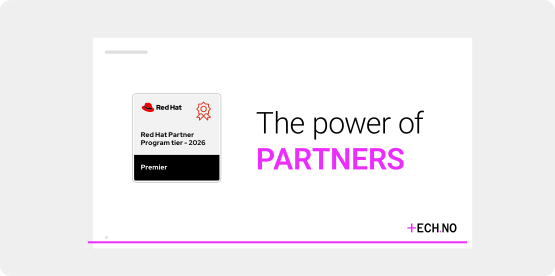
Partners can use Credly badges when referencing their partnership with Red Hat in digital materials like presentations and social media.
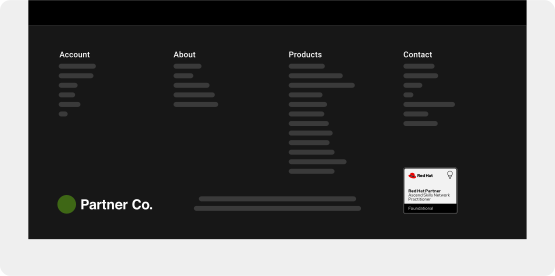
Partners can showcase their Credly badge on their website. The badge should be hyperlinked to the partner’s verification page on the Credly website.
Not this: Don’t co-brand a partner’s logo with a Credly badge.

Not this: Don’t use the Credly badge to make a logo.

Not this: Don’t print Credly badges on swag.
Questions
If you have questions about how to articulate your partnership with Red Hat, open a support case on Red Hat Partner Connect.
Have feedback on the Brand Standards? Submit it here.
Questions? Red Hatters can reach out via #help-brand on Slack.
Talking about Red Hat products
When talking about a partnership with Red Hat in general, always use our corporate name (Red Hat) and corporate logo, not the name or logo of one of our products. When addressing specific products, use the name of the Red Hat product. Always use the full name—for example, “Red Hat® OpenShift®,” not just “OpenShift” or an acronym. Use of product logos or technology icons is only permitted with prior approval from Red Hat.

Use the Red Hat logo, even when the copy is referring to a specific Red Hat product.

Use our full product names.

Technical partners can use the provided buttons to show that the partner’s technology is certified for Red Hat products.

Use the provided buttons to show that the partner’s technology is available on Red Hat Ecosystem Catalog.

Not this: Do not refer to partnerships with one specific product.

Not this: Do not abbreviate our product names.

Not this: Do not use Red Hat product branding for partner-led materials.

Not this: Do not use a Red Hat product logo or technology icon without prior approval.

Not this: Do not co-brand with a Red Hat product logo.

Not this: Do not use a technical partner button instead of a co-brand. Only partners offering certified technologies should use a technical partner button.
Questions
If you have questions about how to articulate your partnership with Red Hat, open a support case on Red Hat Partner Connect.
Have feedback on the Brand Standards? Submit it here.
Questions? Red Hatters can reach out via #help-brand on Slack.
Listing Red Hat products in marketplaces
Some partners may offer Red Hat products through marketplaces like AWS or Azure. Typically, these listings include limited space for a logo or thumbnail. A co-brand will generally look too small or cramped in this context. Instead, make it clear to customers that they’re purchasing through a partner and not directly from Red Hat using the partner’s logo or icon.
The listing should use the full Red Hat product name and clearly show the partner as the source or provider.

Use the full Red Hat product name and include the partner as the source or provider of the software.

When the listing has a thumbnail image, use the partner’s logo or icon.

Not this: Do not use a co-brand in the listing thumbnail.

Not this: Do not use a Red Hat logo or technology icon in the listing thumbnail.

Not this: Do not list Red Hat as the source or provider of software being sold by a partner.
Questions
If you have questions about how to articulate your partnership with Red Hat, open a support case on Red Hat Partner Connect.
Have feedback on the Brand Standards? Submit it here.
Questions? Red Hatters can reach out via #help-brand on Slack.
Technical partner buttons
When technical partners build and certify their software and technologies on Red Hat products, they ensure their solutions are consistent, interoperable, and supported, so they can deploy with confidence and focus on delivering transformative technology to their customers.
These partners should not co-brand with Red Hat unless they’re also business partners. Instead, they should use a technical partner button to show the certifications they’ve earned for each technology they provide.


Each technical partner button includes the name of the product the partner’s software is certified on, as well as the technology icon for that product. Red Hat Ecosystem Catalog buttons include the Red Hat fedora instead of a technology icon. The partner may choose to use the dark, light, or one-color version, depending on their use case.
Whenever possible, the button should be linked so that clicking on it leads to the appropriate product page on redhat.com.


Buttons are available for software certified for Red Hat® Enterprise Linux®, Red Hat® OpenShift®, and Red Hat® Ansible® Automation Platform, Red Hat® OpenStack® Platform, and for software that’s available on Red Hat Ecosystem Catalog.
Additional guidance for technical partners, including messaging, is available in the Red Hat partner handbook.
Applying technical partner buttons

Use technical partner buttons to show that technology is certified for a Red Hat product.

Link technical partner buttons to the appropriate page on the Red Hat website.


Not this: Don't use a legacy endorsement logo to show a partnership with Red Hat.

Not this: Don't make changes to the design of the technical partner button.

Not this: Don't use the Red Hat logo or the hat icon alone.

Not this: Don't use Red Hat product logos on partner materials or websites.

Not this: Do not generate Red Hat logos with AI tools — always use the exact logo files provided.
Questions
If you have questions about how to articulate your partnership with Red Hat, open a support case on Red Hat Partner Connect.
Have feedback on the Brand Standards? Submit it here.
Questions? Red Hatters can reach out via #help-brand on Slack.