Red Hat OpenShift Pipelines is a cloud-native, continuous integration and continuous delivery (CI/CD) solution based on Kubernetes resources. It uses Tekton building blocks to automate deployments across multiple platforms by abstracting away the underlying implementation details. Tekton introduces a number of standard custom resource definitions (CRDs) for defining CI/CD pipelines that are portable across Kubernetes distributions.
Red Hat OpenShift Pipelines 1.8 is now Generally Available on OpenShift Container Platform 4.10, and is planned to be available on OpenShift Container Platform 4.11 and 4.12.
New Features and Enhancements:
- Red Hat OpenShift Pipelines on Arm: With this release, you can run Red Hat OpenShift Pipelines 1.8 and later on an OpenShift Container Platform cluster that is running on Arm architecture.
- Tekton Hub enhancements:
- As an administrator, you can configure Tekton Hub to use a custom database rather than the default database.
- As an administrator, if you enable Tekton Hub, it periodically updates the catalog with the current information. You can configure the length of this period.
- As an administrator, you can install Tekton Hub with minimal input because it has better default configuration settings. You can start running Tekton Hub and work with your teams to decide what customizations they need.
- Pipelines as code enhancements:
- Add Git repository via webhook: You can add your Git repository to Pipelines as Code by using the webhook mechanism. This way, you can use Pipelines as Code even if GitHub Apps is not feasible.
- Trigger multiple pipelines for one Git event: You can trigger multiple pipeline runs for one git event e.g. PR.
- Manual and third party triggers: You as a developer will be able to trigger pipelinerun directly without being tightened up to a code flow.
- Support for additional git providers like Gitlab and Bitbucket
- Bootstrapping via dev console:
- You can create a Github application from the dev console. (Figure 1)
- You can configure the git provider (GitHub, GitLab and BitBucket) by adding repositories to enable pipeline as code. (Figure 2)

Figure 1
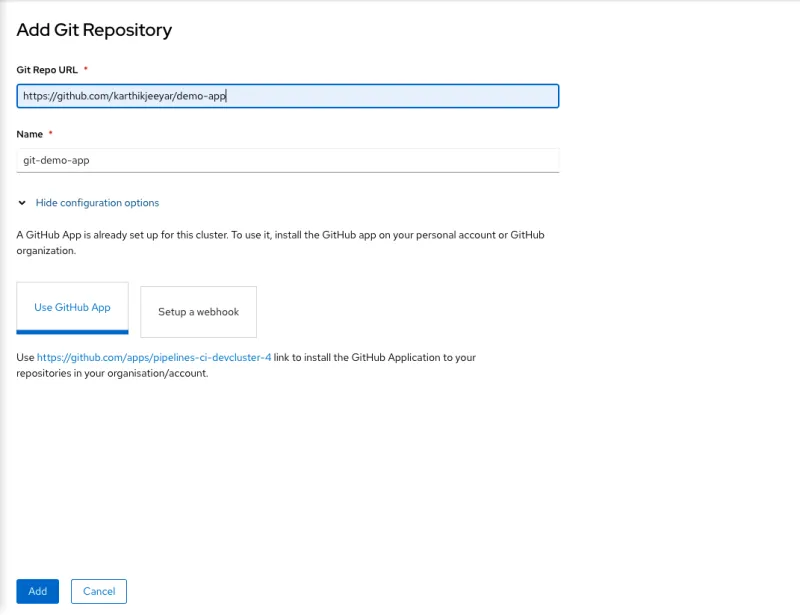 Figure 2
Apart from the features mentioned above, support for the PipelineResource custom resource (CR) and Condition custom resource (CR) have been removed as we are deprecating the tekton.dev/v1alpha1 API version.
For a full list and detailed information about each item in this release, please check out the Release Notes section of the OpenShift Documentation.
Where to next?
You can install Red Hat OpenShift Pipelines using the Operator listed in the OpenShift Container Platform OperatorHub and start using pipelines.
For more detailed understanding of Openshift Pipelines, check out Understanding OpenShift Pipelines.
Sobre el autor

Más como éste
From maintenance to enablement: Making your platform a force-multiplier
NGINX Gateway Fabric certified for Red Hat OpenShift
Creating JavaScript | Command Line Heroes
Edge computing covered and diced | Technically Speaking
Navegar por canal

Automatización
Las últimas novedades en la automatización de la TI para los equipos, la tecnología y los entornos

Inteligencia artificial
Descubra las actualizaciones en las plataformas que permiten a los clientes ejecutar cargas de trabajo de inteligecia artificial en cualquier lugar

Nube híbrida abierta
Vea como construimos un futuro flexible con la nube híbrida

Seguridad
Vea las últimas novedades sobre cómo reducimos los riesgos en entornos y tecnologías

Edge computing
Conozca las actualizaciones en las plataformas que simplifican las operaciones en el edge

Infraestructura
Vea las últimas novedades sobre la plataforma Linux empresarial líder en el mundo

Aplicaciones
Conozca nuestras soluciones para abordar los desafíos más complejos de las aplicaciones

Virtualización
El futuro de la virtualización empresarial para tus cargas de trabajo locales o en la nube
