As your business modernizes its cloud technology, it’s important to scale your cloud environments securely. Azure Red Hat OpenShift (ARO) supports your security needs at scale. With shared responsibility between Red Hat and Microsoft, ARO can help your organization boost cloud security in several ways.
Through ARO’s built-in security features your organization can simplify software deployment and reduce operational complexity with automated security maintenance and ongoing monitoring. The Red Hat Site Reliability Engineering (SRE) team automates, manages and monitors your platform so your business can focus on value-driven tasks without the burden of manually applying security updates and patches. As our SRE teams would say, “We make infrastructure boring.”
We continuously look for ways to improve security standards for customers, and recently we implemented several new security features.
Cybersecurity vulnerabilities (CVEs) and upgrades
Customers are able to take advantage of the benefits of the work the Red Hat Security team provides. The Red Hat security team looks at CVEs, identifies the severity, and if appropriate, provides errata for them. Red Hat Errata helps users determine what updates are available and how important they are based on analysis by Red Hat engineering. A majority of these Erratas will be provided via a version upgrade which can be applied to the clusters through either automated or manual tooling provided as part of Azure Red Hat OpenShift. The automated method leverages the recently released Managed Upgrade Operator. To configure the operator, all you have to do is apply a YAML file with a scheduled time at which you’d like the upgrade to take place and the operator will do the rest. For more details around how to configure the operator, refer to this document.
Cluster configuration upgrades
We continually work with Microsoft and customer security teams on implementing security best practices.
Two recently released features based on customer and Microsoft feedback include Storage and Egress Lockdown.
Storage Lockdown adds increased security to the storage accounts. This was done by changing the configuration of the storage account to force the use of a higher TLS version and a newer storage account version. It also checks to make sure the storage account is private and encryption is turned on. This feature is available for all Azure Red Hat OpenShift customers. Learn more about Storage lockdown.
We also received feedback that while private clusters were private (no ingress allowed), customers wanted to limit the remaining dependency on Egress traffic. This dependency’s primary purpose was for the cluster to communicate with Azure endpoints (for example to the Azure container registry). To enhance the security of these deployments, we created a private endpoint which would provide access to the Azure resources, so clusters can be deployed without a path to the Internet, for minimal deployment scenarios. You will notice in the diagram below [1] a private endpoint which provides the cluster access to the service. This private endpoint provides exclusive access to the specific resources that the cluster depends on.
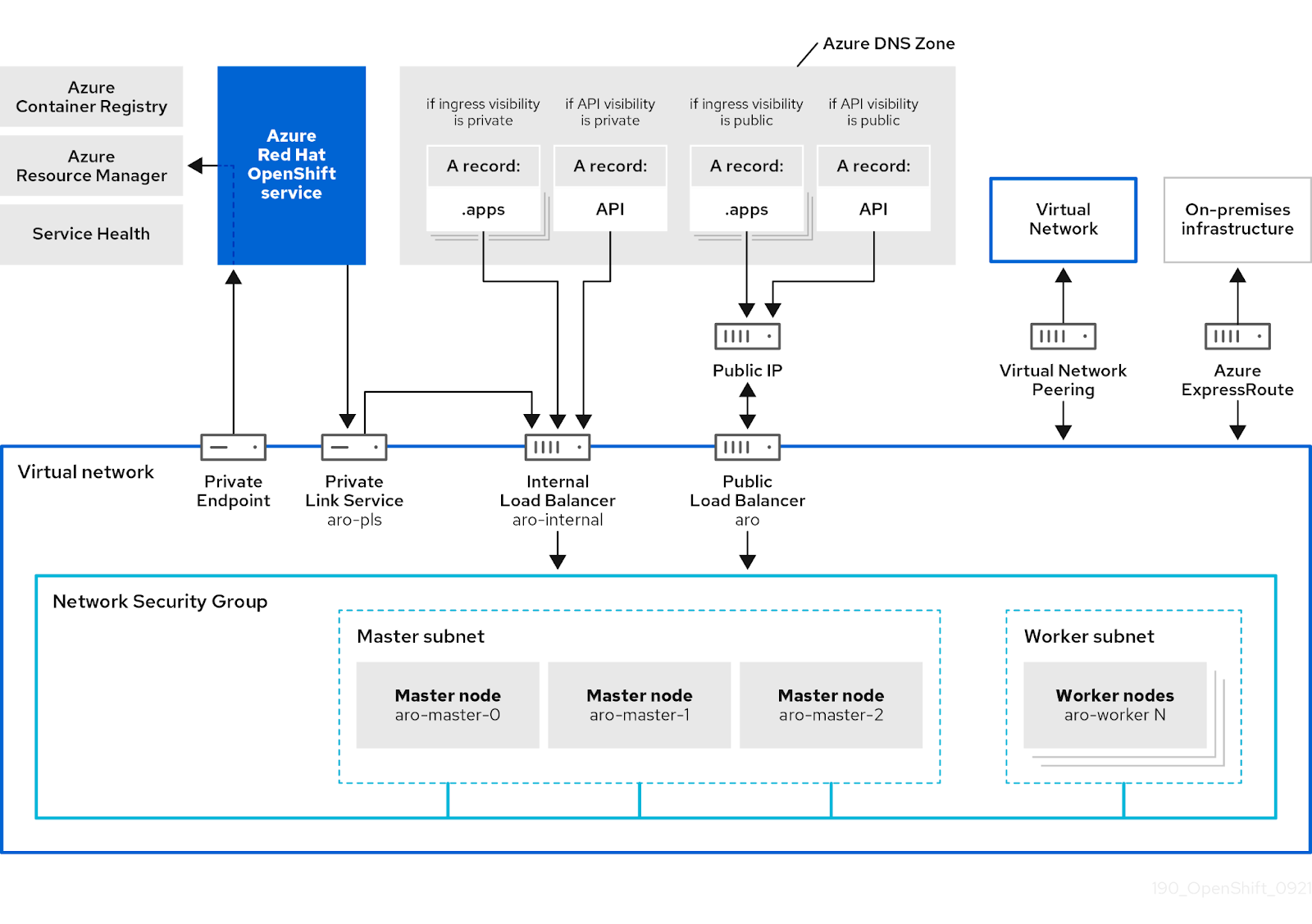
Figure 1 - Network topology of Azure Red Hat OpenShift
Some customers may elect to connect to additional registries or other external resources; this may be recommended for some use cases, as these can provide access to additional Red Hat Operators but this traffic would flow through the VNet peering and Azure Express route. Learn more about Egress Lockdown.
Compliance and certifications
Microsoft Azure offers a range of compliance solutions, and by using Azure Red Hat Openshift, customers get the benefits of Azure’s compliances coupled with Red Hats, combined to provide a large range of options.. Through the collaboration with Microsoft Azure, we have obtained numerous certifications inside their cloud, including PCI DSS, FedRAMP, HIPAA and many more. Visit the Azure compliance page for more information on these.
Red Hat also provides a full set of compliance tooling for additional security needs. Red Hat Advanced cluster Management provides management and controls via built-in policies which can be enforced upon Azure Red Hat OpenShift clusters. Red Hat Advanced Cluster Security (ACS) for Kubernetes provides a native Kubernetes security approach, adding an additional native layer of security to applications on the platform..
If you are looking to get started with Azure Red Hat OpenShift, read this blog to learn how to deploy the product through the Azure portal.
저자 소개

유사한 검색 결과
과거의 운영 방식에서 벗어나 IT의 미래 구축
AI의 다음 변곡점: 에이전트를 엔터프라이즈 슈퍼유저로 전환
Collaboration In Product Security | Compiler
Keeping Track Of Vulnerabilities With CVEs | Compiler
채널별 검색

오토메이션
기술, 팀, 인프라를 위한 IT 자동화 최신 동향

인공지능
고객이 어디서나 AI 워크로드를 실행할 수 있도록 지원하는 플랫폼 업데이트

오픈 하이브리드 클라우드
하이브리드 클라우드로 더욱 유연한 미래를 구축하는 방법을 알아보세요

보안
환경과 기술 전반에 걸쳐 리스크를 감소하는 방법에 대한 최신 정보

엣지 컴퓨팅
엣지에서의 운영을 단순화하는 플랫폼 업데이트

인프라
세계적으로 인정받은 기업용 Linux 플랫폼에 대한 최신 정보

애플리케이션
복잡한 애플리케이션에 대한 솔루션 더 보기

가상화
온프레미스와 클라우드 환경에서 워크로드를 유연하게 운영하기 위한 엔터프라이즈 가상화의 미래
