
Organizations globally are adopting OpenShift for various workloads including Big Data Analytics, AI/ML, Application runtimes, databases, developer tools, programming languages (Spring, Java, Python, etc.).
Data Analytics/AI/ML is a top emerging workload category on OpenShift, as mentioned in our recent press release. I am happy to share that Microsoft SQL Server 2019 Big Data Clusters now supports Red Hat OpenShift Container Platform (version 4.3 and higher), and Microsoft Azure Red Hat Openshift (a fully managed service of OpenShift on Azure), as its first fully supported container and Kubernetes platform.
Big Data Clusters is a set of capabilities introduced with the Microsoft SQL Server 2019 release. It allows you to deploy scalable clusters of containerized instances of SQL Server, Spark and the Hadoop Data File System (HDFS), with Kubernetes as the orchestration engine. The end result is a unified data platform, enabling you to read, write, and process big data from Transact-SQL or Spark, and achieve data driven business insights from the high-value relational data, with high-volume big data. The Big Data Clusters components shown in the diagram below require Linux containers to help package and isolate application and database services with their dependencies, making it easy to build & deploy them anywhere. The Big Data Cluster Architecture details are available here.
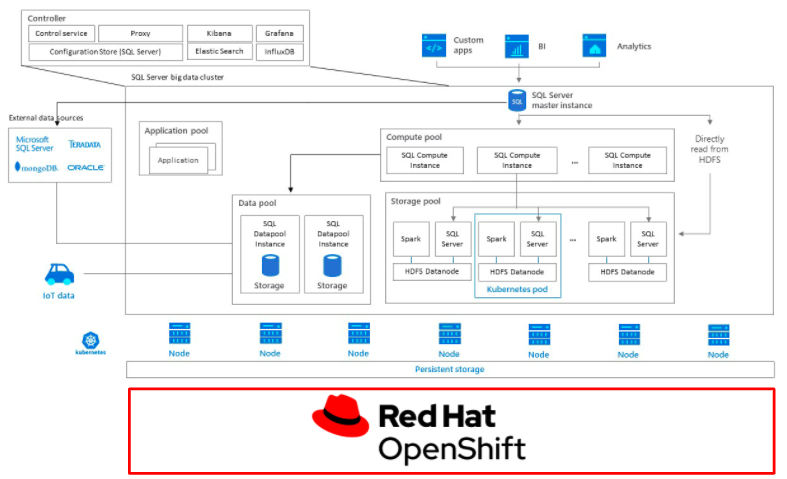
With Big Data Clusters on OpenShift, enterprise organizations can more securely deploy and manage a fully supported data analytics solution on the industry leading containers and Kubernetes platform. With integrated DevOps capabilities, OpenShift also allows extending DevOps to the entire Data Analytics & ML lifecycle, and enables collaboration across teams. The end result is the agility, scalability, flexibility, cross-cloud portability and security needed to roll out successful analytics/ML powered intelligent applications across hybrid and multi-cloud environments.
Security is top of mind for every organization, and has been a key reason for organizations to select OpenShift as their Kubernetes platform for various application workloads. Red Hat and Microsoft engineers collaborated to develop detailed security guidelines for running Big Data Clusters on OpenShift as part of this joint solution. The Big Data Clusters on OpenShift security whitepaper can be downloaded here.
Here is the Microsoft blog with details on the Big Data Clusters support for OpenShift. And, here is a hot off the press Reference Architecture from our friends at HPE showing prescriptive solution architecture for designing and deploying Big Data Clusters on Red Hat OpenShift Container Platform and HPE Synergy platform. For technical details on Big Data Clusters, please visit here.
This extends our strategic collaboration with Microsoft on SQL Server on Red Hat Enterprise Linux (RHEL), and is just the beginning of our joint collaboration on SQL Server 2019 Big Data Clusters. Stay tuned to learn more as we roll out Reference Architectures with our mutual infrastructure partners, and help organizations achieve business goals and objectives by operationalizing Big Data Clusters on OpenShift.
Feel free to reach out to your Microsoft and Red Hat sales teams if you would like to have a deeper conversation on SQL Server 2019 Big Data Clusters on OpenShift and how the joint solution can help achieve your business goals and objectives.
저자 소개
유사한 검색 결과
Red Hat이 파트너의 비즈니스 가치 극대화를 지원하는 5가지 새로운 방법
Red Hat 파트너가 최고의 통신 비즈니스 자산인 이유
Edge computing covered and diced | Technically Speaking
Transforming Your Acquisition
채널별 검색

오토메이션
기술, 팀, 인프라를 위한 IT 자동화 최신 동향

인공지능
고객이 어디서나 AI 워크로드를 실행할 수 있도록 지원하는 플랫폼 업데이트

오픈 하이브리드 클라우드
하이브리드 클라우드로 더욱 유연한 미래를 구축하는 방법을 알아보세요

보안
환경과 기술 전반에 걸쳐 리스크를 감소하는 방법에 대한 최신 정보

엣지 컴퓨팅
엣지에서의 운영을 단순화하는 플랫폼 업데이트

인프라
세계적으로 인정받은 기업용 Linux 플랫폼에 대한 최신 정보

애플리케이션
복잡한 애플리케이션에 대한 솔루션 더 보기

가상화
온프레미스와 클라우드 환경에서 워크로드를 유연하게 운영하기 위한 엔터프라이즈 가상화의 미래
