
A successful business transition depends on technology adoption and cultural shift. Enterprise IT needs to partner with operations technology (OT) to ensure applications and systems at factories are deployed and managed in a secure and standardized manner. The best practices of open hybrid cloud that leverage technologies like Kubernetes, automation, artificial intelligence (AI), and machine learning (ML) can also be extended to the industrial edge, all the way to the factory floor.
As edge adoption gains momentum, many industries are looking to use it to improve production optimization and operations. Combining edge computing with AI, ML, and GitOps enables manufacturers to proactively fix assembly-line issues and automate workflows. These changes help improve product quality, reduce downtime, minimize human error, and make operations smoother and cheaper.
This article looks at an architectural approach for industrial companies to become operationally agile.
An architectural approach to a modernized industrial edge
The following is an example solution for a large manufacturer with a centralized site responsible for core functions and factories located in far-flung locations. The onsite factory cluster receives sensor data from line servers and then analyzes it in real time with AI/ML models to predict failure. This data is also sent to the centralized datacenter or cloud for further processing and storage.
[ Learn more about handling data-intensive intelligent applications in a hybrid cloud blueprint. ]
This process workflow at a single factory location needs to scale easily to multiple sites with consistency and without tedious and error-prone manual configurations.
Use AI/ML to infer real-time insights
AI/ML models can infer actionable insights from a large amount of sensor data generated at the factory. The factory staff has access to the real-time status of production lines, including predictive information on factory health.
Use GitOps at the industrial edge
With GitOps, enterprises use the Git version control system as the declarative source of truth for the continuous deployment (CD) of system and application updates. Administrators manage system complexity by pushing reviewed commit changes in configuration settings and artifacts to Git. The changes are then automatically pushed into operational systems. Manufacturing organizations can use GitOps similarly to manage changes and upgrades across centralized and edge sites.
Logical solution view
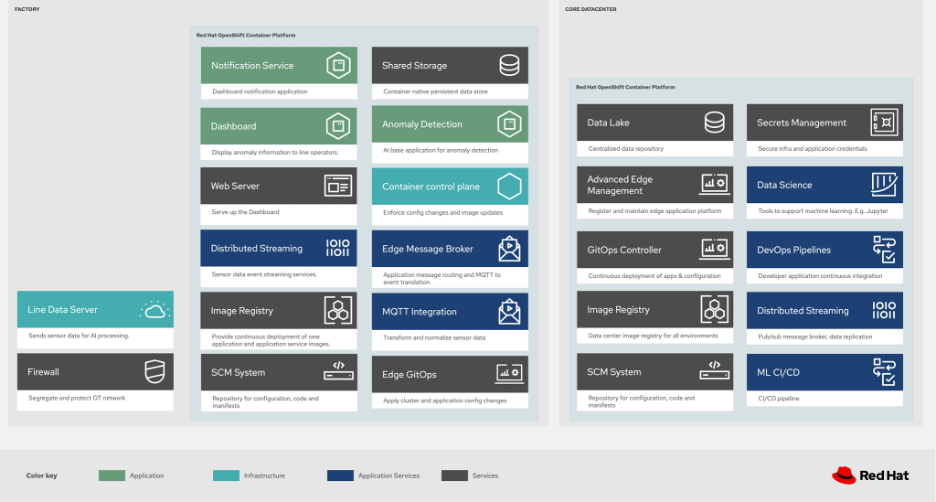
Conceptually, the industrial edge solution stack is deployed on an open cloud-native infrastructure like Red Hat OpenShift and can be categorized into:
- Local applications distributed across factory sites
- Core functions located at a centralized site(s)
Factory site
At the factory sites distributed across edge locations, the telemetry data from sensors is acquired, normalized, and processed before transmission to the core datacenter. New edge applications, including AI/ML models, are needed for real-time inferencing. The factory also hosts an image registry and source-code repositories, so edge sites can continue functioning while disconnected from the core datacenter.
Centralized site
In addition to handling the core enterprise functions, the core datacenter and cloud are also responsible for the AI/ML model development, DevOps pipeline, and long-term storage of edge data. The cluster and application life-cycle management functions, including the ones at the edge sites, are also handled at the central location.
[ Learn more about validated patterns. ]
Technology components
The following technology was chosen for this solution:
- Red Hat OpenShift is an enterprise-ready Kubernetes container platform built for an open hybrid cloud strategy. It provides a consistent application platform to manage hybrid cloud, multicloud, and edge deployments.
- Red Hat Advanced Cluster Management for Kubernetes controls clusters and applications from a single console, with built-in security policies. You can extend the value of Red Hat OpenShift by deploying apps, managing multiple clusters, and enforcing policies across multiple clusters from core to edge sites.
- Red Hat Quay is a private container registry that stores, builds, and deploys container images. It analyzes your images for security vulnerabilities and identifies potential issues that can help you mitigate security risks.
- Red Hat AMQ Streams is a data-streaming platform with high throughput and low latency. It streams sensor data to corresponding microservices for automated diagnosis.
- Red Hat OpenShift Data Science allows data scientists and developers to rapidly develop, train, and test ML models that can be deployed at factory sites to infer real-time insights.
- Red Hat OpenShift Data Foundations is software-defined storage for containers. As OpenShift's data and storage services platform, OpenShift Data Foundation helps teams develop and deploy applications quickly and efficiently across clouds.
- Red Hat Enterprise Linux is an open source Linux operating system providing a foundation to scale existing apps—and roll out emerging technologies—across bare-metal, virtual, container, and all types of cloud environments.
- HashiCorp Vault protects infrastructure and application secrets by securing, storing, and tightly controlling access.
Wrap up
Edge computing brings many opportunities to organizations looking to optimize production and efficiency using modern practices. Combining AI, ML, and GitOps provides operators with the data they need—whether at a central datacenter or a remote edge location—to understand and predict the health of their production systems.
Resources
Check out the Red Hat Portfolio Architecture Center for successful customer deployments of Red Hat and partner open source software.
Check out Red Hat Edge's validated patterns to set up your own industrial edge solution.
Check out my article on edge computing from the perspective of internet of things (IoT) application developers.
저자 소개
Ishu Verma is an AI Solution Architect at Red Hat dabbling in emerging technologies like AI Ops, AI safety and security. He, along with fellow open source hackers, works on building enterprise focused solutions with open source technologies. Prior to Red Hat, Ishu worked in technical marketing at Intel on IoT Gateways and building end-to-end IoT solutions with partners.
유사한 검색 결과
Red Hat Device Edge, 이제 NVIDIA Jetson Orin에서 사용 가능
격차 해소: 데이터 소스에 AI와 쿠버네티스 도입
Container Roundup | Compiler
Untangling Networks | Compiler
채널별 검색

오토메이션
기술, 팀, 인프라를 위한 IT 자동화 최신 동향

인공지능
고객이 어디서나 AI 워크로드를 실행할 수 있도록 지원하는 플랫폼 업데이트

오픈 하이브리드 클라우드
하이브리드 클라우드로 더욱 유연한 미래를 구축하는 방법을 알아보세요

보안
환경과 기술 전반에 걸쳐 리스크를 감소하는 방법에 대한 최신 정보

엣지 컴퓨팅
엣지에서의 운영을 단순화하는 플랫폼 업데이트

인프라
세계적으로 인정받은 기업용 Linux 플랫폼에 대한 최신 정보

애플리케이션
복잡한 애플리케이션에 대한 솔루션 더 보기

가상화
온프레미스와 클라우드 환경에서 워크로드를 유연하게 운영하기 위한 엔터프라이즈 가상화의 미래
