
C/C++ applications and build system scripts are monolith in nature. Achieving binary compatibility is becoming extremely difficult as applications include source information from a variety of local and third party sources, targeting a variety of platforms. Even classically monolithic applications may include a complex dependency graph, including transitive dependencies statically or dynamically linked. Another factor that adds to the complexity is that the deployment framework for different technology types is moving towards using Docker containers and the adoption of Kubernetes or Kubernetes variants.
In this blog post, we’ll focus on improving the C++ application build and deployment experience by using Conan, a C++ package manager, to build your App. We’ll then proceed to use OpenShift S2I to Dockerize your C++ applications. Also, to streamline the deployment, we’ve added JFrog Artifactory.
To get familiar with the process, we’ve created an example that displays the process of building, containerizing and running your C++ applications using Conan. We’ll build and containerize the C++ application that’s hosted on GitHub using the cpp–conan-builder:0.1 builder image.
# Run sti (s2i) command to containerize a C++ project (on github)

s2i build https://github.com/memsharded/example-poco-timer cpp-conan-builder:0.1 timer-app:0.1
Next, we can run the containerized C++ app, timer-app:0.1, that we got from the above command. Docker Image that includes both the output binary and the scripts responsible for running the application.
# Run containerized version of C++ projects

docker run -it timer-app:0.1

Let’s get started by creating the builder image.
Step 1: Creating a Builder Image for Conan
The source code for this sample project is available in GitHub.
Clone the Conan builder image, and generate the builder image. The builder image includes Conan, gcc 7.x, make and other tools required for building C++ projects.
# clone repo

git clone url https://github.com/JFrog/project-examples.git && cd

project-examples/openshift-s2i-examples/cpp-conan
# Generate builder image that includes Conan, gcc 7.x, make
 docker build -t cpp-conan-builder:0.1
The following Docker file corresponds to the builder image.
FROM centos/devtoolset-7-toolchain-centos7MAINTAINER John Smith <johns@delta.com>
USER 0
RUN INSTALL_PKGS="git make cmake epel-release" && \
yum install -y --setopt=tsflags=nodocs install $INSTALL_PKGS && \
rpm -V $INSTALL_PKGS && \
yum clean allRUN yum install -y python-pip && pip install conan
ENV GIT_COMMITTER_EMAIL=johns@delta.com
ENV GIT_COMMITTER_NAME=JohnSCOPY ./.s2i/bin/ /usr/local/s2i
LABEL io.openshift.s2i.scripts-url="image:///usr/local/s2i"
RUN mkdir -p /opt/app-root && chown -R 1001:0 /opt/app-rootENV HOME=/opt/app-root
ENV RT_CONAN_URL=
ENV RT_ACCESS_TOKEN=
ENV RT_USER=
USER 1001
WORKDIR ${HOME}
CMD ["echo","S2I Builder image to build C++ application via Conan"]
The builder image packages S2I scripts that are responsible for building and running the application.
Step 2: Creating a Reproducible Image Using S2I Scripts
S2I allows you to easily create reproducible Docker images using your C++ source code as input and produces a new image that runs the application as output. It includes the following two main scripts:
- Assemble Script: Builds the C++ project and generates the binary file. We use Conan to avoid rebuilding C++ dependencies including the transitive dependencies.
- Run Script: Runs the application.
Our sample C++ project relies on the Poco library. Poco depends on OpenSSL, and OpenSSL depends upon zlib.
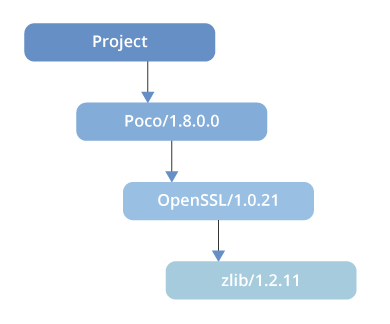
Using Conan, the dependencies are downloaded automatically from the conan-center by default which removes the need to build Poco, OpenSSL and zlib.
For more information on Conan and the related project, click here.
2a. Running the Assemble Script
cp -Rf /tmp/src/. /opt/app-root/if [ -z "$RT_CONAN_URL" ]
then
echo "Using default Conan repository $RT_CONAN_URL"
else
echo "About to add a remote Conan repository"
conan remote add conan-local $RT_CONAN_URL
fiif [[ -n "$RT_ACCESS_TOKEN" && -n "$RT_USER" ]] ; then
echo "About to set conan-local $USERNAME $RT_ACCESS_TOKEN"
conan user -p $RT_ACCESS_TOKEN -r conan-local $RT_USER
ficd /opt/app-root/
echo "Running conan install build missing"
conan install . --build missingecho "Running cmake commands"
cmake . -G "Unix Makefiles" -DCMAKE_BUILD_TYPE=Release
cmake --build .
# conan upload * --all -r conan-local --confirm
2b. Running the Builder Script
The builder script exposes the parameters to configure Conan to download packages from Artifactory. It is recommended to either use the multi-step build pattern or use short-lived access tokens to authenticate with Artifactory as displayed below.
export RESPONSE=$(curl -H "X-JFrog-Art-Api:$RT_API_KEY" -XPOST "$RT_URL/api/security/token"
-d "username=$RT_USER" -d "scope=member-of-groups:readers" -d "expires_in=600")export RT_ACCESS_TOKEN=$(echo "$RESPONSE"| jq -r .access_token)
s2i build https://github.com/memsharded/example-poco-timer cpp-conan-builder:0.1 timer-app:0.1
-e "RT_CONAN_URL=$RT_URL/api/conan/conan-local" -e "RT_USER=$RT_USER" -e
"RT_ACCESS_TOKEN=$RT_ACCESS_TOKEN"
Run the C++ containerized app created in the previous step.
docker run -it timer-app:0.1
The following script runs when the container starts:
#!/bin/bash

echo "Running Timer C++ Application"

cd $HOME && ./bin/timer
A Peek Behind the Scenes: Running C++ Containerized Apps
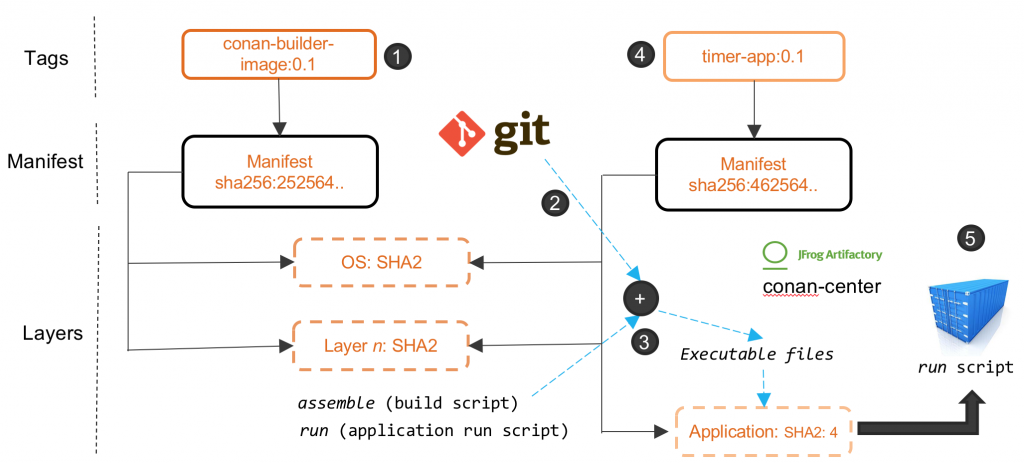
The following five steps are triggered by the Source to Image command:
- The container for the builder image starts and includes the required set of tools for compiling the C++ projects.
- A Git clone of the project is executed.
- The assemble (build script) is executed that is responsible for building the project using Conan. In this step, the pre-compiled packages of dependencies are downloaded from Conan repositories (Artifactory, conan-center).
- Once completed, the output binary is created.
- A new Docker manifest is created that has an extra Docker image layer that includes the output binary generated in step 3. This image is tagged using the name specified in the S2I command.
- The run script is executed when the containerized application starts.
Now that you’re up and running, hop over to learn more about Conan and Artifactory.
저자 소개
유사한 검색 결과
신속한 패치 적용이 어려우신가요? 최후의 방어선, 제로 트러스트
Red Hat 파트너가 최고의 통신 비즈니스 자산인 이유
Scaling with Orchestrators | Compiler
Container Roundup | Compiler
채널별 검색

오토메이션
기술, 팀, 인프라를 위한 IT 자동화 최신 동향

인공지능
고객이 어디서나 AI 워크로드를 실행할 수 있도록 지원하는 플랫폼 업데이트

오픈 하이브리드 클라우드
하이브리드 클라우드로 더욱 유연한 미래를 구축하는 방법을 알아보세요

보안
환경과 기술 전반에 걸쳐 리스크를 감소하는 방법에 대한 최신 정보

엣지 컴퓨팅
엣지에서의 운영을 단순화하는 플랫폼 업데이트

인프라
세계적으로 인정받은 기업용 Linux 플랫폼에 대한 최신 정보

애플리케이션
복잡한 애플리케이션에 대한 솔루션 더 보기

가상화
온프레미스와 클라우드 환경에서 워크로드를 유연하게 운영하기 위한 엔터프라이즈 가상화의 미래
