
In distributed system management, defining the "ideal state" of a server is rarely black and white. Different operational goals often create tension between performance tuning and security hardening, where optimizing for one can inadvertently break the other. To resolve this friction, Red Hat Lightspeed has introduced a new cross-service validation capability between our advisor and compliance services.
- Red Hat Lightspeed advisor: Recommendations for misconfigurations and best practices to improve stability, performance, and availability.
- Compliance: Monitors compliance with security baselines to report on and meet regulatory requirements at scale.
By bridging the logic between these services, you can now proactively detect when a performance recommendation contradicts a specific security policy. So when you're told to "fix" a system, you're not being told to create a compliance violation in the process.
How Lightspeed advisor recommendations work
To understand how conflicts happen, it's important to understand how Lightspeed advisor operates. The service is built on a foundation of recommendations: Python scripts that codify the expertise found in Red Hat Knowledgebase articles and support tickets.
These recommendations analyze the configuration of your systems for specific conditions. If a known issue is detected (like a database configuration that causes latency), it triggers a recommendation and provides a specific remediation, such as a command to install a missing package or tune a kernel parameter.
Problem: State contradiction
Recently, we identified a challenge where these two services—both operating correctly within their own scope—could create a deadlock for users. The issue arose when a performance and a security recommendation both target the same RPM or configuration file with opposing desired states. A common example involves the tuned RPM:
- Performance logic: Lightspeed advisor identifies a database workload and checks for the
tunedRPM. If it is missing, the recommendation logic triggers:dnf install tuned. - Security logic: The compliance scanner checks the active security profile. Many hardening guides (like a specific CIS level) explicitly require minimizing the attack surface by removing
tuned.
For the user, this results in a flapping state where installing the tuned RPM to satisfy Lightspeed advisor causes the compliance scan to fail, and removing it to satisfy the compliance service triggers the advisor recommendation to reappear.
We realized that treating these recommendations in isolation was placing the burden of conflict resolution on the system administrator, often without the necessary context.
Solution: Cross-service validation logic
To fix this, we needed to move away from isolated recommendation evaluation and implement a cross-referencing layer. The goal was to detect these conflicts programmatically, both during our internal recommendation development and at runtime for the user.
We approached this by mapping the resolution data from Lightspeed advisor against the security content automation protocol (SCAP) content used by the compliance service.
1. Mapping the data
The challenge was that Lightspeed advisor recommendations are written in Python, while compliance rules rely on extensible configuration checklist description format (XCCDF) profiles. This meant we couldn't simply compare text strings. We needed a way to translate between imperative code and declarative security definitions.
To solve this, we built a conflict detection engine that parses the resolution steps of a Lightspeed advisor recommendation and queries the full library of supported compliance profiles (Red Hat Enterprise Linux 7 through 10) for rules that explicitly forbid that state.
2. Runtime context awareness
Identifying a theoretical conflict isn't enough. We need to know if it applies to a specific system. To bridge this gap, we updated the advisor frontend logic to check the system context. When the user interface renders a recommendation, it performs the following sequence:
We updated the advisor frontend logic to check the system context. When the user interface renders a recommendation:
- It checks the recommended remediation ID
- It queries the compliance service to see which policies are currently enabled and assigned to that specific inventory host
- If the enabled policy contains a rule that conflicts with the remediation, a flag is raised
The result: Empowered decision-making
We deliberately decided against automatically suppressing conflicting recommendations. While hiding the conflict might result in a "cleaner" dashboard, it would obscure the critical context needed to manage your environment effectively.
In the real world, operational priorities vary. You might have a specific node where the database throughput is critical, and you are willing to accept a documented compliance exception to achieve it. By implementing a conditional alert rather than a silent suppression, we place the control back in your hands so you can make the decision that best fits your specific environment.
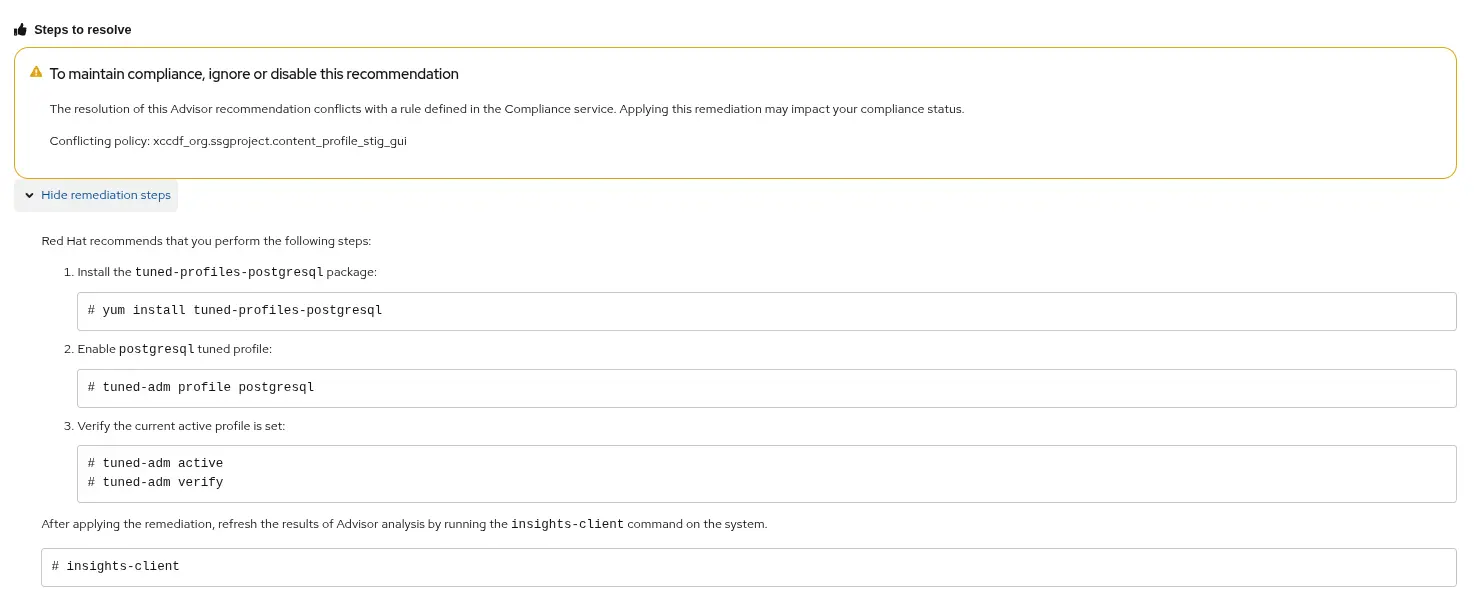
If a conflict is detected against an active policy, the Lightspeed advisor UI now injects a dynamic note into the remediation steps: "The resolution of this Lightspeed advisor recommendation conflicts with a rule defined in the compliance service. Applying this remediation may impact your compliance status," followed by the compliance policy name.
A new standard for recommendations
To prevent future conflicts from entering the ecosystem, we shifted validation left by integrating conflict detection directly into our internal development pipeline. Now, our CI process automatically validates new Lightspeed advisor recommendations against Red Hat Enterprise Linux security profiles before it hits production.
By bridging the logic gap between our performance and security datasets, we've ensured that Red Hat Lightspeed recommendations aren't just technically accurate in isolation, but operationally valid in the context of a hardened, compliant environment. Ultimately, this isn't just about cleaner code—it is about delivering the full context you need to make the right decisions for your infrastructure, rather than concealing the complexity behind a silent failure.
Try Red Hat Lightspeed today, included with your existing subscriptions.
For more information, visit https://www.redhat.com/en/lightspeed.
제품 체험판
Red Hat Enterprise Linux | 제품 체험판
저자 소개
Talia Kaplanian is a Senior Product Manager in Red Hat's Hybrid Cloud Business Unit for Red Hat Lightspeed, focusing on the user journey through data collection, advisor recommendations, and remediation capabilities. Her diverse background spanning software and data engineering, quality assurance, and product management and ownership drives her passion for building holistic and reliable enterprise solutions.
유사한 검색 결과
안정적인 코드를 재작성하지 마세요: Lightwell로 귀사의 수익과 개발자의 속도를 보호하는 방법
기업 속도의 새로운 가치 기준
Can Compliance Be A Piece Of Cake? | Compiler
Collaboration In Product Security | Compiler
채널별 검색

오토메이션
기술, 팀, 인프라를 위한 IT 자동화 최신 동향

인공지능
고객이 어디서나 AI 워크로드를 실행할 수 있도록 지원하는 플랫폼 업데이트

오픈 하이브리드 클라우드
하이브리드 클라우드로 더욱 유연한 미래를 구축하는 방법을 알아보세요

보안
환경과 기술 전반에 걸쳐 리스크를 감소하는 방법에 대한 최신 정보

엣지 컴퓨팅
엣지에서의 운영을 단순화하는 플랫폼 업데이트

인프라
세계적으로 인정받은 기업용 Linux 플랫폼에 대한 최신 정보

애플리케이션
복잡한 애플리케이션에 대한 솔루션 더 보기

가상화
온프레미스와 클라우드 환경에서 워크로드를 유연하게 운영하기 위한 엔터프라이즈 가상화의 미래
