
The Future-State Business Capability Model How-To is a series to help IT and architecture practitioners think about a few key steps to build a future-state business capability model to influence business and technology senior leaders and executive decision makers. Part 1 ran last week and looked at the first two steps to creating a strategy-defined project planning model: understanding the goals of the organization and determining the architectural scope model to use. This post explores the steps to actually defining and implementing your planning model.
Step 3: Define the plan to develop your future state capability model
-
- Determine if your organization requires a current state capability model. If your organization does not have a current state capability model, this may be an easier exercise to initiate dialogue and understand the concept.
- Identify how the corporate goals and strategy are applicable to the future state lifecycle. If required, translate the corporate goal to the applicable lifecycle. For example, a Corporate Revenue Goal can be translated into order transaction volume, number of newly hired associates, number of marketing campaigns or new product launches.
- Determine your standard definitions to categorize your capabilities. For example, Core vs. Differentiate is a foundational interpretation. Determine what capabilities are “core” (something required to keep our business running) vs “differentiating” (something that has a direct impact on our growth). This is a helpful reference for modeling: CEB’s Business Architecture Handbook.
Step 4: Develop your future state capability model
-
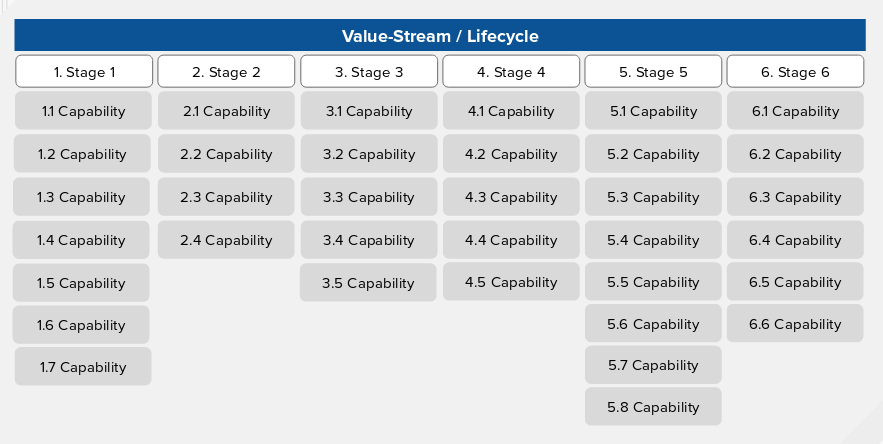
- Within your lifecycle, first determine the highest level of activities / stages that constitute the full breadth of actions needed to deliver the end-to-end lifecycle
- For each key activity, determine the next level of detail to capture the full inventory of activities delivered
- A few reminders:
- Build on existing models from your research. There are many examples of baseline business architecture models available for you to benchmark your organization and accelerate the concepts you want to capture, as highlighted in Figure 4 - Generic Capability Model.
- Don’t get bogged down in the details. Too much detail may instead be a conversation about elements that make up a capability, but are not really the capability. For example, it’s easy to discuss process details versus the capability that the organization needs
- Action! Capabilities should be documented in a verb-noun structure, so they read as if they are doing something. Eg. Create Quote, Process Order, Initiate Associate Onboarding
Step 5: Put your capability model into practice
-
- Initiate a gap analysis on the maturity of your capabilities.
- Define the assessment required to deliver your future state capabilities that achieve expected outcomes
- Categories include: create new, optimize, transform, sunset
- Align your capability model with your existing portfolios, by understanding which services and projects utilize and affect the capabilities, as defined in your assessment
- Combine these and other data points to inform your strategic planning, prioritization, and decision making.
Building a future state capability model will greatly enhance the organization’s ability to make strategically aligned business decisions for the near term and in the future. Capabilities that reflect the business strategies and goals, will highlight to leadership, stakeholders, and teams, which business and technology products and services that are differentiating for strategic growth and improvement.
저자 소개
유사한 검색 결과
내일로 가는 길: 현재의 기술과 미래의 AI를 연결
Introducing Quarkus on Red Hat OpenShift
Communicating the Value of Connecting Systems | Code Comments
채널별 검색

오토메이션
기술, 팀, 인프라를 위한 IT 자동화 최신 동향

인공지능
고객이 어디서나 AI 워크로드를 실행할 수 있도록 지원하는 플랫폼 업데이트

오픈 하이브리드 클라우드
하이브리드 클라우드로 더욱 유연한 미래를 구축하는 방법을 알아보세요

보안
환경과 기술 전반에 걸쳐 리스크를 감소하는 방법에 대한 최신 정보

엣지 컴퓨팅
엣지에서의 운영을 단순화하는 플랫폼 업데이트

인프라
세계적으로 인정받은 기업용 Linux 플랫폼에 대한 최신 정보

애플리케이션
복잡한 애플리케이션에 대한 솔루션 더 보기

가상화
온프레미스와 클라우드 환경에서 워크로드를 유연하게 운영하기 위한 엔터프라이즈 가상화의 미래
