
To effectively prioritize an organization’s collection of work, including operational services and projects to support products and innovation, leading organizations develop standard evaluation criteria to make data-driven decisions. These data-driven decisions help leadership make the right investments and ensure the organization is working on the most impactful work to improve competitive advantage. An organization’s decision makers should build simple and clear data requirements to enhance decision making and to better inform leadership and stakeholders.
Portfolio planning is the alignment of an organization's corporate strategy to data-driven decisions about capabilities and resources to achieve desired business outcomes. Effective portfolio planning and management capabilities should provide the organization with dashboards, reports, and analytics to inform better decision making.
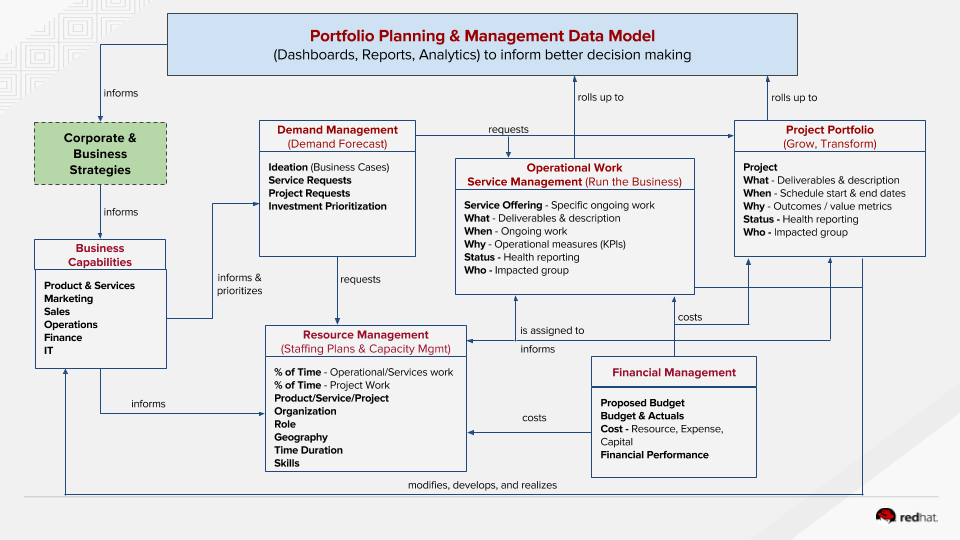
The portfolio planning and management data model in the figure is used to represent the primary data needed to provide the organization’s leadership and stakeholders with the right information about operational services, projects, resources, and financing. Corporate and business strategies inform what business capabilities are required to prioritize the new work requested of the organization.
The business capabilities and architecture overview was highlighted in the last blog, and it defines what the business needs to do to achieve its strategies and how the business operates to realize desired business outcomes or results.
Demand management includes the information and investment prioritization from business cases to prove why a new product, service, or project request is needed to modify, develop, or realize business capabilities.
The information needed for decision making is simplified and similar across the operational service data to run the business or project portfolio data to grow and transform the business. This data highlights what is being delivered with a concise description, when will the business and stakeholders receive the deliverable, and why it adds value to the organization in terms of operational KPIs or business value metrics. Additionally, the data should identify the impacted business and stakeholder groups and what costs are associated with the staffing resources, expenses, and capital required for the investments.
The primary data for the operational services and projects is important to establish in order to allocate staffing resources to each body of work. Resources are allocated to these bodies of work by a percentage of time, by organization, role, geography, time duration, and skills required to support the work. The allocation and capacity management of an organization's staffing resources ensures that the right people and roles, in the right geographies, at the right time, with the right skills are in place to effectively manage and execute the required work.
All of the data entities and attributes have associated costs and the organization should track and measure the data required to forecast, budget, and measure the financial performance associated with ongoing services, projects and staffing resources.
In conclusion, understanding the primary information about operational services and projects and the associated staffing and financing is paramount in order to effectively obtain and manage the data required to make better decision making for an organization’s portfolio planning and management practices.
저자 소개
유사한 검색 결과
내일로 가는 길: 현재의 기술과 미래의 AI를 연결
Introducing Quarkus on Red Hat OpenShift
Communicating the Value of Connecting Systems | Code Comments
채널별 검색

오토메이션
기술, 팀, 인프라를 위한 IT 자동화 최신 동향

인공지능
고객이 어디서나 AI 워크로드를 실행할 수 있도록 지원하는 플랫폼 업데이트

오픈 하이브리드 클라우드
하이브리드 클라우드로 더욱 유연한 미래를 구축하는 방법을 알아보세요

보안
환경과 기술 전반에 걸쳐 리스크를 감소하는 방법에 대한 최신 정보

엣지 컴퓨팅
엣지에서의 운영을 단순화하는 플랫폼 업데이트

인프라
세계적으로 인정받은 기업용 Linux 플랫폼에 대한 최신 정보

애플리케이션
복잡한 애플리케이션에 대한 솔루션 더 보기

가상화
온프레미스와 클라우드 환경에서 워크로드를 유연하게 운영하기 위한 엔터프라이즈 가상화의 미래
