
Just a few short years ago, data processing and storage at scale were the major challenges facing organizations working to leverage data engineering solutions. Most of these challenges have been met by current cloud offerings, so now, data engineering focuses on high-level problems and how to use the tooling and solutions to leverage that data at scale.
For the past few years, Red Hat's Portfolio Architecture team has been developing reference architectures based on customers' real-world use cases in various industries. We have multiple criteria for developing and vetting an architecture collection before we publish it, which you can read about in my intro article about Portfolio Architectures.
We're publishing these architectures for anyone's use on our Red Hat Portfolio Architecture Center and community Portfolio Architecture Examples repository site.
This article presents architectures centered around data engineering. There are currently eight architectures in this collection. I'll provide a short overview of each and allow you to explore them in-depth on your own.
- Cloud to edge: Providing a consistent infrastructure experience from cloud to edge and enabling modern containerized applications at the edge
- Datacenter to edge: Bringing computing closer to the edge by monitoring for potential issues with physical infrastructure (edge)
- Edge manufacturing efficiency: Boosting manufacturing efficiency and product quality with artificial intelligence (AI) and machine learning (ML) out to the edge
- Edge medical diagnosis: Accelerating medical diagnosis using condition detection in medical imagery with AI/ML at medical facilities
- Intelligent Data-as-a-Service: Building and delivering systems and platforms in a secure and scalable manner while driving data needs for moving towards consumerization in healthcare
- Payments: Enabling financial institutions to offer customers fast, easy to use, and safe payment services available anytime, anywhere
- Retail data framework: Creating a framework for access to retail data from customers, stock, stores, and staff across multiple internal teams
- SCADA interface modernization: Providing interfaces with SCADA systems that are compliant with NERC regulations, creating different layers of API gateways to protect business services depending on the network zones
[ Learn how to build, maintain, and manage data-intensive intelligent applications in a hybrid cloud blueprint. ]
In the Red Hat Portfolio Architecture Center, you'll find a table of contents outlining the technologies used in each architecture, several example schematic diagrams with descriptions, and a link to open the diagrams directly into the online tooling in your browser.
Cloud-to-edge architecture
The cloud-to-edge architecture is for providing a consistent infrastructure experience from cloud to edge and enabling modern containerized applications at the edge.
This project is a new architecture and is currently a work in progress. I'll share one of the schematic architecture diagrams, and you can monitor the project for updates as it progresses to completion.
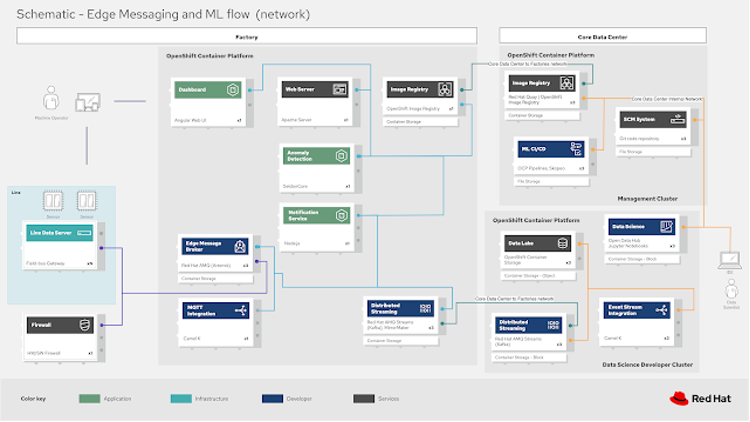
This architecture brings cloud-like capabilities to edge locations.
Datacenter-to-edge architecture
The datacenter-to-edge architecture covers energy and utility infrastructure companies that operate across a vast geographical area that connects upstream drilling operations with downstream fuel processing and delivery to customers. These companies need to monitor their pipelines' condition and other infrastructure for operational safety and optimization.
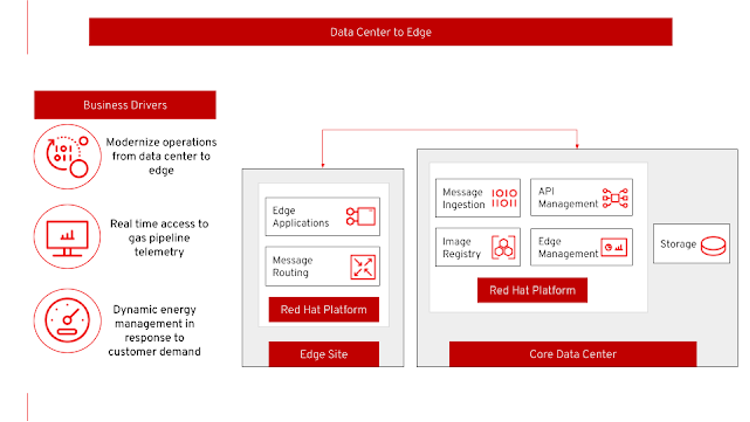
The architecture brings computing closer to the edge by monitoring for potential issues with gas pipelines.
Edge manufacturing efficiency architecture
The edge manufacturing efficiency architecture offers additional functionality to manufacturing. The manufacturing industry consistently uses technology to fuel innovation, production optimization, and operations. By combining edge computing, AI, and ML, manufacturers can benefit from bringing processing power closer to data. This helps them take action faster on concerns like errors and predictive maintenance.

This architecture boosts manufacturing efficiency and product quality with AI and ML out to the edge.
[ Learn how open source platforms, including Kubernetes and Ceph, can help you increase data agility for AI/MI. ]
Edge medical diagnosis architecture
The edge medical diagnosis architecture services the healthcare industry. The use case accelerates medical diagnosis using condition detection in medical imagery with AI/ML at medical facilities.
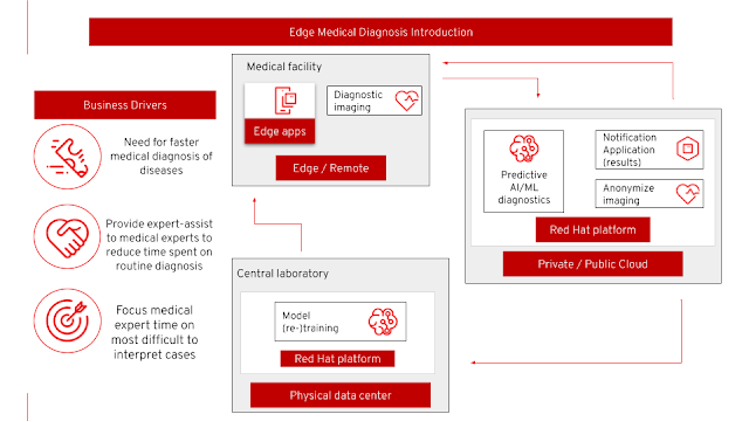
Intelligent Data-as-a-Service architecture
The intelligent Data-as-a-Service (iDaaS) architecture is about building and delivering systems and platforms in a secure and scalable manner while driving data needs for moving towards consumerization in healthcare.
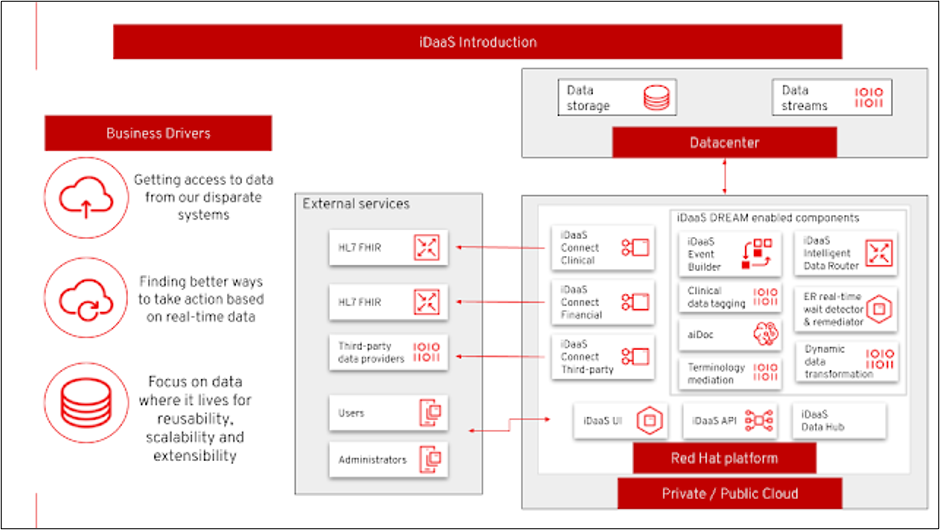
Payments architecture
An offering of (near) real-time payments lets businesses, consumers, and even governments send and accept funds that provide both availability to the recipient and instant confirmation to the sender.
[ Learn how to Modernize your IT with managed cloud services. ]
The payments architecture enables real-time (or at least faster) payments that improve the speed of online payment experiences to customers. This has the potential to give banks a greater opportunity to win, serve, and retain their customers. By building solutions that capture real-time payment business, banks can also drive higher payment volumes, ideally at lower costs, and engage new customer segments.
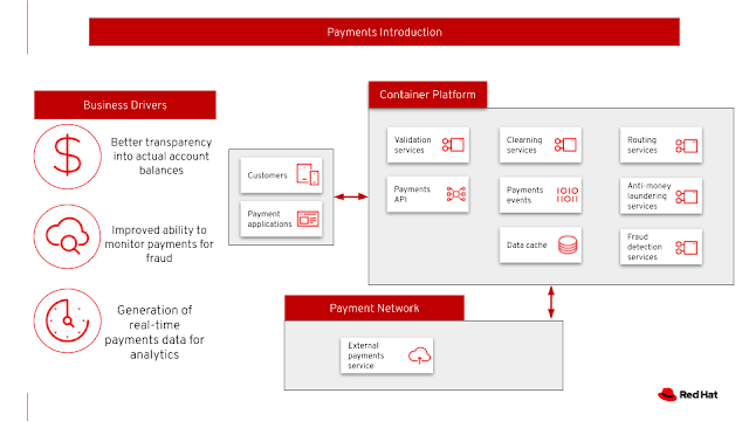
This architecture helps financial institutions enable customers with fast, easy to use, and safe payment services available anytime, anywhere.
Retail data framework architecture
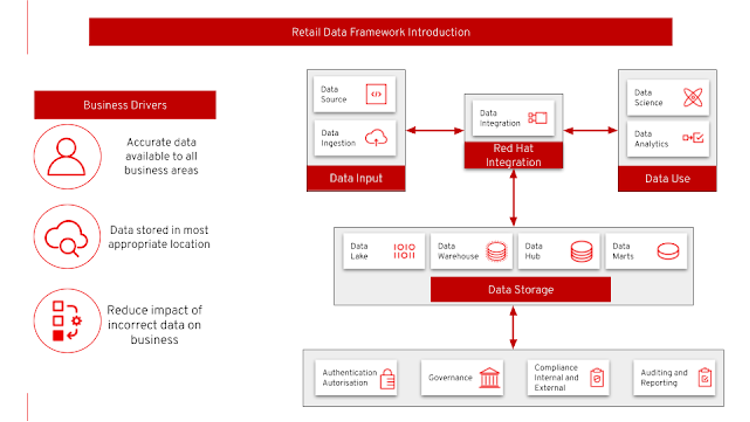
Retail is the process of selling consumer goods or services to customers through multiple distribution channels to earn a profit. A retail data framework handles managing enterprise retail data. The framework or system sets the guidelines and rules of engagement for business and management activities, especially those dealing with or resulting in data creation and manipulation.
The retail data framework architecture creates a framework for access to retail data about customers, stock, stores, and staff across multiple internal teams.
SCADA interface modernization architecture
The supervisory control and data acquisition (SCADA) interface modernization architecture targets energy providers in North America seeking compliance with North American Electric Reliability Corporation (NERC) regulations by modernizing interfaces between their business applications and their SCADA systems. This modernization also provides better information consumption that can be combined with AI/ML and decision-management tools to address customer needs more effectively.
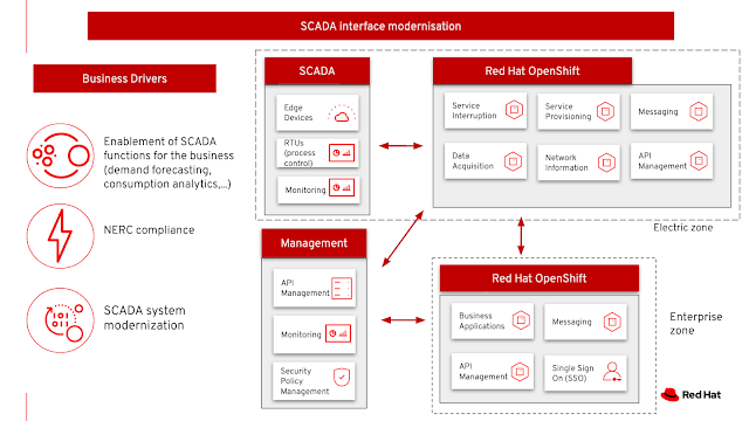
The architecture provides interfaces with SCADA systems that comply with NERC regulations, creating different layers of API gateways to protect business services based on the network zones.
[ Learn more by downloading event-driven architecture for a hybrid cloud blueprint. ]
Learn more
These are eight of the many reference architectures Red Hat's Portfolio Architects have published, and we'll continue to publish them as we complete them. If you are interested in more architecture solutions like these, feel free to explore the Red Hat Portfolio Architecture Center.
This article originally appeared on Eric D. Schabell's blog and is republished with permission.
저자 소개
유사한 검색 결과
Red Hat Ansible 올스타: 네트워크 및 인프라 자동화의 미래를 주도합니다
Ansible Automation Platform을 위한 새로운 오토메이션 오케스트레이터로 IT 워크플로우를 규모에 맞게 통합
Random Acts Of Automation | Compiler
Container Roundup | Compiler
채널별 검색

오토메이션
기술, 팀, 인프라를 위한 IT 자동화 최신 동향

인공지능
고객이 어디서나 AI 워크로드를 실행할 수 있도록 지원하는 플랫폼 업데이트

오픈 하이브리드 클라우드
하이브리드 클라우드로 더욱 유연한 미래를 구축하는 방법을 알아보세요

보안
환경과 기술 전반에 걸쳐 리스크를 감소하는 방법에 대한 최신 정보

엣지 컴퓨팅
엣지에서의 운영을 단순화하는 플랫폼 업데이트

인프라
세계적으로 인정받은 기업용 Linux 플랫폼에 대한 최신 정보

애플리케이션
복잡한 애플리케이션에 대한 솔루션 더 보기

가상화
온프레미스와 클라우드 환경에서 워크로드를 유연하게 운영하기 위한 엔터프라이즈 가상화의 미래
