

Organizations are increasingly turning to agile development models and DevOps. This approach enables development organizations to deliver more enhancements and bug fixes in a timely manner, which provides more value to their users.
While DevOps can include security earlier in the software lifecycle, this has not always been the case in practice. DevSecOps explicitly calls on organizations to pay attention to security best practices and to automate them or "shift left" as much as possible.
[ How to explain DevOps in plain English ]
DevSecOps means baking in application and infrastructure security from the start. To be successful, organizations must look upstream, where their dependencies come from, and also at how components integrate in the production environment. It also means automating security gates to keep the DevOps workflow from slowing down. As you learn from experience, you codify that into the automation process.
DevSecOps supply chain best practices
A successful DevSecOps-based supply chain must consider four areas of concern:
- Security of developer dependencies
- Security of code development
- Security of deployment of resources into a secure environment
- Software bills of materials (SBOM)
Within each of these areas, there are many best practices to apply, especially in cloud-native development using container technology:
- Scanning new development code for potential vulnerabilities
- Scanning dependent images that new code will be layered upon
- Attesting to the veracity of images using image signing
- Scanning images for known CVEs
- Scanning the environment for potential networking vulnerabilities
- Scanning for misconfigurations of images and other assets
- Ensuring consistent automated deployment of secure configuration using GitOps
- Continuous upgrading of security policies from both trusted third parties and your experience
[ Check out Red Hat's Portfolio Architecture Center for a wide variety of reference architectures you can use. ]
Multicluster DevSecOps validated pattern
Validated patterns are detailed deployments created by Red Hat for various use cases. These predefined configurations combine products from the Red Hat portfolio and technology ecosystem to help stand up architectures faster.
This pattern deploys the following Red Hat products:
- Red Hat OpenShift Container Platform (OCP), a Kubernetes platform
- Red Hat OpenShift GitOps based on ArgoCD
- Red Hat Advanced Cluster Management (ACM) based on Open Cluster Management
- Red Hat OpenShift Pipelines based on Tekton
- Red Hat Quay, an Open Container Initiative (OCI) image registry with security features enabled
- Red Hat Open Data Foundation for highly available storage
- Red Hat Advanced Cluster Security (ACS) for scanning and monitoring
Multicluster deployments
All the components in this pattern can be deployed on a single cluster. This makes for a simple demo. This pattern deploys a real-world architecture where central management, development environments, and production are all deployed on different clusters. This ensures that the pattern is structured for real-world deployments, with all the functionality needed to make such an architecture work already built in. This allows pattern consumers to concentrate on what is being delivered, rather than how it's delivered.
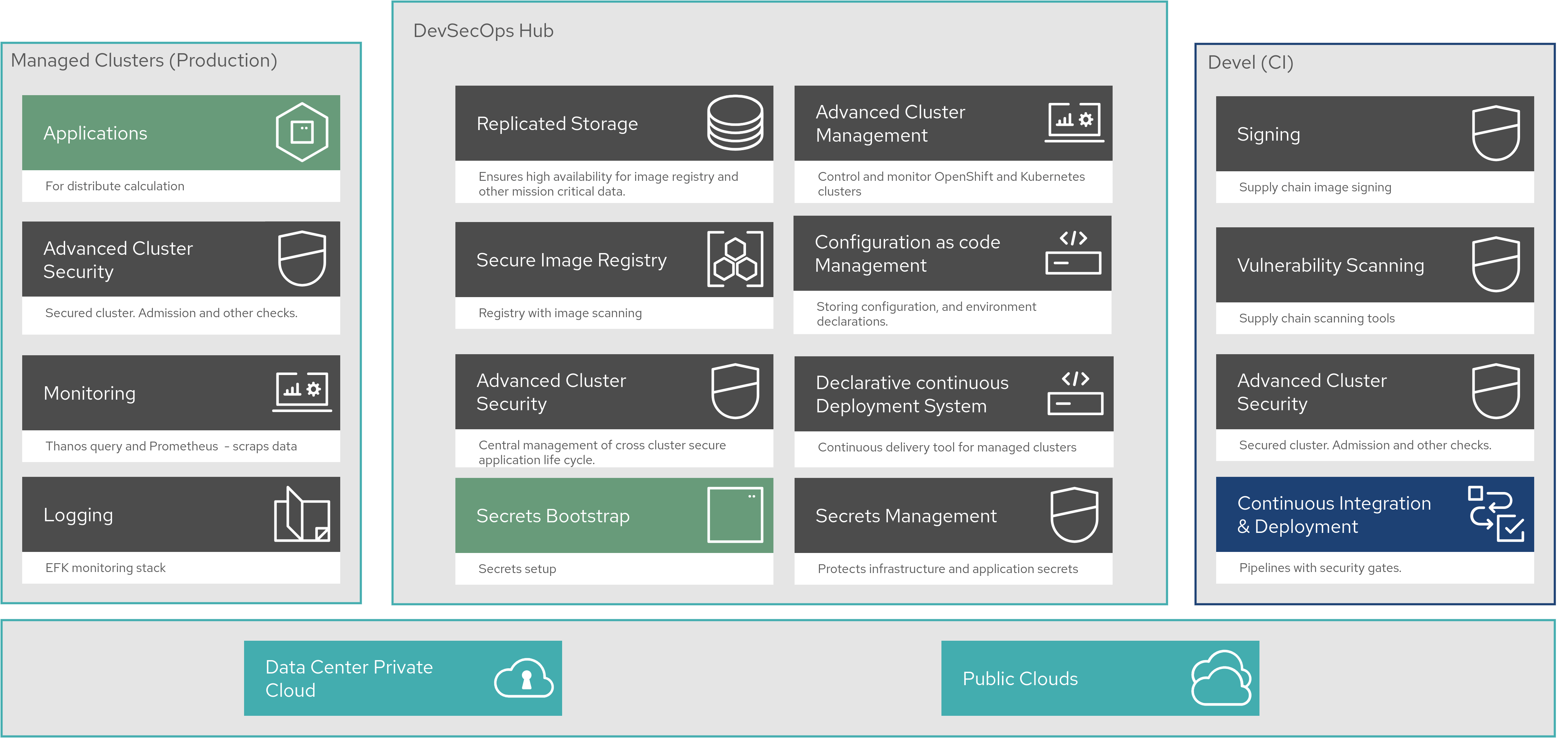
The heavy lifting in the pattern includes a great deal of integration between components, especially those spanning across clusters:
- Deployment of Quay Enterprise with OpenShift Data Foundations as a storage backend
- Deployment of a Quay Bridge operator configured to connect with Quay Enterprise on a hub cluster
- Deployment of ACS on managed nodes with integration back to ACS central on the hub
- Deployment of a secure pipeline with scanning and signing tools, including ACS
[ Kubernetes: Everything you need to know ]
DevSecOps and pipelines
In Introducing OpenShift Pipelines, Jaafar Chraibi notes that "OpenShift Pipelines makes CI/CD concepts such as a pipeline, a task, or a step natively instantiatable so it can use the scalability, security, and ease of deployment capabilities of Kubernetes." The pattern consumes many of the OpenShift Pipelines' out-of-the-box tasks but also defines new tasks for scanning and signing. It also includes them in enhanced DevSecOps pipelines.

While these pipelines are included in the pattern, the pattern also implements the use of a pipelines-as-code feature where the pipeline can be part of the application code repository. "This allows developers to ship their CI/CD pipelines within the same Git repository as their application, making it easier to keep both of them in sync in terms of release updates."
CI pipeline to support software supply chain security
This pattern includes some other technologies in the development continuous integration (CI) pipeline, including Cosign, a Sigstore project, implemented with Tekton Chains. Cosign supports container signing, verification, and storage in an OCI registry. It enables consumers to sign their pipeline resources, images, and share the attestation files. This provides downstream consumers assurances that they are consuming a trusted artifact.
This design also implements open source tools SonarQube for static code analysis, Nexus for securely storing build artifacts in-cluster, and an open source reports application to upload and present the reports from the security pipeline.
It's not a problem if you're not using these tools in your environment. The pattern framework is flexible. Organizations using different services can swap out what's in the pattern with their software of choice to fit their environment.
Next steps
This pattern provides a complete deployment solution for multicluster DevSecOps that can be used as part of a supply chain deployment pattern across different industries.
The documentation provides detailed instructions for how to install the pattern and more technical details about the different components in the pattern.
This originally appeared on Hybrid Cloud Patterns and is republished with permission.
저자 소개
William Henry is a Senior Distinguished Engineer with more than 30 years of experience building enterprise applications and distributed systems for both government and private industry. He has worked at Red Hat for over 18 years in R&D working on many of Red Hat's products. William currently works in Red Hat's Data and AI team as Technical Oversight Lead, focusing on data AI readiness and Agentic AI.
Jonny is a Special Projects Engineer with the Validated Patterns team at Red Hat, he is also the co-host of the "Ask an OpenShift Admin" livestream.
유사한 검색 결과
안정적인 코드를 재작성하지 마세요: Lightwell로 귀사의 수익과 개발자의 속도를 보호하는 방법
기업 속도의 새로운 가치 기준
Can Compliance Be A Piece Of Cake? | Compiler
Collaboration In Product Security | Compiler
채널별 검색

오토메이션
기술, 팀, 인프라를 위한 IT 자동화 최신 동향

인공지능
고객이 어디서나 AI 워크로드를 실행할 수 있도록 지원하는 플랫폼 업데이트

오픈 하이브리드 클라우드
하이브리드 클라우드로 더욱 유연한 미래를 구축하는 방법을 알아보세요

보안
환경과 기술 전반에 걸쳐 리스크를 감소하는 방법에 대한 최신 정보

엣지 컴퓨팅
엣지에서의 운영을 단순화하는 플랫폼 업데이트

인프라
세계적으로 인정받은 기업용 Linux 플랫폼에 대한 최신 정보

애플리케이션
복잡한 애플리케이션에 대한 솔루션 더 보기

가상화
온프레미스와 클라우드 환경에서 워크로드를 유연하게 운영하기 위한 엔터프라이즈 가상화의 미래
