


The escalating rise of attacks on the software supply chain means organizations must prioritize efforts to protect their entire software supply chain. An attack on an organization's software supply chain can have significant consequences on its financial situation and reputation, underscoring the importance of working to protect every component of your supply chain process. The software industry is coalescing around best practices to address supply chain attacks, including the Secure Software Development Framework (SSDF) and Supply chain Levels for Software Artifacts (SLSA). It also continues to improve tooling to address those best practices.
[ Check out Red Hat Portfolio Architecture Center for a wide variety of reference architectures you can use. ]
This article shows a practical example of using digital signatures in the software supply chain. Digital signatures provide a way to verify the integrity of a piece of software and, hopefully, its provenance. Digital signatures have been widely deployed in the software industry for decades. The difference now is organizations need to use these tools at a scale and with a deeper level of integration than they ever have.
You can better protect your supply chains and software products by digitally signing your source code, dependencies, and build process. This example leverages some of Red Hat's product portfolio and great upstream projects like sigstore to digitally sign a pipeline.
Example DevSecOps pattern
The diagram below is an example of how Red Hat customers can leverage DevSecOps in their build process by adding digital signing capabilities.

The pattern involves:
- Pushing source code into a repository: Tools like gitsign provide keyless
git commitsigning. - Running the software build process in the Red Hat OpenShift Pipeline tool: Red Hat now provides Tekton Chains, which provide the capability to sign the execution of tasks in the pipeline and its artifacts. Tekton Chains is in tech preview but should soon be generally available.
- Leveraging cosign to generate keys and use them to sign output images and artifacts: Cosign can be integrated with key management systems (KMS) and hardware tokens. Cosign can also be used with OpenID Connect (OIDC) for keyless signing.
- Storing images and signatures: Red Hat Quay registry supports the OCI Artifact standard and can store both signed output images and their signatures.
- Policy-based enforcement: Along with signed images is the need for a policy engine to enforce policies disallowing the use of non-signed images. Red Hat Advanced Cluster Security (RHACS) is a policy engine that can manage how OpenShift consumes signed images.
[ Learn more about how to automate DevSecOps in OpenShift. ]
A demo pattern
Below is an example of a completed OpenShift Pipeline reflecting the DevSecOps patterns mentioned above with a sample pet clinic application. It runs through the steps explained in the pattern with digital signing capabilities integrated.
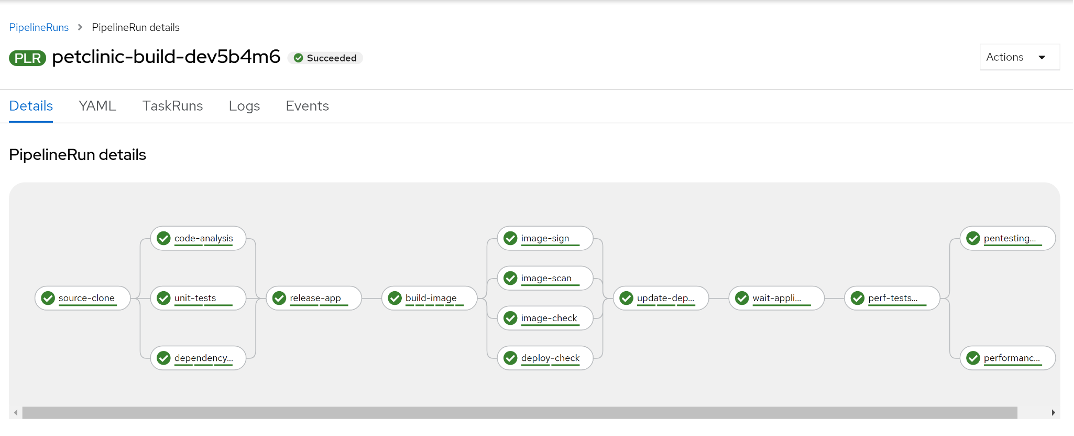
The OpenShift DevSecOps pipeline adds a step to sign the output image. You can leverage cosign to generate keys and sign the output images as part of the build pipeline. The pipeline still leverages RHACS to handle other pipeline security functions. RHACS will scan for vulnerabilities and then check for policy violations and configuration issues.
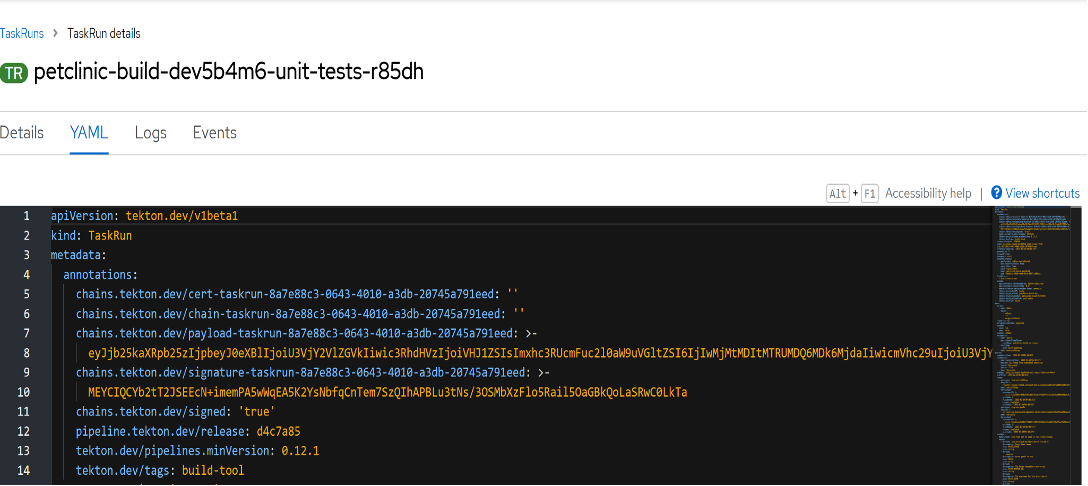
Since this demonstration leverages Tekton Chains, you can sign every execution of the tasks that make up the pipeline. This approach certifies the integrity of the build process from unexpected changes. The above is a manifest for the unit-tests task from the pipeline. Tekton Chains takes a snapshot of the task runs. It then converts the snapshot to one or more standard payload formats. For this example, Tekton Chains annotates the task with the generated payload and payload signature.
This manifest shows the generated payload under chains.tekton.dev/payload-taskrun-8a7e88c3-0643-4010-a3db-20745a791eed. The payload signature is visible under chains.tekton.dev/signature-taskrun-8a7e88c3-0643-4010-a3db-20745a791eed.
[ For more on OpenShift and Tekton, download the complimentary eBook Getting GitOps. ]
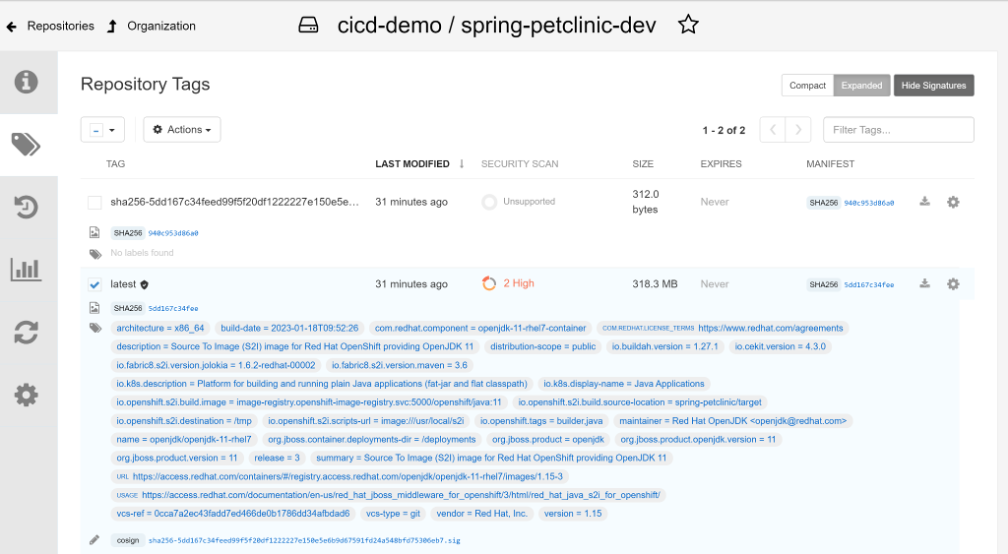
Consider what's different in the Quay registry. Notice the image tag (latest) and a signature tag (with a digest). A cosign reference on the image (at the bottom of the image) points to the signature's tag (digest) value. Quay helps streamline the process by storing the signatures in the same place as the images.
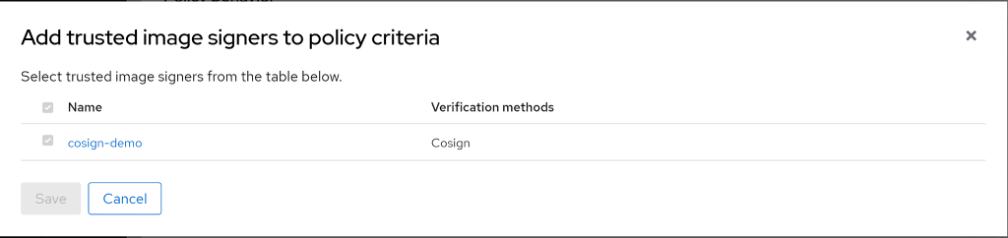
Finally, enforcement is necessary to make sure only signed images are used. Add the cosign keys into RHACS. Create policies around running signed and unsigned images in OpenShift.
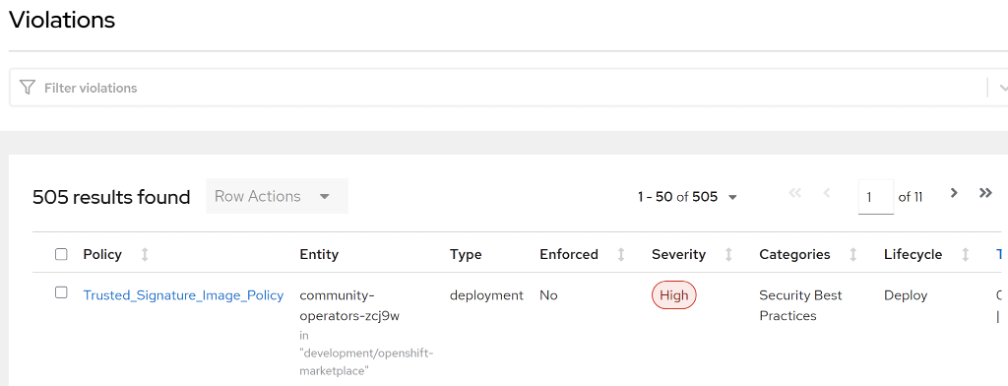
The figure above shows a violation that occurred because of a deployment that was not signed with the key.
You can find the demo code in our GitHub repository if you would like to test this process on OpenShift 4.10 clusters.
Wrap up
Best practices like SLSA are level-based as they acknowledge the difficulty in creating a secure end-to-end software supply chain. The tooling described above can help you start the journey to protecting your software supply chain.
[ Check out Automation at the edge: 7 industry use cases and examples ]
저자 소개
Moyo is a tinkerer with an interest in Cloud Technology. He has been worked in Red Hat since 2018 and is always interested in stuff to collaborate on.
Maya is a Software Engineer in Red Hat's Emerging Technologies Security team. She is passionate about Python, open source, and software supply chain security.
유사한 검색 결과
안정적인 코드를 재작성하지 마세요: Lightwell로 귀사의 수익과 개발자의 속도를 보호하는 방법
기업 속도의 새로운 가치 기준
Can Compliance Be A Piece Of Cake? | Compiler
Collaboration In Product Security | Compiler
채널별 검색

오토메이션
기술, 팀, 인프라를 위한 IT 자동화 최신 동향

인공지능
고객이 어디서나 AI 워크로드를 실행할 수 있도록 지원하는 플랫폼 업데이트

오픈 하이브리드 클라우드
하이브리드 클라우드로 더욱 유연한 미래를 구축하는 방법을 알아보세요

보안
환경과 기술 전반에 걸쳐 리스크를 감소하는 방법에 대한 최신 정보

엣지 컴퓨팅
엣지에서의 운영을 단순화하는 플랫폼 업데이트

인프라
세계적으로 인정받은 기업용 Linux 플랫폼에 대한 최신 정보

애플리케이션
복잡한 애플리케이션에 대한 솔루션 더 보기

가상화
온프레미스와 클라우드 환경에서 워크로드를 유연하게 운영하기 위한 엔터프라이즈 가상화의 미래
