
What is GitLab and the GitLab Operator?
Founded in 2011 and now with over 30 million users, GitLab is an open-source DevSecOps platform presented as a single application built to change how Development, Security, and Ops teams collaborate and build software. GitLab's core objective revolves around providing a space for every individual to contribute, firmly believing that such inclusivity fuels the pace of innovation. They emphasize remote work, open-source principles, DevSecOps methodologies, and iterative processes.
The GitLab Operator is crucial in overseeing the complete lifecycle management of GitLab instances within Kubernetes or OpenShift container platforms. Its primary objective is to simplify installing and configuring GitLab instances, ensuring a seamless transition between different versions. This development initiative aims to enhance the user experience by streamlining the installation and upgrade processes for GitLab instances.
What is an Operator?
An Operator refers to a Kubernetes native application that expands upon the controller concepts of Kubernetes resources. It incorporates specific knowledge related to an application and can be customized to oversee the complete lifecycle management of applications, including tasks such as installation and autoscaling of pods. The Operator comprises three key components: a custom resource, custom controller, and application-specific knowledge. Essentially, an Operator functions as a controller that monitors the custom resource and alters the state of the Kubernetes cluster based on the application-specific knowledge integrated into the custom resource definition. Operators are highly capable Kubernetes tools that can automate an application's comprehensive management, simplifying the operational tasks involved.
Install the GitLab Operator on OpenShift
Step 1: Prerequisites
Deploy a Custom SCC:
    allowHostDirVolumePlugin: false
    allowHostIPC: false
    allowHostNetwork: false
    allowHostPID: false
    allowHostPorts: false
    allowPrivilegeEscalation: true
    allowPrivilegedContainer: false
    allowedCapabilities: null
    apiVersion: security.openshift.io/v1
    defaultAddCapabilities:
    - NET_BIND_SERVICE
    fsGroup:
      type: MustRunAs
    groups: []
    kind: SecurityContextConstraints
    metadata:
      name: gitlab-nginx-ingress-scc
    priority: null
    readOnlyRootFilesystem: false
    requiredDropCapabilities:
    - ALL
    runAsUser:
      type: MustRunAs
      uid: 101
    seLinuxContext:
      type: MustRunAs
Deploy the IngressClass:
    apiVersion: networking.k8s.io/v1
    kind: IngressClass
    metadata:
      name: gitlab-nginx
    spec:
      controller: "k8s.io/ingress-nginx"
Deploy cert-manager via OLM into your OpenShift cluster.
Step 2: Install GitLab Operator
Install the GitLab Operator:
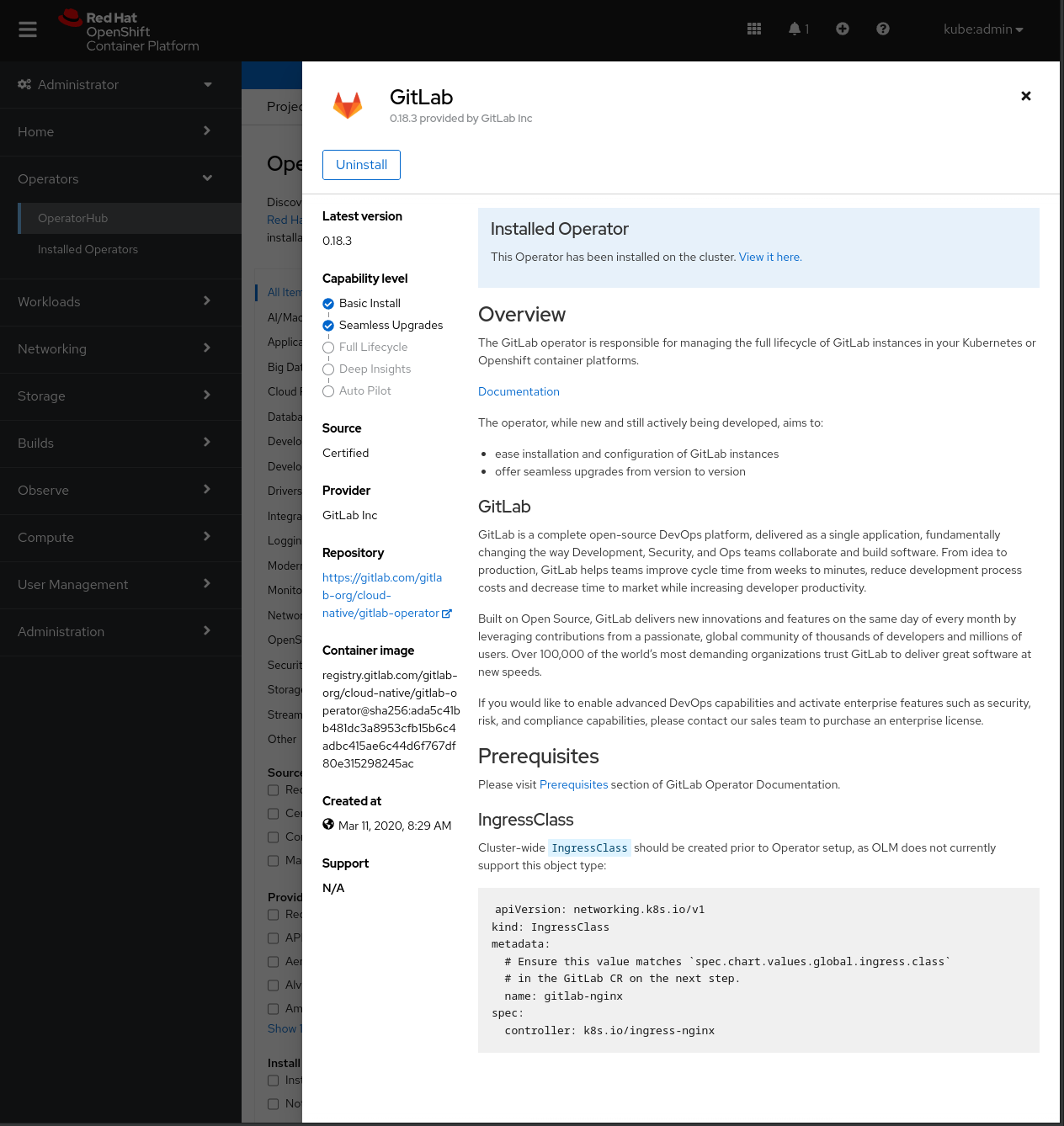

Create a GitLab instance and check that the instance is running:
    $ oc -n gitlab-system get gitlab

    NAME STATUS VERSION
    gitlab Running 6.10.3
Check that the GitLab pods are all running and healthy:
    $ oc -n gitlab-system get po


    NAME READY STATUS RESTARTS AGE
    gitlab-controller-manager-77dd5cfb98-99787 2/2 Running 0 19m
    gitlab-gitaly-0 1/1 Running 0 17m
    gitlab-gitlab-exporter-594bdf655b-l6f62 1/1 Running 0 16m
    gitlab-gitlab-shell-9fdbdcf87-2t655 1/1 Running 0 10m
    gitlab-gitlab-shell-9fdbdcf87-p5x8g 1/1 Running 0 16m
    gitlab-kas-798947c9df-7pg7h 1/1 Running 0 10m
    gitlab-kas-798947c9df-p6pxg 1/1 Running 0 16m
    gitlab-migrations-1-40b-1-sc87g 0/1 Completed 0 16m
    gitlab-minio-68796dfbf7-vc7sf 1/1 Running 0 17m
    gitlab-minio-create-buckets-1-8j2wg 0/1 Completed 0 17m
    gitlab-nginx-ingress-controller-57c7fdcf99-pqnfn 1/1 Running 0 18m
    gitlab-nginx-ingress-controller-57c7fdcf99-zgrh5 1/1 Running 0 18m
    gitlab-postgresql-0 2/2 Running 0 17m
    gitlab-redis-master-0 2/2 Running 0 17m
    gitlab-registry-556c46c55c-k4stp 1/1 Running 0 10m
    gitlab-registry-556c46c55c-xp9rh 1/1 Running 0 16m
    gitlab-shared-secrets-1-5p3-hm8p8 0/1 Completed 0 18m
    gitlab-shared-secrets-1-9ah-selfsign-cv7dg 0/1 Completed 0 17m
    gitlab-sidekiq-all-in-1-v2-774fb74b69-cvvtg 1/1 Running 0 11m
    gitlab-toolbox-57d6b56fdc-nsnzt 1/1 Running 0 16m
    gitlab-webservice-default-588bbd84f5-h7mgp 2/2 Running 0 11m
    gitlab-webservice-default-588bbd84f5-mtsfj 2/2 Running 0 10m
Step 3: Configure your GitLab instance
Check that the ingress was created:
    $ oc -n gitlab-system get ing

    NAME CLASS HOSTS ADDRESS PORTS AGE
    gitlab-kas gitlab-nginx kas.opdev.io ...us-east-1.elb.amazonaws.com 80, 443 55s
    gitlab-minio gitlab-nginx minio.opdev.io ...us-east-1.elb.amazonaws.com 80, 443 86s
    gitlab-registry gitlab-nginx registry.opdev.io ...us-east-1.elb.amazonaws.com 80, 443 55s
    gitlab-webservice-default gitlab-nginx gitlab.opdev.io ...us-east-1.elb.amazonaws.com 80, 443 54s
Update DNS to match the hostnames used in the ingress.
Browse to the domain in the ingress:

Obtain the initial root credentials to the GitLab instance:
oc -n gitlab-system get secrets gitlab-gitlab-initial-root-password -o yaml | yq e '.data.password' - | base64 -d

These instructions have been verified to work on the current GitLab-supported OpenShift cluster versions, specifically v4.9 through v4.11 at the time of writing.
Wrap up
Now that you're officially a pro at installing the GitLab Operator and configuring a GitLab instance on OpenShift, you can experiment with what this Operator offers!
GitLab is a powerful, open-source platform with an extensive community contributing code daily, transforming collaboration and software development in Development, Security, and Ops teams. The GitLab Operator is a great tool to quickly spin up and manage the lifecycle of a GitLab instance, simplifying the installation, use, and upgrading of your instances. For more information, explore their website and documentation.
저자 소개
유사한 검색 결과
신속한 패치 적용이 어려우신가요? 최후의 방어선, 제로 트러스트
Red Hat Enterprise Linux의 이미지 모드를 지금 바로 사용해야 하는 4가지 이유
Scaling with Orchestrators | Compiler
Container Roundup | Compiler
채널별 검색

오토메이션
기술, 팀, 인프라를 위한 IT 자동화 최신 동향

인공지능
고객이 어디서나 AI 워크로드를 실행할 수 있도록 지원하는 플랫폼 업데이트

오픈 하이브리드 클라우드
하이브리드 클라우드로 더욱 유연한 미래를 구축하는 방법을 알아보세요

보안
환경과 기술 전반에 걸쳐 리스크를 감소하는 방법에 대한 최신 정보

엣지 컴퓨팅
엣지에서의 운영을 단순화하는 플랫폼 업데이트

인프라
세계적으로 인정받은 기업용 Linux 플랫폼에 대한 최신 정보

애플리케이션
복잡한 애플리케이션에 대한 솔루션 더 보기

가상화
온프레미스와 클라우드 환경에서 워크로드를 유연하게 운영하기 위한 엔터프라이즈 가상화의 미래
