
This article will outline a solution for installing Red Hat OpenShift Service on AWS (ROSA) using AWS Gateway Load Balancer for frictionless access to the public Internet minus the complexities associated with traditional proxy-based solutions.
ROSA requires access to publically hosted Red Hat image registries in order to download core platform components and operators that form the basis of any installation as well as for post-installation telemetry to support cluster health monitoring. Thus solving the problem of how to efficiently and securely route egress traffic to the Internet in adherence to corporate compliance policies typically involves the introduction of a firewall device into the network communication chain.
There are several well-known approaches to solving this problem such as using NAT or Transit Gateways in conjunction with proxies that are documented in the official ROSA documentation which can be found here: docs.openshift.com/rosa/welcome/index.html
One method that is not so well-known, and which does not rely on proxies, is to leverage AWS Gateway Load Balancer as a "bump-in-the-wire" in conjunction with firewall appliances which perform packet inspection and payload manipulation in a non-intrusive manner before exiting traffic via the Interent Gateway. Eliminating the dependency on proxies reduces friction and improves security by leveraging the capabilities of stateful firewall appliances available from the AWS Marketplace.
From an architectural pattern there are two options for integrating ROSA with AWS Gateway Load Balancer (GWLB) that this article will examine. The first pattern leverages a centralised control plane with a distributed data plane and the second leverages a centralised control and data plane.
The first architectural pattern is shown in the following diagram. To aid visual simplicity not all components deployed by ROSA are shown. It is assumed that ROSA will be deployed in a customer-managed VPC with private subnets; this is a common approach for customers adopting a Landing Zone construct to organize multiple VPCs for the purpose of distributing systems.
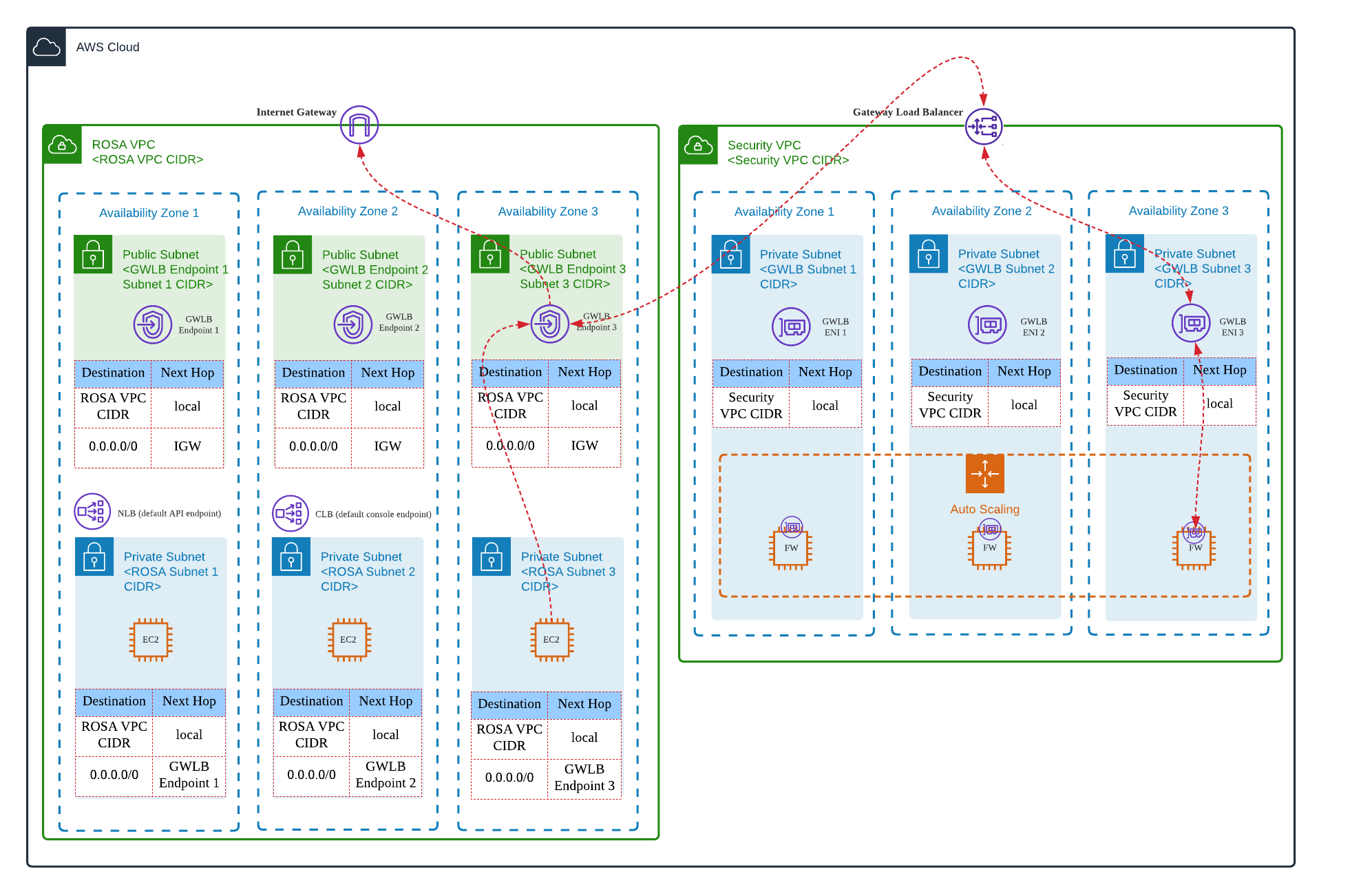
The control plane is composed of a central GWLB instance and a scaleable fleet of inline firewall appliances that allow egress traffic originating from a ROSA cluster to the following list of destinations: docs.openshift.com/rosa/rosa_getting_started/rosa-aws-prereqs.html#osd-aws-privatelink-firewall-prerequisites.
The main defining feature of this architectural pattern is that all Internet-bound traffic is hairpinned through the control plane and requires an additional public subnet in the VPC hosting the ROSA cluster prior to exiting traffic via the Internet Gateway. The advantage of this design is that supports use-cases involving bring-your-own static public IP addresses that third-party systems can allowlist for the purpose of communicating with private ROSA clusters without the need for building a site-to-site VPN.
If this is not a requirement and third-party systems support open communication then a more flexible second architectural pattern can be considered as shown in the following diagram. In this scenario traffic from ROSA and all other VPCs egress to the Internet via a shared Internet Gateway enabled by dynamic IP addresses. The advantage is that no additional public subnet or Internet Gateway needs to be configured in the VPC hosting a private ROSA cluster.

For both architectural patterns what makes the solution non-intrusive and work seamlessly is that it only requires for the default route (0.0.0.0/0) of the subnets hosting the ROSA cluster to point to the corresponding Gateway Load Balancer endpoint of the availability zone. Assuming that the adjoining Security VPC has been correctly setup (see link to firewall rules above) no additional configuration is required on the ROSA cluster (e.g., a cluster-wide proxy) to make this solution work.
Conclusion
Deploying ROSA in conjunction with GWLB enables frictionless secure access to the Internet at a compelling price-point when compared to other AWS offerings such as NAT Gateway and Transit Gateway, resulting in a lower overall TCO.
저자 소개
유사한 검색 결과
Red Hat 파트너가 최고의 통신 비즈니스 자산인 이유
에이전틱 패러독스와 하이브리드 AI의 필요성
Crack the Cloud_Open | Command Line Heroes
Edge computing covered and diced | Technically Speaking
채널별 검색

오토메이션
기술, 팀, 인프라를 위한 IT 자동화 최신 동향

인공지능
고객이 어디서나 AI 워크로드를 실행할 수 있도록 지원하는 플랫폼 업데이트

오픈 하이브리드 클라우드
하이브리드 클라우드로 더욱 유연한 미래를 구축하는 방법을 알아보세요

보안
환경과 기술 전반에 걸쳐 리스크를 감소하는 방법에 대한 최신 정보

엣지 컴퓨팅
엣지에서의 운영을 단순화하는 플랫폼 업데이트

인프라
세계적으로 인정받은 기업용 Linux 플랫폼에 대한 최신 정보

애플리케이션
복잡한 애플리케이션에 대한 솔루션 더 보기

가상화
온프레미스와 클라우드 환경에서 워크로드를 유연하게 운영하기 위한 엔터프라이즈 가상화의 미래
