
Migration Toolkit for Containers (MTC) helps migrate stateful and stateless applications between OpenShift clusters. The most common use case for MTC has been migrating workloads from OpenShift 3 clusters to newer OpenShift 4 clusters facilitating cluster upgrades. In this article we introduce State Only Migration, a kind of migration designed to migrate the application state between clusters where the application manifests are deployed using OpenShift GitOps.
State Only Migration
After Red Hat announced OpenShift GitOps earlier this year, an increasing number of OpenShift users are moving towards leveraging GitOps workflows for cluster configuration and continuous application delivery using ArgoCD and OpenShift Pipelines. As a result, we expect a significant chunk of MTC users adapting to these technologies to deploy their applications in the target clusters. The users looking to migrate their workloads will simply use OpenShift GitOps to deploy the stateless components of their applications. However, they will still be required to migrate the state of the applications from the source to the target cluster. With State Only Migration, we aim to solve this problem. They can use MTC to migrate the application state while the stateless components can be migrated by the external mechanism of their choice:
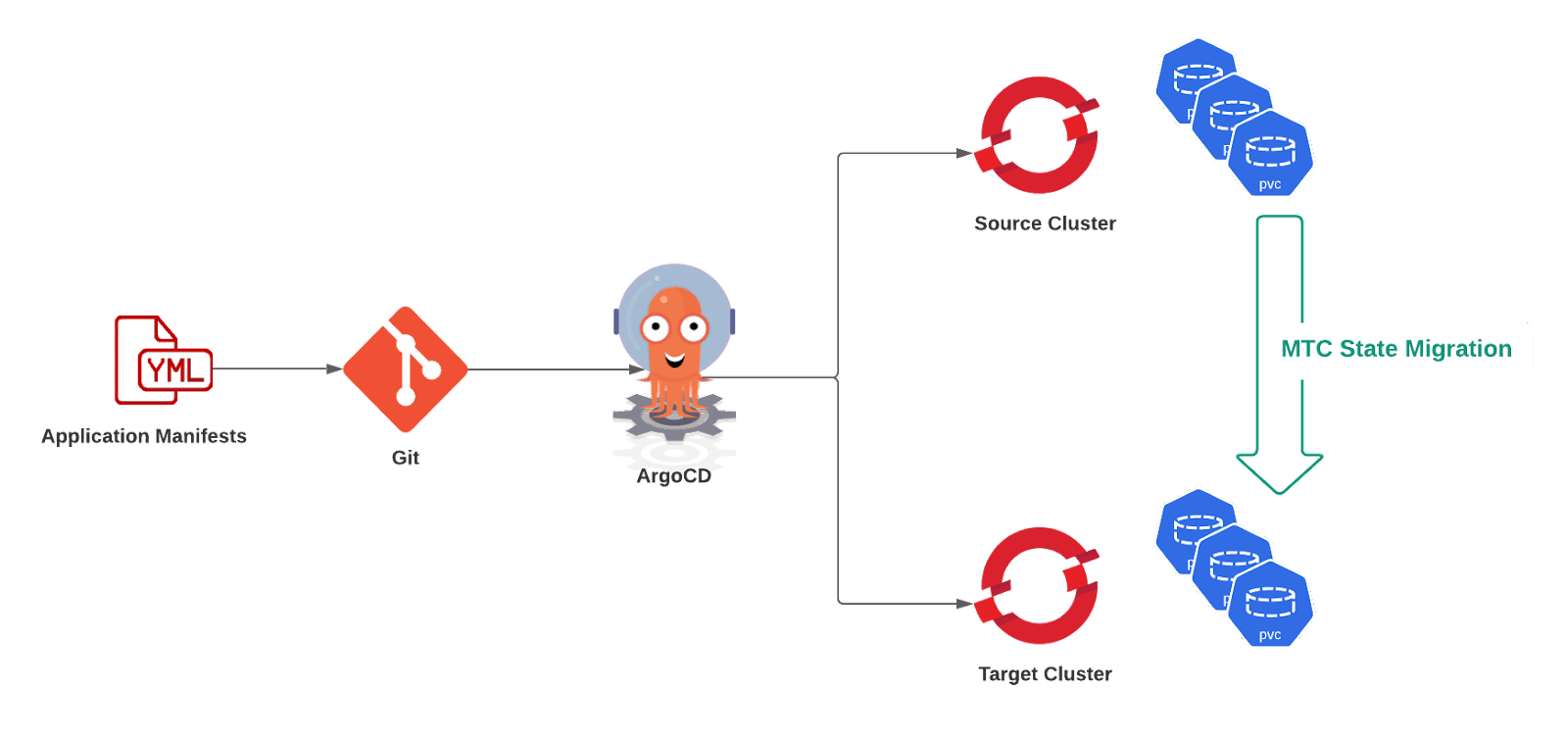
Application state
MTC provides a powerful two-step migration workflow in that Stage migration allows users to migrate PersistentVolume data, while a Final migration allows migrating Kubernetes resources along with any remaining PersistentVolume data. The Stage migration is designed to migrate application state incrementally and can be performed before a Final migration as many times as needed.
The applications running atop OpenShift typically use PersistentVolumes to persist their state. To enable state-only migration, MTC 1.6.0 develops on the idea of stage migration and introduces additional new features to address specific needs of GitOps migration use cases. One of such features is to allow migrating data to volumes that are already provisioned in the target cluster. This ensures that the applications that have their volumes pre-created in the target cluster can still be synchronized with their source cluster counterparts. This feature can also be used when the users simply wish to change the underlying storage classes of their existing PVCs. They can create new PVCs using a different storage class and migrate data to them. To migrate application state, MTC uses Rsync to synchronize data between the source and the target PVC over an OpenShift Route secured by “stunnel,” which is called Direct Volume Migration (DVM). As of MTC 1.6.0, the state migration flows are only supported through DVM.
The state transfer capabilities offered by MTC enable users to leverage newer technologies like OpenShift GitOps for their migration needs while still leaving a path for migrating the application state.
You can find more information about MTC in the OpenShift documentation under the "Migration Toolkit for Containers" section.
저자 소개
유사한 검색 결과
Red Hat 파트너가 최고의 통신 비즈니스 자산인 이유
에이전틱 패러독스와 하이브리드 AI의 필요성
Crack the Cloud_Open | Command Line Heroes
Edge computing covered and diced | Technically Speaking
채널별 검색

오토메이션
기술, 팀, 인프라를 위한 IT 자동화 최신 동향

인공지능
고객이 어디서나 AI 워크로드를 실행할 수 있도록 지원하는 플랫폼 업데이트

오픈 하이브리드 클라우드
하이브리드 클라우드로 더욱 유연한 미래를 구축하는 방법을 알아보세요

보안
환경과 기술 전반에 걸쳐 리스크를 감소하는 방법에 대한 최신 정보

엣지 컴퓨팅
엣지에서의 운영을 단순화하는 플랫폼 업데이트

인프라
세계적으로 인정받은 기업용 Linux 플랫폼에 대한 최신 정보

애플리케이션
복잡한 애플리케이션에 대한 솔루션 더 보기

가상화
온프레미스와 클라우드 환경에서 워크로드를 유연하게 운영하기 위한 엔터프라이즈 가상화의 미래
