
Virtualization isn’t going away any time soon.
Alongside the ever-growing need to modernize and move towards a more elastic, agile, and scalable cloud native infrastructure, many organizations also need to run, maintain, and in a lot of cases grow their traditional virtualization environment.
As a leader in cloud infrastructure, with Red Hat OpenStack Platform and Red Hat OpenShift, Red Hat is in a unique position to offer an integrated approach for customers to enjoy the best of both worlds. How exactly? Let's see!
Red Hat OpenStack Platform Director Operator: What is it?
Director Operator is a Kubernetes Operator-backed deployment method which leverages Kubernetes CRDs, Multus 2nd interfaces, Metal3, Red Hat OpenShift Virtualization and TripleO-Ansible to provide a hybrid deployment solution for both container native workloads and traditional VMs side by side. This deployment methodology will future-proof the workload infrastructure for container-native applications while having it host the traditional VMs with Red Hat OpenStack Platform.
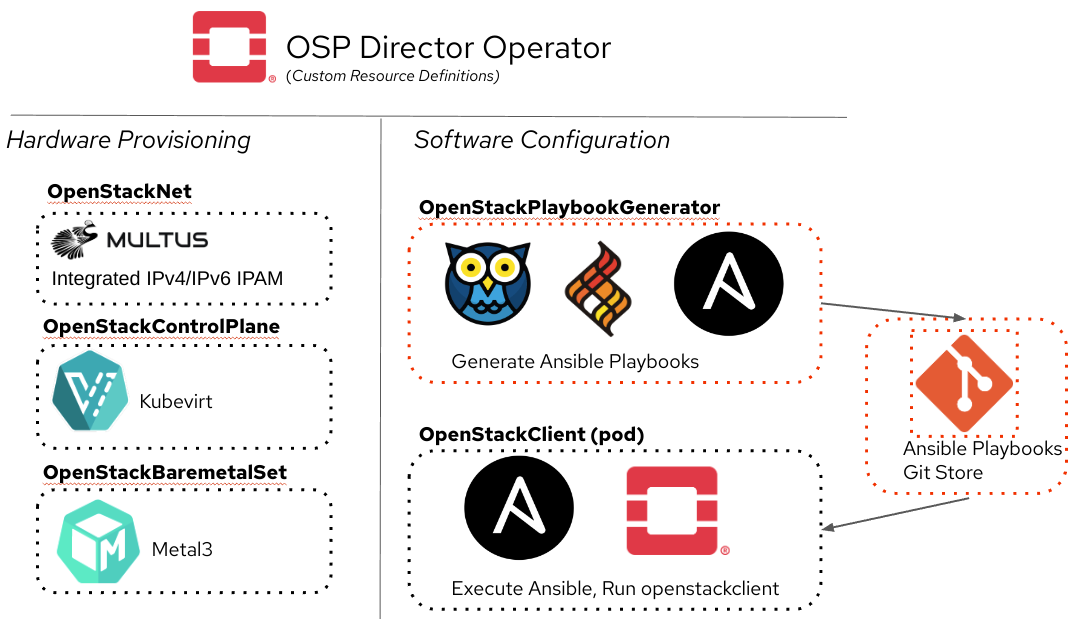
Since the Director Operator is not a net new installer but rather uses TripleO Heat, it maintains the traditional director templating structure, but with a twist! Now said templates are being consumed by a configmap called by a CRD to generate from the Ansible content that will be deployed on the target nodes.
The controller nodes are based on OpenShift Virtualization VMs and are provisioned by calling the ctlplne CRD while the compute nodes andHCI Nodes are being called by the compute provision CRD from the OpenShift Cluster Metal3 inventory. Since, this inventory is shared with the OpenShift infrastructure and the bare metal nodes in it can be repurposed to expand either the OpenStack cluster or the OpenShift cluster if needed.
The Deployment Flow steps using OpenStack Director Operator

Once the deployment finishes the environment will look like this:
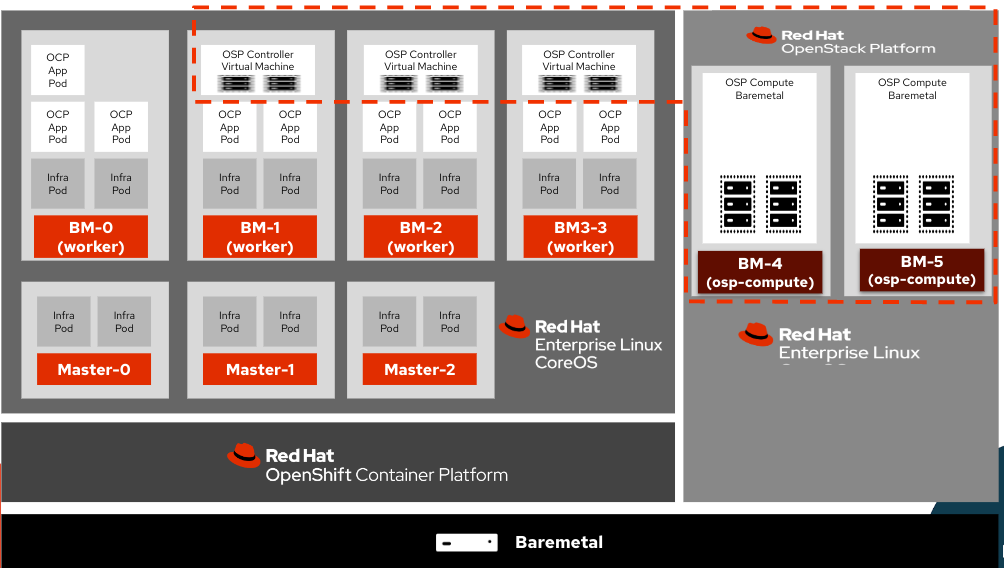
- Red Hat OpenStack Platform has a 5 year long life cycle for which our customers plan critical workloads and certifications that are tied to both an API and host operating system (RHEL).
- In most use cases, the Red Hat OpenStack Platform dataplane is being used to run critical applications which cannot tolerate multiple downtimes. Even if the host OpenShift infrastructure is being updated, the workloads will continue to run without interference.
Join us for the next blog in this series in which we will explore the set-by-step guide on how to deploy a Red Hat OpenStack Platform director operator OpenStack cloud.
저자 소개
유사한 검색 결과
Red Hat 파트너가 최고의 통신 비즈니스 자산인 이유
에이전틱 패러독스와 하이브리드 AI의 필요성
Virtualization Is (Still) King | Compiler
Crack the Cloud_Open | Command Line Heroes
채널별 검색

오토메이션
기술, 팀, 인프라를 위한 IT 자동화 최신 동향

인공지능
고객이 어디서나 AI 워크로드를 실행할 수 있도록 지원하는 플랫폼 업데이트

오픈 하이브리드 클라우드
하이브리드 클라우드로 더욱 유연한 미래를 구축하는 방법을 알아보세요

보안
환경과 기술 전반에 걸쳐 리스크를 감소하는 방법에 대한 최신 정보

엣지 컴퓨팅
엣지에서의 운영을 단순화하는 플랫폼 업데이트

인프라
세계적으로 인정받은 기업용 Linux 플랫폼에 대한 최신 정보

애플리케이션
복잡한 애플리케이션에 대한 솔루션 더 보기

가상화
온프레미스와 클라우드 환경에서 워크로드를 유연하게 운영하기 위한 엔터프라이즈 가상화의 미래
