
There are many ways to install Kubernetes and the obvious starting point is the setup section in the official documentation. But let's be honest, that's a little bit overwhelming, isn't it? This post should give you a high-level overview of what the different approaches are and which one might be the best for your situation. Note that I won't consider local/development setups here, such as Minikube or Minishift. Instead, we're talking about setting up Kubernetes for production usage.
A few questions to consider upfront:
- Is your target environment bare metal, on-premises, public cloud?
- Do you want to have fine-grained control over the install process or more of "push-button-do-it-for-me" install?
- What's your budget (both time and money)?
Really, it's a spectrum of options you're looking at and taking into account the above questions may look somewhat like the following:
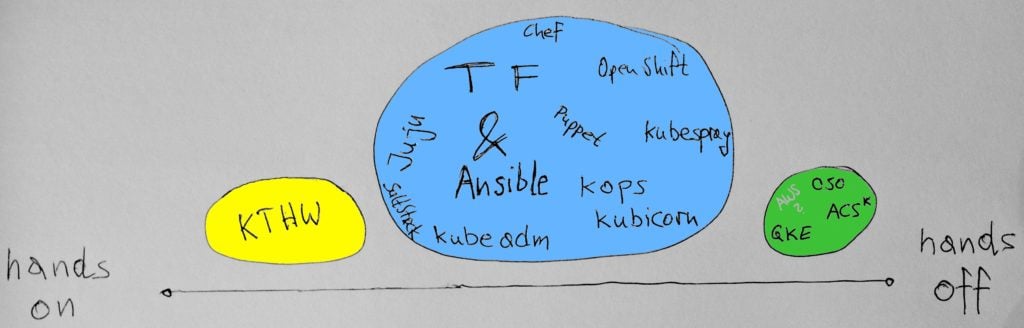
Let's now have a closer look at the different groups and examples of concrete methods and tools:
- Manual means that you manually set up everything from the networking bits over downloading, configuring and launching components such as etcd or
kube-apiserver. You've got full control over what goes where, but it might take you some time and it's error-prone. The ultimate reference in this area is Kelsey Hightower's Kubernetes The Hard Way (KTHW). - Installer are CLI tools that leverage templates and/or automation tools such as Terraform and Ansible. You typically have a lot control over what is going on, but less than in the manual approach. Examples include:
- Hosted effectively means little to no installation effort on your end. For example:
- Azure Container Service (ACS) with Kubernetes
- Google Container Engine (GKE)
- IBM Bluemix Container Service
- OpenShift Online (OSO)
To be clear, this is not a comprehensive listing of all the available options. Some offerings, such as OpenShift Dedicated, just don't fit in any of the categories. Further, the installation realm is moving so fast that whatever I write today could be obsolete tomorrow. For example, at GopherCon 2017, less than a month ago, at time of writing, kubicorn was open-sourced and I got involved in it, because it is a promising and very flexible approach. Another example, reportedly, AWS now also plans to offer its own hosted Kubernetes offering.
Who knows what install options will be available by end of year, so I'd suggest keeping your eyes peeled and your mind open.
Last but not least: In the Kubernetes SIG Cluster Lifecycle we've recently launched a task force that is looking into the adoption of kubeadm and if you're interested, you're more than welcome to chime in here as well.
저자 소개
유사한 검색 결과
Red Hat 파트너가 최고의 통신 비즈니스 자산인 이유
에이전틱 패러독스와 하이브리드 AI의 필요성
Crack the Cloud_Open | Command Line Heroes
Edge computing covered and diced | Technically Speaking
채널별 검색

오토메이션
기술, 팀, 인프라를 위한 IT 자동화 최신 동향

인공지능
고객이 어디서나 AI 워크로드를 실행할 수 있도록 지원하는 플랫폼 업데이트

오픈 하이브리드 클라우드
하이브리드 클라우드로 더욱 유연한 미래를 구축하는 방법을 알아보세요

보안
환경과 기술 전반에 걸쳐 리스크를 감소하는 방법에 대한 최신 정보

엣지 컴퓨팅
엣지에서의 운영을 단순화하는 플랫폼 업데이트

인프라
세계적으로 인정받은 기업용 Linux 플랫폼에 대한 최신 정보

애플리케이션
복잡한 애플리케이션에 대한 솔루션 더 보기

가상화
온프레미스와 클라우드 환경에서 워크로드를 유연하게 운영하기 위한 엔터프라이즈 가상화의 미래
