
Introduction
Kubernetes introduced NetworkPolicies in 1.6 and in OpenShift this feature was made GA in 3.7. Microsegmentation is the idea of protecting each host with host-specific firewall rules.
In this blog post, we will examine approaches for using NetworkPolicies to implement microsegmentation.
NetworkPolicy SDN
OpenShift installation requires you to choose the SDN implementation that is best for you. In OpenShift, available options include Subnet, Multitenant, and NetworkPolicy.
The network policy SDN features are a superset of the subnet and multitenant SDN features, making it an obvious choice for newly-built OpenShift clusters.
By default, NetworkPolicy SDN behaves like Subnet SDN, since there is no NetworkPolicy configured. If you want to recreate the multitenant SDN behavior, you need to add the following NetworkPolicy to each project:
kind: NetworkPolicy

apiVersion: extensions/v1beta1

metadata:

  name: allow-same-and-default-namespace

spec:

  ingress:

  - from:

    - podSelector: {}

  - from:

    - namespaceSelector:

        matchLabels:

          name: default
This NetworkPolicy says that pods in this namespace can accept connections from other pods in the same namespace and from the default namespace (to allow for the router connections).
You also need to label the default project as follows:
oc label namespace default name=default
The creation of this NetworkPolicy object can be automated by editing the OpenShift project template. You can do this during installation by adding the following configuration to your Ansible inventory file:
openshift_project_request_template_edits:

  - key: objects

    action: append

    value:

      kind: NetworkPolicy

      apiVersion: extensions/v1beta1

      metadata:

        name: allow-same-and-default-namespace

        ...
NetworkPolicy Implementation
In OpenShift, NetworkPolicies are implemented as OVS flow rules. NetworkPolicies flow rules are created in table 80. With this command (which you are required to run on one of the SDN nodes) you can view the flow rules corresponding to the defined NetworkPolicies:
ovs-ofctl dump-flows -O OpenFlow13 br0 | grep 80
For example, if you define a NetworkPolicy as follows:
kind: NetworkPolicy

apiVersion: extensions/v1beta1

metadata:

  name: prova

spec:

  podSelector:

    matchLabels:

      app: product-catalog

  ingress:

  - ports:

    - protocol: TCP

      port: 8080
and have a pod that is selected by this NetworkPolicy, the output will be something like this:
cookie=0x0, duration=249.002s, table=80, n_packets=0, n_bytes=0, priority=150,tcp,reg1=0x6d285,nw_dst=10.128.0.67,tp_dst=8080 actions=output:NXM_NX_REG2[]

cookie=0x0, duration=248.994s, table=80, n_packets=0, n_bytes=0, priority=100,ip,reg1=0x6d285,nw_dst=10.128.0.67 actions=drop
where 10.128.0.67 was the address of the pod.
NetworkPolicy Object Ownership
NetworkPolicy objects need to be owned by a team. Possible owners are the application development team, the OpenShift ops team, or the security team. Ultimately, the security team has the mandate to ensure that the NetworkPolicy objects are created correctly regardless of who manages them. Often times a security organization creates security policy documents that other teams in the company need to comply with. These documents will shape how NetworkPolicy objects are created.
Because of the declarative nature of the NetworkPolicies API, it is possible to create tools that work at a higher level of abstraction. With these tools, we can describe the company security policies, and in turn, the tools will derive the NetworkPolicy objects for each deployed application.
These tools will be responsible for continuously ensuring that the correct NetworkPolicy objects are defined. Kubernetes Controllers can be one way to make sure that the actual state matches the desired state. This idea of continuously monitoring the security controls is also known as ongoing security assessments.
Network Zones and Fine-Grained Firewall Rules
In traditional data centers, we usually find coarse-grained network security zones. Each network security zone is isolated from the others with carefully scrutinized and manually configured firewall rules. Traffic within a single zone normally flows freely.
A common set up is a three-tier network with a Demilitarized Zone (DMZ), an internal network, and a data network (in increasing degree of protection). It is not uncommon for large enterprises to have more than three network zones.
Because manual intervention in the firewall rule configuration is necessary, each organization has to strike a balance between security, which calls for smaller, more numerous network security zones, and the cost of maintaining those zones.
Software Defined Networks (SDNs) change this landscape. In fact, with SDN, firewall rule configurations can be easily automated, decreasing the cost of network operations. With SDNs, it is now conceivable to define per-host firewall rules. This concept is also known as microsegmentation.
NetworkPolicies represent firewall rules in the Kubernetes/OpenShift SDN and can be used to achieve microsegmentation.
Zero Trust Network
Zero Trust Network is the idea that when an organization becomes large enough the network should not be considered trusted. This introduces the need to adopt a different approach to designing security controls and building applications.
Zero Trust Networks: Building Secure Systems in Untrusted Networks explains various approaches to get to the right level of security controls needed for a Zero Trust Network. Two foundational security controls are mutual TLS (mTLS) authentication and microsegmentation. These two security controls together can get close to what is needed in a Zero Trust Network.
Zero Trust Network is a concept that is gaining popularity in the context of container-native applications that run in multitenant environments. Furthermore, container-native apps often employ a microservices architecture in which a large number of components make it more important to have automated security controls. The below picture shows mTLS and microsegmentation used together in a container-native architecture:
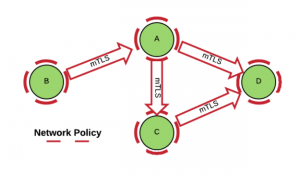
Ideally, we would want a way to automate the implementation of both the mTLS and microsegmentation security controls for the components of a container native architecture.
mTLS is notoriously difficult to automate, but now we can use Istio to easily provision client and server certificates and define authorization rules. For microsegmentation, I created a prototype of a microsegmentation controller.
Microsegmentation Controller
This controller will automatically create NetworkPolicy rules around pods controlled by a service based on a specific annotation. The NetworkPolicy allows inbound traffic only via the ports that are defined by the service. It is relatively simple logic, but it proves the idea of ongoing security assessments. In fact, the microsegmentation controller continuously checks the current state against the desired state.
To set up the controller follow these instructions.
You have probably noticed that this controller is using the meta-controller framework. This project makes it easy to build Kubernetes controllers when they fall in one of the managed patterns.
Once the microsegmentation controller and Istio are correctly installed, you can configure your pods for Zero Trust Network by annotating the services as follows:
annotations:

  auth.istio.io/8080: MUTUAL_TLS

  io.raffa.microsegmentation: 'true'
Conclusions
Declarative firewall rules, in the shape of NetworkPolicies, will help us build more secure architectures by increasing automation, without decreasing the usability of the systems. NetworkPolicies are a building block that will allow vendors to build more sophisticated security tools.
저자 소개
Raffaele is a full-stack enterprise architect with 20+ years of experience. Raffaele started his career in Italy as a Java Architect then gradually moved to Integration Architect and then Enterprise Architect. Later he moved to the United States to eventually become an OpenShift Architect for Red Hat consulting services, acquiring, in the process, knowledge of the infrastructure side of IT.
Currently Raffaele covers a consulting position of cross-portfolio application architect with a focus on OpenShift. Most of his career Raffaele worked with large financial institutions allowing him to acquire an understanding of enterprise processes and security and compliance requirements of large enterprise customers.
Raffaele has become part of the CNCF TAG Storage and contributed to the Cloud Native Disaster Recovery whitepaper.
Recently Raffaele has been focusing on how to improve the developer experience by implementing internal development platforms (IDP).
유사한 검색 결과
Red Hat 파트너가 최고의 통신 비즈니스 자산인 이유
에이전틱 패러독스와 하이브리드 AI의 필요성
Crack the Cloud_Open | Command Line Heroes
Edge computing covered and diced | Technically Speaking
채널별 검색

오토메이션
기술, 팀, 인프라를 위한 IT 자동화 최신 동향

인공지능
고객이 어디서나 AI 워크로드를 실행할 수 있도록 지원하는 플랫폼 업데이트

오픈 하이브리드 클라우드
하이브리드 클라우드로 더욱 유연한 미래를 구축하는 방법을 알아보세요

보안
환경과 기술 전반에 걸쳐 리스크를 감소하는 방법에 대한 최신 정보

엣지 컴퓨팅
엣지에서의 운영을 단순화하는 플랫폼 업데이트

인프라
세계적으로 인정받은 기업용 Linux 플랫폼에 대한 최신 정보

애플리케이션
복잡한 애플리케이션에 대한 솔루션 더 보기

가상화
온프레미스와 클라우드 환경에서 워크로드를 유연하게 운영하기 위한 엔터프라이즈 가상화의 미래
