The recent release of Red Hat OpenShift Container Platform (RHOCP) 4.4 brings even more flexibility and features to your organization’s Open Hybrid Cloud. With expanded platform support, more advanced Kubernetes features, and increased developer focus, this release certainly continues the evolution of the Kubernetes platform!
While the feature list for 4.4 is exciting and worth a thorough review, there is something else, not on that list, that we think is just as exciting and would like to share with you.
For over six months, since the release of RHOCP 4.2, we have supported deploying RHOCP 4 on-premises with Red Hat OpenStack Platform (RHOSP). With RHOCP 4.2 and 4.3, Red Hat support and consulting teams have been working closely with customers improving the integration of these two great platforms.
Today, we are excited to announce an important milestone of this effort with the release of the brand new, completely updated version of the Red Hat OpenShift Container Platform 4.4 on Red Hat OpenStack Platform 13 and 16.0 Reference Architecture!
This new reference architecture is a complete update and rewrite to the Deploying OpenShift Container Platform 3.11 on Red Hat OpenStack Platform 13 document released in the second half of 2019. If you are still using RHOCP 3.11, you need to continue to reference the RHOCP 3.11 document, because the RHOCP 3 and 4 releases and the integrations with RHOSP are significantly different. But with all the exciting features of the 4.x stream, and the support for both RHOSP 13 and RHOCP 16, we think you’ll be ready to take the next step and go for RHOCP 4!
The reference architecture aims to take a slightly different approach to how these types of documents are written. We’ve presented the material in two parts.
The first part provides an overview of the many integration solution choices available when implementing RHOCP on RHOSP. We describe them in depth and review the options when integrating these two great technologies.
Some highlights include:
- Support for RHOSP 13 and 16.0.
- Utilizes the Full Stack Automation installation method for RHOCP on RHOSP.
- Integrates RHOSP director-deployed Red Hat Ceph Storage with RHOCP providing all storage including, volumes, registry, and instance storage.
- Reviews multiple RHOSP networking backends.
- Discusses considerations for DNS, security, and critical resources management.
- Thoroughly defines and illustrates the integration points between the two platforms.
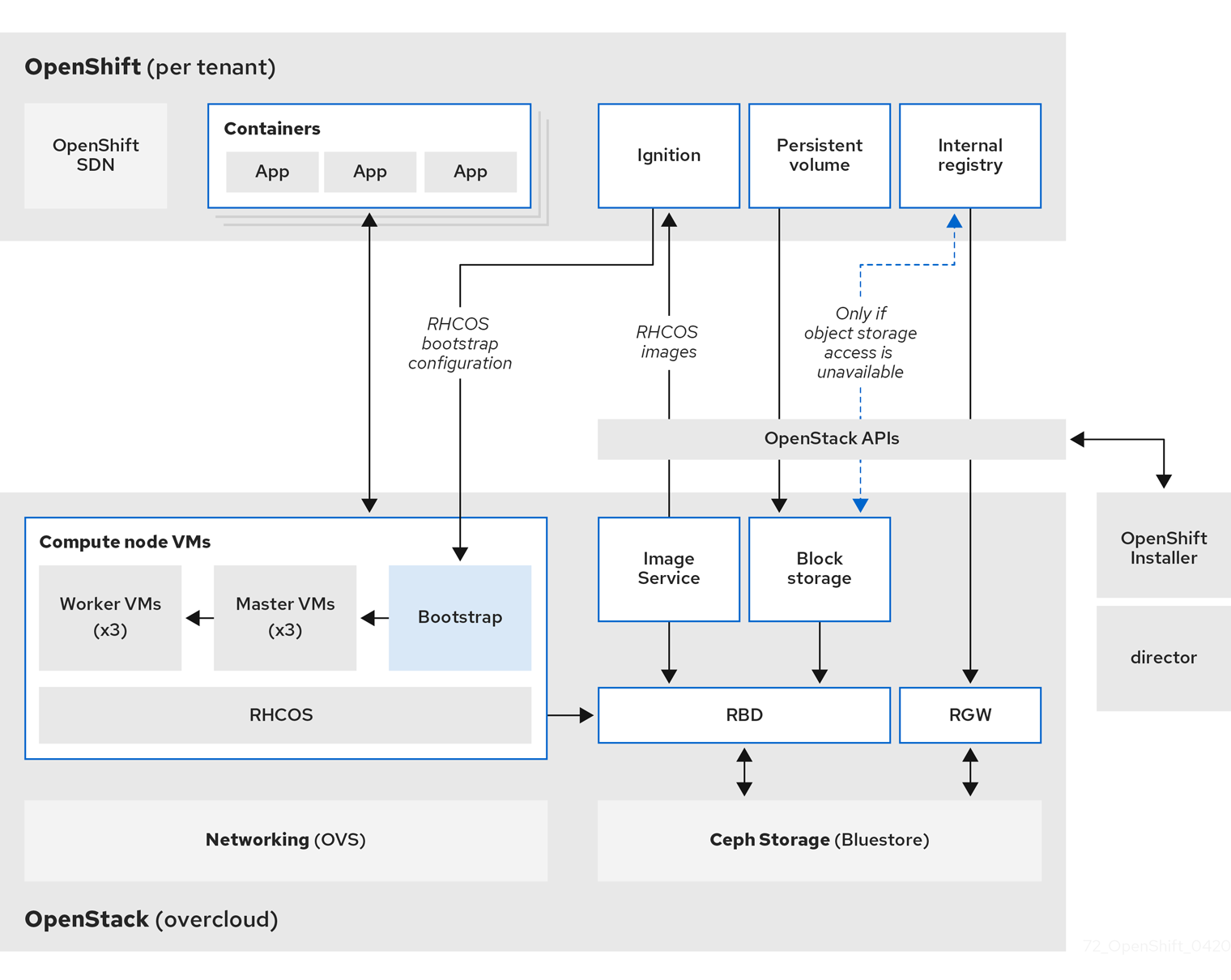
The second part provides a review of how we implemented an actual RHOCP on RHOSP deployment in the Red Hat labs. We aim to show how the integrated solution can be achieved based on our specific selections from the many solution choices reviewed in part one.
And then we go one step further.
Working closely with our global Quality Engineering teams, we tested the solution.
That’s right, we took our combined experiences, across internal teams and customers, to ensure an integrated solution that passes the same rigorous tests required of our software’s individual components.
This means that this reference architecture, when implemented with the choices we indicate from part one, is fully supported for production use in your data center, today.
Pretty cool, eh?
Now, we know that one document cannot solve every enterprise's requirements, and it’s not meant to!
However, we hope to provide you a guide as a supported starting point. We seek to provide a picture of an integration that we know works, with enough supporting material around the decision points to enable you to make informed decisions for your own organizational requirements.
We like to think of this document as the “on-premises starting point” in your Hybrid Cloud journey with some real-world implementation examples that allow you to see how components can be implemented together as an integrated and supported solution.
We encourage you to download the architecture and spend some time reviewing the entire document. Take a moment to understand the format and the choices made and to relate them to your own requirements, as it’s likely that you may need to vary from what we implemented. This does not mean you won’t be supported – reach out to your local Red Hat support teams with any questions about this; they are more than happy to help!
We hope that with this document we can provide a common talking point for you to more easily begin or continue the on-premises Hybrid Cloud conversation with your own architects, IT teams, and management members. Of course, our friendly Red Hatters are eager to help, so please reach out to find out more about this document and all our other solutions.
저자 소개

유사한 검색 결과
과거의 운영 방식에서 벗어나 IT의 미래 구축
AI의 다음 변곡점: 에이전트를 엔터프라이즈 슈퍼유저로 전환
Crack the Cloud_Open | Command Line Heroes
Edge computing covered and diced | Technically Speaking
채널별 검색

오토메이션
기술, 팀, 인프라를 위한 IT 자동화 최신 동향

인공지능
고객이 어디서나 AI 워크로드를 실행할 수 있도록 지원하는 플랫폼 업데이트

오픈 하이브리드 클라우드
하이브리드 클라우드로 더욱 유연한 미래를 구축하는 방법을 알아보세요

보안
환경과 기술 전반에 걸쳐 리스크를 감소하는 방법에 대한 최신 정보

엣지 컴퓨팅
엣지에서의 운영을 단순화하는 플랫폼 업데이트

인프라
세계적으로 인정받은 기업용 Linux 플랫폼에 대한 최신 정보

애플리케이션
복잡한 애플리케이션에 대한 솔루션 더 보기

가상화
온프레미스와 클라우드 환경에서 워크로드를 유연하게 운영하기 위한 엔터프라이즈 가상화의 미래
