
As Red Hat OpenShift clusters scale to support hundreds of microservices, the sheer volume of telemetry data can become overwhelming. Platform architects often face a difficult paradox: Maintain visibility required for security and compliance while also managing rising storage costs and "noise" associated with high-volume infrastructure logs. In this article, I explore how to leverage the ClusterLogForwarder (CLF) API and Loki filters in Red Hat OpenShift to move from a "collect everything" model to a route-by-value strategy.
Infrastructure metadata and application insight
In a standard OpenShift deployment, the ingress controller (HAProxy) and various system operators generate a continuous stream of metadata. While these logs are essential for a security operations center (SOC), they are often noise to an application developer attempting to trace a logic error.
The diagram below illustrates the common "collect all" problem, where all logs are funneled into a single storage backend, leading to increased costs and performance issues.
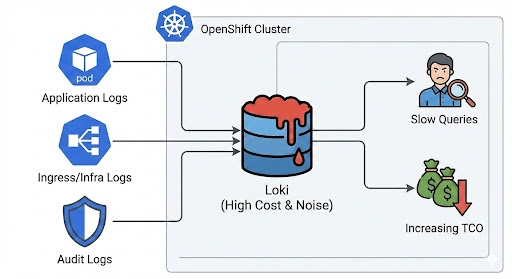
Storing high-volume, low-entropy logs (like 200 OK health checks) in high-performance storage leads to:
- Index bloat: Slower query response times due to massive cardinality
- Storage pressure: Reduced retention periods for critical application data
- Compliance risk: Difficulty in isolating sensitive audit trails
The logic of the ClusterLogForwarder
The CLF acts as a high-level abstraction over the underlying collector (Vector). It uses a declarative approach to define inputs, filters, outputs, and pipelines. The diagram below illustrates how the ClusterLogForwarder can fork a single log stream into multiple pipelines using selective filters, ensuring data reaches the correct destination without duplication.
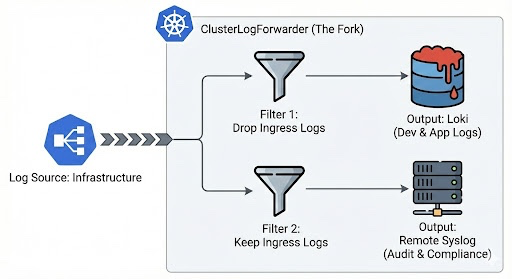
Strategic policy selection: Drop vs. keep
Before configuring your pipelines, it is crucial to understand the two primary logic gates provided by the ClusterLogForwarder API. Choosing between a drop or keep strategy depends on whether you are practicing exclusionary or inclusionary data governance.
The drop strategy (exclusionary)
The drop filter acts as a ban list. It allows all logs to pass through by default unless they match the specific criteria you define.
- "I want to see everything except the noise."
- Best for: Developer-facing pipelines (Loki). It helps ensure that as new applications are deployed to the cluster, their logs are collected automatically without manual configuration updates.
- Risk profile: Low. You are unlikely to miss important data, but you risk storage growth if a new, noisy application is deployed.
The keep strategy (inclusionary)
The keep filter acts as an allow list. It immediately discards all incoming logs unless they match your specific criteria.
- "Discard everything except the gold."
- Best for: Compliance and security pipelines (SIEM/audit). It helps to ensure that only strictly regulated data reaches sensitive backends, preventing log leakage of personally identifiable information (PII) from other namespaces.
- Risk profile: High. If a new audit source is added to the cluster, it's dropped by default until you explicitly update the filter.
Defining advanced selective filters
To take advantage of these methods, you must have:
- Red Hat OpenShift 4.16+ for advanced CLF filter support
- Red Hat OpenShift logging operator installed in the
openshift-loggingnamespace - A functional LokiStack or external Syslog/S3 destination
Filters are applied during the processing phase of the collector. We use the test array to match metadata fields. For Ingress logs, we specifically target the openshift-ingress namespace.
spec:
  filters:
    - name: exclude-ingress-from-loki
      type: drop
      drop:
        - test:
            - field: .kubernetes.namespace_name
              matches: openshift-ingress
    - name: isolate-audit-traffic
      type: keep
      keep:
        - test:
            - field: .log_type
              matches: audit
Multi-backend pipeline orchestration
The pipeline is where the routing occurs. By referencing different filterRefs, we can ensure that a single log source (like infrastructure) is processed differently depending on its destination.
pipelines:
    - name: developer-loki-stream
      inputRefs:
        - application
        - infrastructure
      outputRefs:
        - default-loki
      filterRefs:
        - exclude-ingress-from-loki
    - name: security-compliance-stream
      inputRefs:
          - audit
          - infrastructure
      outputRefs:
          - remote-syslog
      filterRefs:
          - isolate-audit-traffic
Use case 1: Compliance-driven audit isolation
Problem: Audit logs (API server, OAuth, and so on) must be kept for 3 years, but application logs only for 7 days.
Solution: Split the stream. Audit logs are forked into low-cost S3 buckets.
Use case 2: Silencing system noise
Problem: Namespaces likeopenshift-monitoring generate logs that developers don't need.
Solution: Use the regex-based drop filter matches:openshift-monitoring|openshift-operators
Use case 3: Incident response "debug" throttling
Problem: A DEBUGlog storm during an incident can crash the logging backend.
Solution: Filter by severity:
name: filter-debug
  type: drop
  drop:
    - test:
        - field: .level
          matches: debug|DEBUG
Validation: Monitoring the data flow
After applying your configuration, verify the health of your pipelines. A Valid status indicates that the collector has successfully re-generated its internal Vector configuration.
oc get clusterlogforwarder instance -n openshift-logging -o yaml
To see the fork in action, compare the ingestion rates in Loki to the received logs in your Syslog server. You should see a marked decrease in Loki cardinality.
Strategic business outcomes
There are several potential benefits to this methodology.
- Cost control: Tiered storage reduces the cost per GB by offloading infra logs to cheaper sinks
- Risk mitigation: Ensures PII or sensitive audit data is isolated and encrypted
- Developer velocity: Faster queries (less data to scan) allow SREs to identify root causes faster
Data sovereignty in the hybrid cloud
Implementing a selective log routing strategy enables a tiered logging architecture that is both cost-effective and compliant. This final diagram illustrates the strategic "After" state, where different log types are routed to the most appropriate storage tier across a hybrid cloud environment.
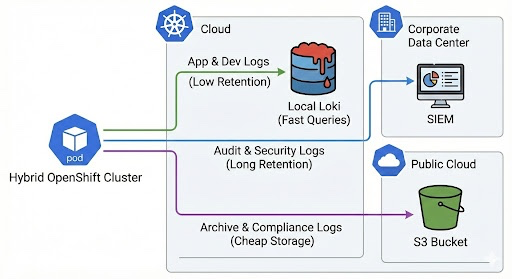
Architecture is the art of making intentional choices. By choosing where your logs land, you are managing the resilience and economics of your entire platform. Selective forwarding ensures that your logging infrastructure remains a tool for insight, rather than a burden of noise.
제품 체험판
Red Hat OpenShift Container Platform | 제품 체험판
저자 소개
Viral Gohel is a Senior Technical Account Manager at Red Hat. Specializing in Red Hat OpenShift, middleware, and application performance, he focuses on OpenShift optimization. With over 14 years at Red Hat, Viral has extensive experience in enhancing application performance and ensuring optimal OpenShift functionality.
유사한 검색 결과
Red Hat OpenShift 4.21: 더 스마트해진 확장, 더 빠른 마이그레이션 및 AI 기반 효율성
AWS용 Red Hat Enterprise Linux를 최대한 활용하기
채널별 검색

오토메이션
기술, 팀, 인프라를 위한 IT 자동화 최신 동향

인공지능
고객이 어디서나 AI 워크로드를 실행할 수 있도록 지원하는 플랫폼 업데이트

오픈 하이브리드 클라우드
하이브리드 클라우드로 더욱 유연한 미래를 구축하는 방법을 알아보세요

보안
환경과 기술 전반에 걸쳐 리스크를 감소하는 방법에 대한 최신 정보

엣지 컴퓨팅
엣지에서의 운영을 단순화하는 플랫폼 업데이트

인프라
세계적으로 인정받은 기업용 Linux 플랫폼에 대한 최신 정보

애플리케이션
복잡한 애플리케이션에 대한 솔루션 더 보기

가상화
온프레미스와 클라우드 환경에서 워크로드를 유연하게 운영하기 위한 엔터프라이즈 가상화의 미래
