
Having a grasp of common architectural patterns is essential to designing software architecture at scale. Using them saves not only time but also ensures a reliable implementation of your design. There’s no need to reinvent the wheel when there’s an architectural pattern available that applies to an architecture you’re developing.
The following is a brief overview of the Event Sourcing architectural pattern.
Understanding the Event Sourcing pattern
The Event Sourcing pattern involves sending a continuous stream of messages to an authoritative storage target. Each message describes an event in the system. Examples include: A write to the database, request to a web server, or logging activity from within an application. Services and applications then query the event store for interesting events in a way that is particular to the purpose of the given service or application.
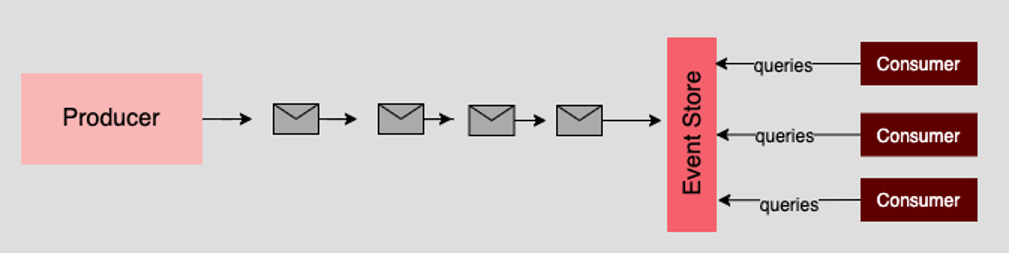
Pros
- Great for fail-safety. If the downstream source fails, its data can be reconstituted from the event store.
- Extremely flexible. Any type of message can be stored. Any consumer can access the event store as long as appropriate access rights are granted.
- Excellent for real-time data reporting, especially when used with an event-driven message broker such as Kafka.
Cons
- Requires an extremely efficient network infrastructure given the inherent time sensitivity of the pattern and the susceptibility to potential latency issues.
- Requires a reliable way to control message formats, for example, using a schema registry.
- Different events will contain different payloads. There needs to be a single source of truth for defining and determining message formats for a particular event.
Putting it all together
Event Sourcing is gaining popularity as more applications need real-time data delivered in an asynchronous yet ordered manner, for example, ride-share applications. Also, Event Sourcing is gaining wide acceptance as a way to consume and manage applications’ log data at web-scale. As mentioned above, an event source can serve as a common point of truth for applications regardless of how the given application intends to process the data.
저자 소개
Bob Reselman is a nationally known software developer, system architect, industry analyst, and technical writer/journalist. Over a career that spans 30 years, Bob has worked for companies such as Gateway, Cap Gemini, The Los Angeles Weekly, Edmunds.com and the Academy of Recording Arts and Sciences, to name a few. He has held roles with significant responsibility, including but not limited to, Platform Architect (Consumer) at Gateway, Principal Consultant with Cap Gemini and CTO at the international trade finance company, ItFex.
유사한 검색 결과
귀사의 Lightwell 전략에 단순한 패치 그 이상이 필요한 5가지 이유
선순환으로 이어지는 멘토링: 신입 인재에게 돌아오는 멘토십의 가치
Container Roundup | Compiler
Untangling Networks | Compiler
채널별 검색

오토메이션
기술, 팀, 인프라를 위한 IT 자동화 최신 동향

인공지능
고객이 어디서나 AI 워크로드를 실행할 수 있도록 지원하는 플랫폼 업데이트

오픈 하이브리드 클라우드
하이브리드 클라우드로 더욱 유연한 미래를 구축하는 방법을 알아보세요

보안
환경과 기술 전반에 걸쳐 리스크를 감소하는 방법에 대한 최신 정보

엣지 컴퓨팅
엣지에서의 운영을 단순화하는 플랫폼 업데이트

인프라
세계적으로 인정받은 기업용 Linux 플랫폼에 대한 최신 정보

애플리케이션
복잡한 애플리케이션에 대한 솔루션 더 보기

가상화
온프레미스와 클라우드 환경에서 워크로드를 유연하게 운영하기 위한 엔터프라이즈 가상화의 미래
