

In Red Hat OpenShift we have always tried to provide a great observability experience out of the box through first class open source projects like Prometheus, Vector, Jaeger, Grafana Tempo and others. We have now added support for OpenTelemetry to the platform which enables customers to use the OpenTelemetry collector, auto-instrumentation injection and OpenTelemetry protocol (OTLP).
Supporting the OTLP protocol is very important for system interoperability. Most of the software-as-a-service (SaaS) observability vendors support OTLP as an ingestion protocol. Another facet of OpenTelemetry is decoupling data collection from storage. This architecture helps avoid vendor lock-in, and provides unified cross-signal capabilities for data collection, processing and forwarding to the observability backend.
In this article we explore how the OpenTelemetry protocol can be used on OpenShift to ingest in-cluster data (workloads instrumented with OpenTelemetry) and how telemetry data can be exported from OpenShift via OTLP.
In-cluster OTLP ingestion
On OpenShift, the installation of the Red Hat build of OpenTelemetry operator allows you to ingest OTLP traces, metrics and logs. From the collector, the data can be sent to the in-cluster telemetry storage (Tempo for traces and Prometheus for metrics) or any external system that supports OTLP ingestion (see the next section for more details).
Observability needs are constantly evolving and unified configuration decreases maintenance burden and provides a stronger security posture. Placing an OpenTelemetry collector in front of the telemetry backend clearly separates data collection from storage. This architecture enables users to apply unified filtering and routing configuration for all signals, and to easily maintain and change the configuration over time. The routing enables users to better manage cost and decide which data is stored in cheaper in-cluster storage or exported to SaaS vendors.

Configuration
The following OpenTelemetry collector configuration enables:
- the OTLP receiver for ingesting OTLP messages over gRPC or HTTP
- the OTLP exporter for sending traces to Tempo
- the Prometheus exporter for exporting metrics to the user-workload monitoring stack
apiVersion: opentelemetry.io/v1alpha1
kind: OpenTelemetryCollector
metadata:
  name: otel
  namespace: observability
spec:
  mode: deployment
  observability:
    metrics:
      enableMetrics: true
  config: |
    receivers:
      otlp:
        protocols:
          grpc:
          http:
    exporters:
      otlp/tempo:
       endpoint: "tempo-simplest-distributor:4317"
       tls:
          insecure: true
      prometheus:
        endpoint: 0.0.0.0:8889
        resource_to_telemetry_conversion:
          enabled: true # by default resource attributes are dropped
    service:
      pipelines:
        traces:
          receivers: [otlp]
          exporters: [otlp/tempo]
        metrics:
          receivers: [otlp]
          exporters: [prometheus]
Traces
Traces can be forwarded to an in-cluster Tempo instance via OTLP protocol.
Metrics
Metrics from the collector can be sent to the OpenShift user-workload monitoring stack via the Prometheus exporter by scraping the collector. The alternative will be to use the Cluster Observability Operator and push the metrics in via Prometheus experimental OTLP HTTP API. However this feature is not supported at the time of writing this article.
The collector CR spec.observability.metrics.enableMetrics instructs the operator to create a service monitor for scraping the collector’s Prometheus exporter.
Logs
At the moment Loki does not support ingesting logs via OTLP, but the upstream OpenTelemetry collector contrib contains Loki push exporter (RFE for adding LokiExporter to Red Hat collector distribution 3.2). OpenShift users can use the community build of the OpenTelemetry collector contrib repository to use the Loki exporter.
The Loki exporter is not included in the Red Hat build of OpenTelemetry (as of version 3.1).
Out-cluster OTLP export
Exporting all telemetry signals is only partially supported. The metrics and logging stacks on OpenShift do not support OTLP sinks, but workaround solutions are available.
Configuration
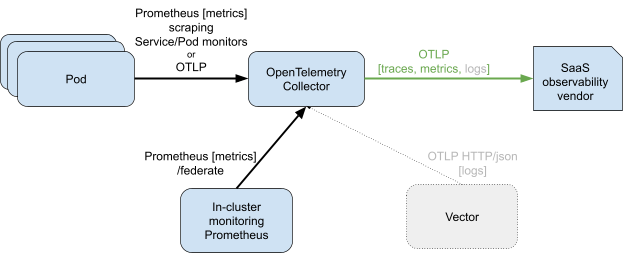
The following configuration deploys an OpenTelemetry collector as a StatefulSet which enables OTLP receiver, Prometheus receiver and Target Allocator (TA). The TA can scrape Prometheus metrics from workloads configured with Service and Pod monitors. The Prometheus receiver scrapes the federate endpoint of the in-cluster monitoring stack. Before applying the config, create the role-based access control (RBAC) needed by the collector’s Prometheus target allocator.
# Give collectors RBAC to access metrics
apiVersion: rbac.authorization.k8s.io/v1
kind: ClusterRoleBinding
metadata:
  name: otel-collector
roleRef:
  apiGroup: rbac.authorization.k8s.io
  kind: ClusterRole
  name: cluster-monitoring-view
subjects:
  - kind: ServiceAccount
    name: otel-collector
    namespace: observability
---
# TLS for prometheus receiver
kind: ConfigMap
apiVersion: v1
metadata:
  name: cabundle
  annotations:
    service.beta.openshift.io/inject-cabundle: "true"
---
apiVersion: opentelemetry.io/v1alpha1
kind: OpenTelemetryCollector
metadata:
  name: otel
  namespace: observability
spec:
  mode: statefulset
  targetAllocator:
    enabled: true
    prometheusCR:
      enabled: true
      serviceMonitorSelector:
        app: frontend
  volumeMounts:
    - name: cabundle-volume
      mountPath: /etc/pki/ca-trust/source/service-ca
      readOnly: true
  volumes:
    - name: cabundle-volume
      configMap:
        name: cabundle
  config: |
    exporters:
      otlp:
       endpoint: https://observability-vendor.com:4317
    prometheus:
        endpoint: 0.0.0.0:8989
        metric_expiration: 10m
    receivers:
      otlp:
        protocols:
          grpc:
          http:
      prometheus:
        config:
          scrape_configs:
            - job_name: 'federate'
              scrape_interval: 15s
              scheme: https
              tls_config:
                ca_file: /etc/pki/ca-trust/source/service-ca/service-ca.crt
              bearer_token_file: /var/run/secrets/kubernetes.io/serviceaccount/token
              honor_labels: false
              params:
                'match[]':
                  - ‘{__name__="cluster:usage:containers:sum"}’
                  - ‘{__name__=~"cluster:cpu_usage_cores:sum|cluster:memory_usage_bytes:sum"}’
                  - ‘{__name__=~"workload:cpu_usage_cores:sum|workload:memory_usage_bytes:sum"}’
                  - ‘{__name__="namespace_memory:kube_pod_container_resource_limits:sum|namespace_memory:kube_pod_container_resource_requests:sum|namespace_cpu:kube_pod_container_resource_limits:sum|namespace_cpu:kube_pod_container_resource_requests:sum|"}’
              metrics_path: '/federate'
          	   metric_relabel_configs:
              - action: labeldrop
                regex: ‘(prometheus_replica|prometheus)’
              static_configs:
                - targets:
                  - "prometheus-k8s.openshift-monitoring.svc.cluster.local:9091"
    service:
      telemetry:
        metrics:
          address: ":8888"
      pipelines:
        traces:
          receivers: [otlp]
          exporters: [otlp]
        metrics:
          receivers: [otlp, prometheus]
          exporters: [otlp, prometheus]
The collector also enables Prometheus exporter which can be locally port-forwarded to see the scraped metrics:
 # HELP cluster_cpu_usage_cores_sum
# TYPE cluster_cpu_usage_cores_sum gauge
cluster_cpu_usage_cores_sum{instance="prometheus-k8s.openshift-monitoring.svc.cluster.local:9091",job="federate"} 2.692632467806617
# HELP cluster_memory_usage_bytes_sum
# TYPE cluster_memory_usage_bytes_sum gauge
cluster_memory_usage_bytes_sum{instance="prometheus-k8s.openshift-monitoring.svc.cluster.local:9091",job="federate"} 1.2121485312e+10
# HELP cluster_usage_containers_sum
# TYPE cluster_usage_containers_sum gauge
cluster_usage_containers_sum{instance="prometheus-k8s.openshift-monitoring.svc.cluster.local:9091",job="federate"} 506
# HELP scrape_duration_seconds Duration of the scrape
# TYPE scrape_duration_seconds gauge
scrape_duration_seconds{instance="prometheus-k8s.openshift-monitoring.svc.cluster.local:9091",job="federate"} 0.002200895
# HELP scrape_samples_post_metric_relabeling The number of samples remaining after metric relabeling was applied
# TYPE scrape_samples_post_metric_relabeling gauge
scrape_samples_post_metric_relabeling{instance="prometheus-k8s.openshift-monitoring.svc.cluster.local:9091",job="federate"} 5
# HELP scrape_samples_scraped The number of samples the target exposed
# TYPE scrape_samples_scraped gauge
scrape_samples_scraped{instance="prometheus-k8s.openshift-monitoring.svc.cluster.local:9091",job="federate"} 5
# HELP scrape_series_added The approximate number of new series in this scrape
# TYPE scrape_series_added gauge
scrape_series_added{instance="prometheus-k8s.openshift-monitoring.svc.cluster.local:9091",job="federate"} 5
# HELP target_info Target metadata
# TYPE target_info gauge
target_info{http_scheme="https",instance="prometheus-k8s.openshift-monitoring.svc.cluster.local:9091",job="federate",net_host_name="prometheus-k8s.openshift-monitoring.svc.cluster.local",net_host_port="9091"} 1
# HELP up The scraping was successful
# TYPE up gauge
up{instance="prometheus-k8s.openshift-monitoring.svc.cluster.local:9091",job="federate"} 1
# HELP workload_cpu_usage_cores_sum
# TYPE workload_cpu_usage_cores_sum gauge
workload_cpu_usage_cores_sum{instance="prometheus-k8s.openshift-monitoring.svc.cluster.local:9091",job="federate"} 0.005644136111111113
# HELP workload_memory_usage_bytes_sum
# TYPE workload_memory_usage_bytes_sum gauge
workload_memory_usage_bytes_sum{instance="prometheus-k8s.openshift-monitoring.svc.cluster.local:9091",job="federate"} 9.8480128e+07
Metrics
The metrics from the in-cluster monitoring stack are scraped from the Prometheus federate endpoint.
The federation is a good fit to export aggregated metrics (see OpenShift docs for federation limitations) to your vendor of choice while keeping fine-grained metrics at the local cluster level (and avoid huge costs from your vendor). Our configuration scrapes platform and workload CPU and memory metrics.
To overcome the federation limitations for the user-workload metrics the Target Allocator from the OpenTelemetry operator can be used to directly scrape Prometheus metrics.
Logs
At the moment OpenShift logging (Vector) does not have capability to export logs in the OTLP format (missing OTLP sink in Vector) that could be consumed by the collector. However, an alternative solution is possible by deploying OpenTelemetry collector as a DaemonSet with FileLog receiver. The receiver scrapes pod log from /var/log/pods/* directory (see example config).
Conclusion
In this article we have covered two use-cases. The first is collecting in-cluster OTLP traces, metrics and logs and exporting all telemetry signals via OTLP from the cluster. We have described a solution for the first use-case for traces and metrics, but, at the moment, there is still an issue with sending logs to the log store (Loki). Future release of Red Hat build of OpenTelemetry will provide Loki exporter until OTLP ingestion is available in Loki.
The second use-case (exporting OTLP) is well supported for all signals, but there is a limitation for exporting all metrics from the in-cluster monitoring stack. The Red Hat build of OpenTelemetry allows users to export logs via OTLP when using the appropriate receivers, such as FileLog receiver. As of today, this cannot be achieved with Vector, since the OTLP sink is not yet implemented.
Configuration manifest files can be found here.
Discover more about our Observability components and upcoming developments.
We value your feedback, which is crucial for enhancing our products. Share your questions and recommendations with us using the Red Hat OpenShift feedback form. You can also express your interest in the RFEs shared in this article.
References
저자 소개
Pavol Loffay is a principal software engineer at Red Hat working on open-source observability technology for modern cloud-native applications. He contributes to and maintains the Cloud Native Computing Foundation (CNCF) projects OpenTelemetry and Jaeger. In his free time, Pavol likes to hike, climb, and ski steep slopes in the Swiss Alps.
유사한 검색 결과
귀사의 애플리케이션 플랫폼은 미래에 대비되어 있나요?
전문성을 검증하는 새로운 기준: Red Hat 자격증 주요 업데이트
Heroes in a Bash Shell | Command Line Heroes
The CTO And The Vision | Compiler: Re:Role
자세히 알아보기
초보자를 위한 하이브리드 클라우드 전략영어 (English) 버전으로 제공됩니다 (한국어 미지원) 2023년 Gartner® Magic Quadrant™ 컨테이너 관리 부문 리더로 선정된 Red Hat영어 (English) 버전으로 제공됩니다 (한국어 미지원) - Red Hat OpenShift 체험
채널별 검색

오토메이션
기술, 팀, 인프라를 위한 IT 자동화 최신 동향

인공지능
고객이 어디서나 AI 워크로드를 실행할 수 있도록 지원하는 플랫폼 업데이트

오픈 하이브리드 클라우드
하이브리드 클라우드로 더욱 유연한 미래를 구축하는 방법을 알아보세요

보안
환경과 기술 전반에 걸쳐 리스크를 감소하는 방법에 대한 최신 정보

엣지 컴퓨팅
엣지에서의 운영을 단순화하는 플랫폼 업데이트

인프라
세계적으로 인정받은 기업용 Linux 플랫폼에 대한 최신 정보

애플리케이션
복잡한 애플리케이션에 대한 솔루션 더 보기

가상화
온프레미스와 클라우드 환경에서 워크로드를 유연하게 운영하기 위한 엔터프라이즈 가상화의 미래
