
The software-defined industrial control system is a huge opportunity for open source technologies. Moving away from bespoke specialized hardware (like PLC devices) to standard hardware with software only is a trend that crosses industries, extending now into the industrial and manufacturing world. This type of shift for industrial organizations is similar to telcos moving to network function virtualisation (NFV) and open radio access networks (ORAN).
Successfully implementing this trend, however, requires low latency capabilities. The controller has to respond quickly to an external event, such as a robot hitting a wall and stopping it before it actually makes contact. Please note that I avoid the term "real time", which requires specialized Real Time Operating Systems (RTOS). Instead, the best term to use is "predictable latency."
One of Red Hat’s answers to this burgeoning industrial trend is Red Hat Enterprise Linux (RHEL) for Real Time, which serves as the base for the Red Hat OpenShift Performance Addon Operator (PAO). While this was developed for the telco space, it’s very suitable for reuse for operational technologies and industrial control systems.
Together with Intel, we presented Digital Transformation at the Edge with Red Hat and Intel Edge Controls for Industrial, the result of a combined testing and evaluation effort between our two companies.
Let's take a look at the data:
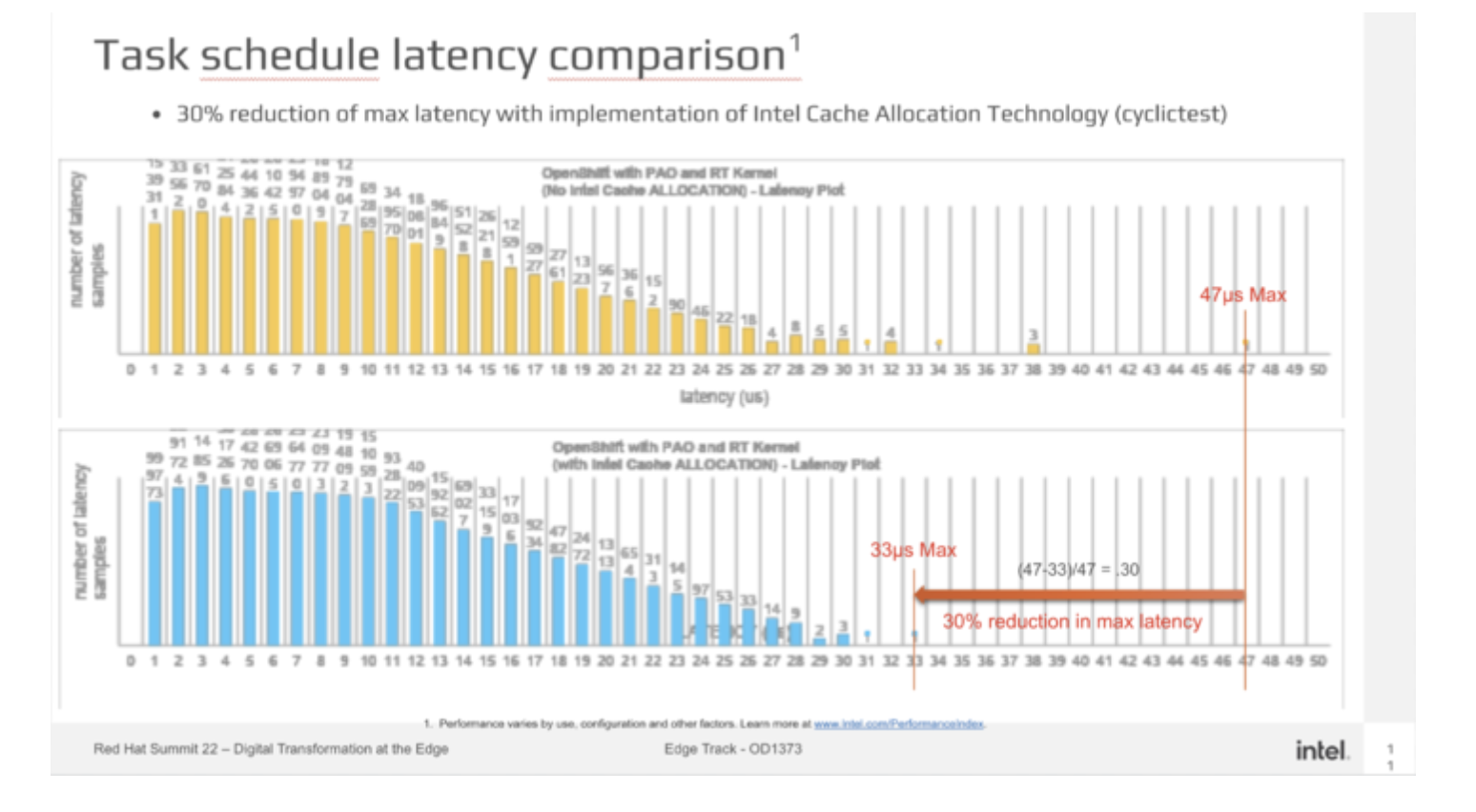 This test is done using Red Hat OpenShift on bare metal with the Performance Add-On Operator and the RHEL Real-Time kernel (RT-Kernel). Max latency (the time from event to response) is around 47 µsec to 33 µsec. This is more or less out of the box on standard hardware, with next to no special tuning besides activating Intel Cache Allocation Technology. This is already good enough for many industrial control system applications with PLC cycle times in the ~10 msec range, leaving enough headroom for the actual program execution.
But it gets even better:
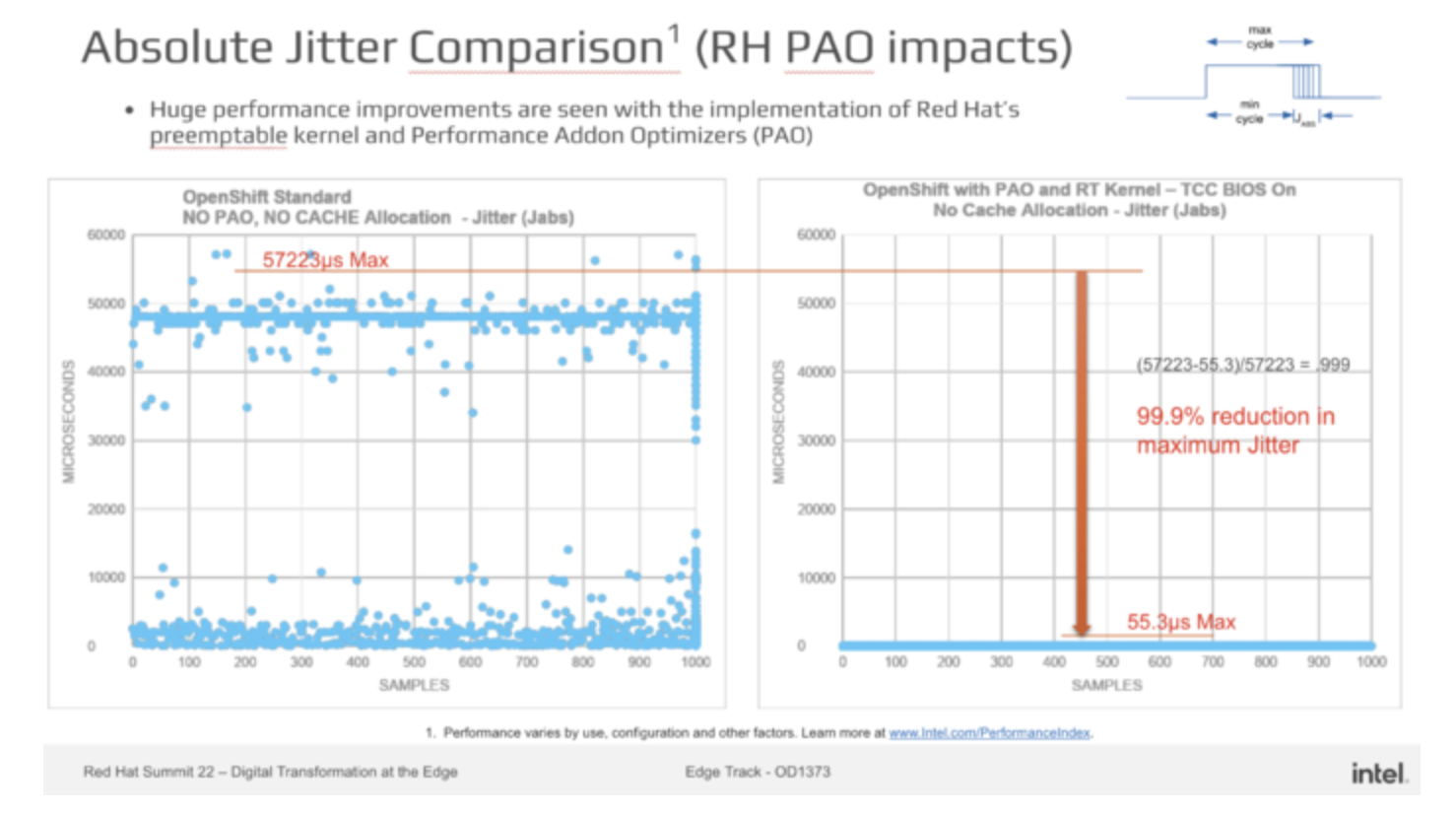 This chart shows the value of the OpenShift Performance Add-On Operator and the RHEL RT-Kernel it deploys. Note that we switched from latency (how quickly does the system respond) to jitter (how consistently does the system respond, which is actually more important). You can see on a default system (standard kernel), it is around 57 msec — not acceptable for most control applications.
But just by turning on the OpenShift Performance Add On Operator, with no additional tuning, this drops down to 55 µsec. That's an improvement of three orders of magnitude.
Let's take a look at what's possible when we add Intel capabilities to the equation:
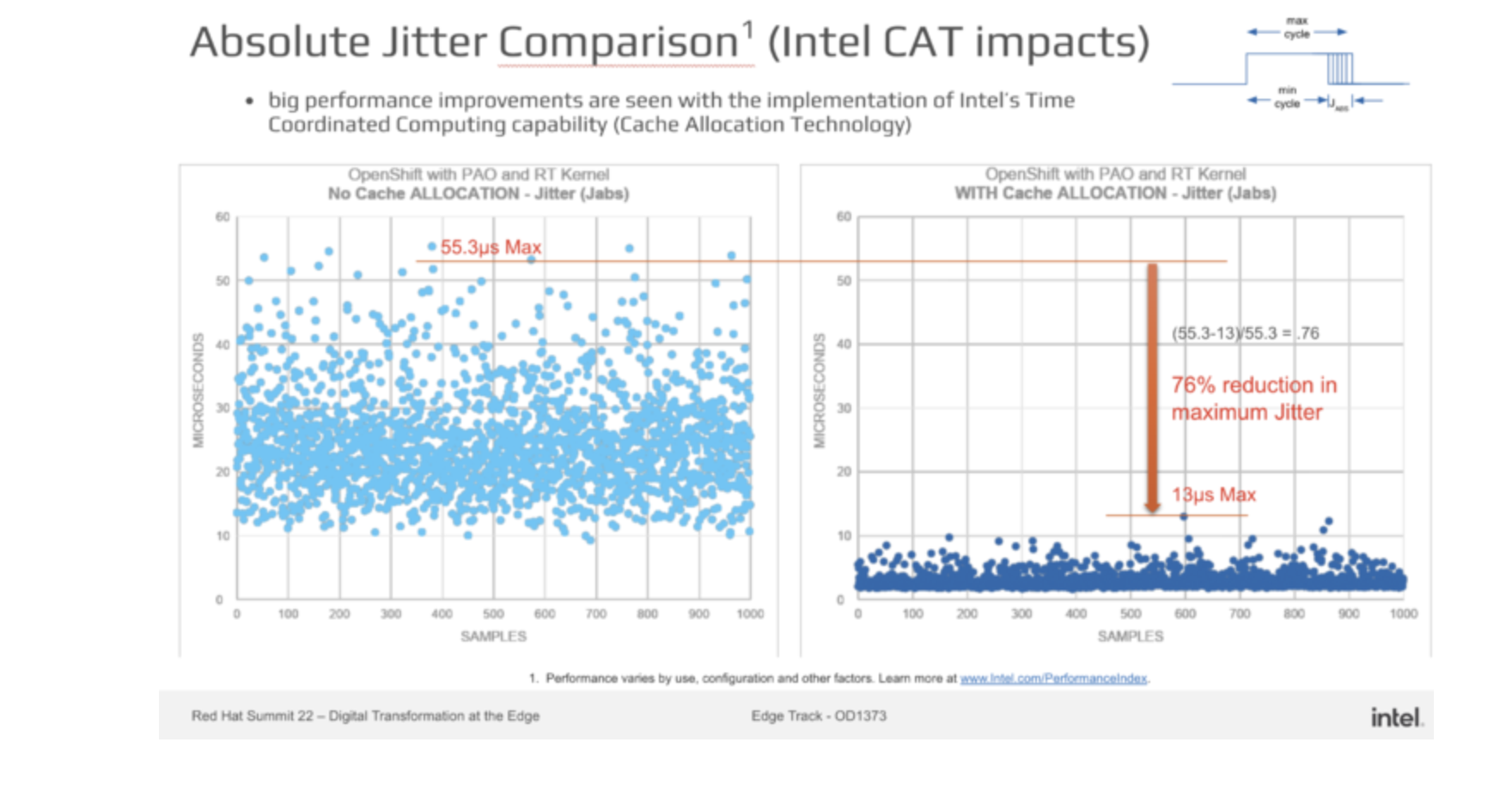 The reason for the left hand side wide deviations is CPU cache misses. If the code/data is not in the cache, it takes quite some time to fetch it from memory. First and second level caches can be disturbed by other workloads or processes running on the same core. Intel Cache Allocation Technology avoids this by dedicating parts of the CPU cache to a process.
Looking at the new numbers, the old minimum turns into the new maximum, with a 76% reduction in max jitter.
Conclusion
The numbers show that low latency workload like industrial control systems can run on modern standard hardware in containerized environments. No need for special purpose devices, no need for long lasting heavy fine tuning. The out of the box performance characteristics are good enough for most use cases.
저자 소개
Daniel works as a Principal Product Manager at Red Hat. He is responsible for defining and managing the Red Hat OpenShift edge related projects including: MicroShift, Red Hat Device Edge and Single Node OpenShift products. Daniel is a catalyst that brings together the necessary resources (people, technology, methods) to make projects and products a success. Daniel has more than 25 years of experience in IT. In the past years, Daniel has focused on hybrid cloud and container technologies in the Industrial space.
유사한 검색 결과
Red Hat Device Edge, 이제 NVIDIA Jetson Orin에서 사용 가능
격차 해소: 데이터 소스에 AI와 쿠버네티스 도입
Infrastructure At The Edge | Compiler
Compute confidential: In hardware we trust | Technically Speaking
채널별 검색

오토메이션
기술, 팀, 인프라를 위한 IT 자동화 최신 동향

인공지능
고객이 어디서나 AI 워크로드를 실행할 수 있도록 지원하는 플랫폼 업데이트

오픈 하이브리드 클라우드
하이브리드 클라우드로 더욱 유연한 미래를 구축하는 방법을 알아보세요

보안
환경과 기술 전반에 걸쳐 리스크를 감소하는 방법에 대한 최신 정보

엣지 컴퓨팅
엣지에서의 운영을 단순화하는 플랫폼 업데이트

인프라
세계적으로 인정받은 기업용 Linux 플랫폼에 대한 최신 정보

애플리케이션
복잡한 애플리케이션에 대한 솔루션 더 보기

가상화
온프레미스와 클라우드 환경에서 워크로드를 유연하게 운영하기 위한 엔터프라이즈 가상화의 미래
