As communications service providers (CSPs) embrace the shift to 5G, they’re not just adopting faster speeds, they are entering a new world of cloud-native, microservices-driven networks. But for all its promise, 5G brings challenges, especially when it comes to interoperability and lifecycle management of the 5G control plane.
Complexities of a cloud-native and multivendor network
Unlike traditional monolithic networks of the past, 5G networks rely on microservices-based, cloud-native network functions (CNFs) that must work reliably across different vendors’ platforms, orchestration layers, and cloud infrastructures. This introduces different complexity in integration, testing, and compliance adherence with standards like 3GPP, particularly for service-based interfaces (SBIs) in the control plane.
Vendor-specific implementations can also create hidden dependencies, making automated scaling, fault management, and upgrades in a multivendor environment difficult. Additionally, ensuring end-to-end visibility, consistent security policies, and performance across a disaggregated ecosystem requires advanced observability, orchestration, and governance frameworks. Not surprising, these are areas where the industry is still maturing.
Red Hat and Oracle support CSPs in accelerating their cloud-native evolution by combining global experience and proven deployment practices.
“The shift to a 5G core demands a common cloud-native foundation to unlock agility and true multivendor flexibility. Our collaboration with Oracle delivers a pre-integrated, common telco cloud platform that helps CSPs streamline their deployments, accelerate time to market, and achieve operational efficiency in this new era," said Honoré LaBourdette, Vice President, Global Telco Ecosystem Success team, Red Hat.
Why integration matters
To help support a successful deployment, the platform requires initial setup and optimization, including establishing a reliable cluster environment, integrating essential add-ons, and applying advanced tuning to deliver predictable performance. Worker nodes will be specifically configured to maximize efficiency and provide consistent, high-quality service.
These application packages need to be securely stored in a private repository for protection and streamlined management. Using automated deployment tools, new applications can be onboarded, minimizing manual effort and supporting rapid scaling to meet business needs.
The platform’s networking setup should be designed for managing efficient control operations, with flexible options to separate traffic streams and help provide reliable, secure service delivery. Integration, automation, and observability are critical for smoothly connecting 5G core network functions with the underlying infrastructure since it paves the way for agile scaling as business needs evolve.
Red Hat and Oracle collaborate to deliver a fully cloud-native solution that enhances lifecycle management and deployment efficiency for CSPs. Red Hat OpenShift serves as the common, cloud-native telecommunications (telco) platform, optimized to run Oracle 5G Core, supporting automated onboarding, scaling, and upgrades through standardized continuous integration/continuous delivery (CI/CD) pipelines. The joint solution brings together proven deployment experience and global best practices to provide consistent, reliable operations across multivendor environments.
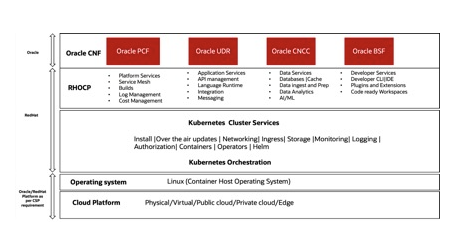
This integration helps reduce deployment complexity, shortens time to market, and supports CSPs in achieving faster, more efficient service delivery.
The power of pre-integration experience
By building on this foundation of pre-integration knowledge, CSPs can bridge the gap between application and platform teams. Integrating the Oracle 5G Control Plane CNF with Red Hat OpenShift means CSPs can achieve better performance, automation, scalability, observability, and cost efficiency out-of-the-box, while enabling multivendor flexibility and preparing for future 5G/6G evolutions.
“Oracle Communications enables CSPs to accelerate the deployment of secure, reliable 5G networks to offer choice of deployment on public clouds such as Oracle Cloud Infrastructure as well as on-premise,” said Sally Graves, Vice President, Product Development, Oracle Communications. “Running Oracle 5G Core on Red Hat provides CSPs with agile, automated network function lifecycle management, improving operational efficiency and unlocking new, 5G-enabled revenue streams."
Pre-integration experience is highly valuable when deploying Oracle 5G Core on Red Hat OpenShift, as it shortens the learning curve for the deployment team and helps accelerate delivery as many potential integration challenges are already addressed.
Whether you’re looking to roll out new services at scale or help provide operational excellence, tapping into Red Hat’s global deployment experience and Oracle’s 5G Core expertise is key to unlocking the full potential of your 5G journey with less effort.
For more information, visit Red Hat and Oracle.
제품 체험판
Red Hat OpenShift Container Platform | 제품 체험판
저자 소개

Mark Longwell is the Director, Telco and Edge Alliances in the Hybrid Platforms Business unit, with a focus on Telco partners. Mark joined Red Hat in 2016. At Red Hat, Mark focuses on leveraging his extensive Linux partnering experience to work with Red Hat's Global Telco and Edge partners on various go-to-market activities, CNF and VNF Certifications on Red Hat technologies, and technical and sales enablement activities. In his spare time, Mark likes to hike and follow Liverpool Football Club. Mark lives in Boston, MA.
Specialty areas: CNF/VNF Certification, Telco Partnering and Onboarding, global alliances, RAN, ORAN and 5G Core in the Telco market space, and all things alliances and business development related in the Telco space.
유사한 검색 결과
귀사의 애플리케이션 플랫폼은 미래에 대비되어 있나요?
전문성을 검증하는 새로운 기준: Red Hat 자격증 주요 업데이트
Heroes in a Bash Shell | Command Line Heroes
Rolling with the Punches | Compiler: Tales From The Database
채널별 검색

오토메이션
기술, 팀, 인프라를 위한 IT 자동화 최신 동향

인공지능
고객이 어디서나 AI 워크로드를 실행할 수 있도록 지원하는 플랫폼 업데이트

오픈 하이브리드 클라우드
하이브리드 클라우드로 더욱 유연한 미래를 구축하는 방법을 알아보세요

보안
환경과 기술 전반에 걸쳐 리스크를 감소하는 방법에 대한 최신 정보

엣지 컴퓨팅
엣지에서의 운영을 단순화하는 플랫폼 업데이트

인프라
세계적으로 인정받은 기업용 Linux 플랫폼에 대한 최신 정보

애플리케이션
복잡한 애플리케이션에 대한 솔루션 더 보기

가상화
온프레미스와 클라우드 환경에서 워크로드를 유연하게 운영하기 위한 엔터프라이즈 가상화의 미래
