
Not all traffic has the same priority, and when there is contention for bandwidth, there should be a mechanism for network appliances outside the OpenShift Container Platform (OCP) cluster to prioritize the traffic. To enable this, we will use Quality of Service (QoS) Differentiated Services Code Point (DSCP), which allows us to classify packets by setting a 6-bit field in the IP header, effectively marking the priority of a given packet relative to other packets as "Critical," "High Priority," "Best Effort," and so on.
Marking packets with DSCP as they head out allows a router to distinguish between them and determine, for example, which require higher bandwidth or higher priority and handle their requirements properly.
Starting from OCP 4.11 (enabled by default to all customers), a new Developer Preview OVN-Kubernetes Container Network Interface (CNI) feature is introduced: EgressQoS, which enables a cluster administrator to mark pods egress traffic with a valid QoS DSCP value. The markings will be consumed and acted on by network appliances outside the OCP cluster to optimize traffic flow throughout their networks.
Configuring the router to handle DSCP markings is outside the scope of this post. Instead, we'll focus on how we can apply different markings to traffic coming from pods heading to an external destination using EgressQoS.
A simple user story example: As a cluster administrator, I pre-configured my router to handle the different DSCP values (using colors for demonstration, in reality they are decimals from 0-63) of incoming traffic, by giving “green” traffic full priority, “yellow” traffic low priority, and “red” best effort. I want egress traffic coming from different applications (pods) on a given namespace (namespace1) to be marked with different DSCP “colors” so my router can handle them properly and allow their requirements to be fulfilled.
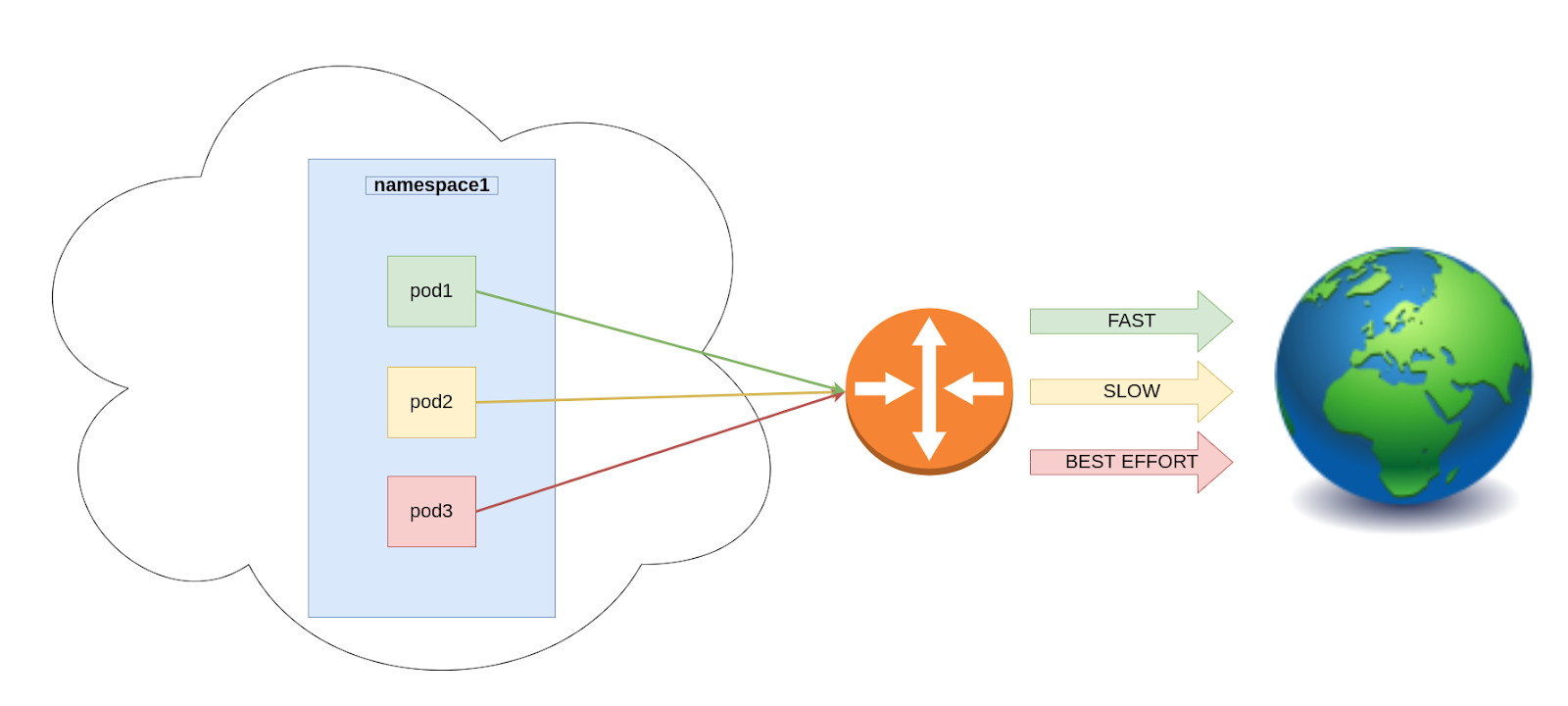
In this post, we'll explore how such configuration is available in OCP clusters that use OVN-Kubernetes CNI as their network provider.
What is EgressQoS?
Starting from OCP 4.11, EgressQoS (Developer Preview) is a namespaced Custom Resource Definition (CRD) that enables marking pods egress traffic with a valid QoS DSCP value. A namespace supports having only one EgressQoS resource named default (other EgressQoSes will be ignored).
An EgressQoS resource allows specifying a list of QoS rules, each consisting of 3 fields:
-
dscp: DSCP value for matching egress traffic
-
dstCIDR (optional): Apply DSCP to traffic heading to this CIDR
-
podSelector (optional): Apply DSCP to traffic from pods whose labels match this selector
kind: EgressQoS
apiVersion: k8s.ovn.org/v1
metadata:
  name: default
  namespace: default
spec:
  egress:
  - dscp: 30
    dstCIDR: 1.2.3.0/24
  - dscp: 42
    podSelector:
      matchLabels:
        app: example
  - dscp: 28
This example marks the packets originating from pods in the default namespace in the following way:
-
All traffic heading to an address that belongs to
1.2.3.0/24is marked with DSCP 30. -
Egress traffic from pods labeled
app: exampleheading to a CIDR that is not1.2.3.0/24is marked with DSCP 42. -
All egress traffic is marked with DSCP 28.
IMPORTANT: The priority of a rule is determined by its placement in the egress array. An earlier rule is processed before a later rule. In this example, if the rules are reversed, all traffic originating from pods in the default namespace is marked with DSCP 28, regardless of its destination or pods labels. Because of that, specific rules should always come before general ones in that array.
Usage Example
Following a similar example to the user story we mentioned previously, here we would like to have the packets coming from the default namespace to be marked the following way:
-
All packets heading to
172.18.0.6/32marked with DSCP 40. -
All packets heading to
172.18.0.7/32from pods labeledapp: demomarked with DSCP 50.
To achieve that, we create the following EgressQoS resource in our OCP cluster:
apiVersion: k8s.ovn.org/v1
kind: EgressQoS
metadata:
  name: default
  namespace: default
spec:
  egress:
  - dscp: 40
    dstCIDR: 172.18.0.6/32
  - dscp: 50
    dstCIDR: 172.18.0.7/32
    podSelector:
      matchLabels:
        app: demo
Assuming these are the pods in the default namespace:

We can expect the traffic to be marked like:

And, indeed, running tcpdump on each of the destinations and pinging them from the pods results in:
tcpdump on 172.18.0.6 host:
bash-5.0# tcpdump -i eth0 -v icmp

tcpdump: listening on eth0, link-type EN10MB (Ethernet), capture size 262144 bytes

10:40:06.238100 IP (tos 0xa0, ttl 62, id 23892, offset 0, flags [DF], proto ICMP (1), length 84)

ovn-worker > a7acb5556708: ICMP echo request, id 7424, seq 0, length 64


10:40:08.280624 IP (tos  0xa0, ttl 62, id 42569, offset 0, flags [DF], proto ICMP (1), length 84)

ovn-worker2 > a7acb5556708: ICMP echo request, id 6656, seq 0, length 64
tcpdump on 172.18.0.7 host:
bash-5.0# tcpdump -i eth0 -v icmp

tcpdump: listening on eth0, link-type EN10MB (Ethernet), capture size 262144 bytes

10:44:33.847400 IP (tos 0xc8, ttl 62, id 58984, offset 0, flags [DF], proto ICMP (1), length 84)

ovn-worker > 90d8708e53a8: ICMP echo request, id 7680, seq 0, length 64


10:44:37.536332 IP (tos 0x0, ttl 62, id 33532, offset 0, flags [DF], proto ICMP (1), length 84)

ovn-worker2 > 90d8708e53a8: ICMP echo request, id 6912, seq 0, length 64
DSCP is derived from the tos field. To get the right decimal value from the hexadecimal we must convert it to decimals and shift 2 bits to the right (e.g., 0xc8 = 200, after shifting 2 bits to the right we get 50).
When a packet from a pod exits a node, its src is changed to the node’s IP, hence we see here that the packets come from our nodes.
Overall, from our tcpdump outputs we can see that we have reached the desired state.
Summary
In this post we saw how an OCP cluster running OVN-Kubernetes CNI can use QoS DSCP to mark selected pods’ egress traffic with a simple CRD. This allows routers and other network appliances that are connected to the cluster to prioritize packets from pods the same way they do for virtual machines (VMs) and bare-metal servers.
저자 소개
유사한 검색 결과
기업 속도의 새로운 가치 기준
asago 소개: 오픈소스 AI 안전 및 거버넌스 오케스트레이션
Random Acts Of Automation | Compiler
How Red Hat cleared IT debt for scalable AI
채널별 검색

오토메이션
기술, 팀, 인프라를 위한 IT 자동화 최신 동향

인공지능
고객이 어디서나 AI 워크로드를 실행할 수 있도록 지원하는 플랫폼 업데이트

오픈 하이브리드 클라우드
하이브리드 클라우드로 더욱 유연한 미래를 구축하는 방법을 알아보세요

보안
환경과 기술 전반에 걸쳐 리스크를 감소하는 방법에 대한 최신 정보

엣지 컴퓨팅
엣지에서의 운영을 단순화하는 플랫폼 업데이트

인프라
세계적으로 인정받은 기업용 Linux 플랫폼에 대한 최신 정보

애플리케이션
복잡한 애플리케이션에 대한 솔루션 더 보기

가상화
온프레미스와 클라우드 환경에서 워크로드를 유연하게 운영하기 위한 엔터프라이즈 가상화의 미래
