
Have you read the announcement of the alpha release of Red Hat OpenShift Application Runtimes (RHOAR)? We also posted an introduction to the component in RHOAR earlier.
One of the curated runtimes included with RHOAR is Vert.x. Vert.x is an open source toolkit for building reactive, high concurrency, low latency applications and is well-suited for supporting the asynchronous communications required by a microservices architecture.
Vert.x is distributed as a toolkit for building reactive applications on the Java virtual machine (JVM). There are a three important points in this description: toolkit, reactive and "on the JVM."
First, Vert.x is a toolkit. Meaning, Vert.x is not an application server, a container nor a framework. It’s not a JavaScript library either. Vert.x is a plain old jar file, so a Vert.x application is an application that uses this jar file. Vert.x does not define a packaging model, all Vert.x components are plain boring jar files. How does this impact you and your application? Let’s imagine you are using a build tool such as Maven or Gradle, to make your application a Vert.x application just add the vertx-core dependency. Wanna use another Vert.x components, just add it as a dependency. It’s simple, burden-less. Starting the application is a simple class with the public static void main(String[] args) entry point. No specific IDE or plugin to install to start using Vert.x. Therefore, to use the awesomeness provided by Vert.x, you just need to use it in your code.
Second, Vert.x is reactive. It is specifically made to build reactive applications, or more appropriately, systems. Reactive systems has been defined in the Reactive Manifesto. Although, the manifesto is not a long document to read, we can reduce it to the following 4 bullet points:
- Responsive: a reactive system needs to handle requests in a reasonable time (I let you define reasonable).

- Resilient: a reactive system must stay responsive in the face of failures (crash, timeout, 500 errors…), so it must be designed for failures and deal with them appropriately.
- Elastic: a reactive system must stay responsive under various loads. As a consequence, it must scale up and down, and be able to handle the load with minimal resources.
- Message driven: components from a reactive system interacts using asynchronous message-passing.
The third point is that Vert.x applications run "on the JVM" (Java Virtual Machine 8+). This means Vert.x applications can be developed using any language that runs on the JVM. Including Java(of course), Groovy, Ceylon, Ruby, JavaScript, Kotlin and Scala. We can even mix and match any combination of all these languages. The polyglot nature of Vert.x application allows you use the most appropriate language for the task.
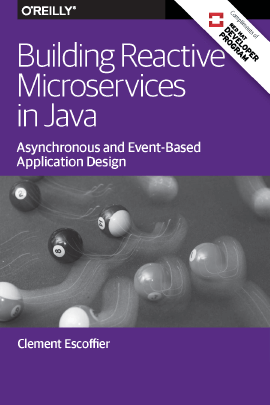
Now this article could dive deeper and deeper into what Vert.x is, but I have a better idea. Let's provide a link to the newly released book titled “Building Reactive Microservices in Java” instead. A book you can download for free compliments of the Red Hat Developer Program! It is a great introduction to using Vert.x and designing asynchronous and event-based applications.
If a new eBook is not for you, a Vert.x cheat sheet is also available on the Red Hat Developer Program web site. It provides step by step details to let you create an application using Vert.x.
I encourage you to get started with reactive programming, or expand your understanding of such using Vert.x Will you take up the challenge? Let us know via comment and tweets. We want to hear you #RHOAR!
저자 소개
With over thirty years in the software industry at companies like Sybase, Siebel Systems, Oracle, IBM, and Red Hat (since 2012), I am currently an AI Technical Architect and AI Futurist. Previously at Red Hat, I led a team that enhanced worldwide sales through strategic sales plays and tactics for the entire portfolio. Prior to that, I managed technical competitive marketing for the Application Services (middleware) business unit.
Today, my mission is to demystify AI architecture, helping professionals and organizations understand how AI can deliver business value, drive innovation, and be effectively integrate into software solutions. I leverage my extensive experience to educate and guide on the strategic implementation of AI. My work focuses on explaining the components of AI architecture, their practical application, and how they can translate into tangible business benefits, such as gaining competitive advantage, differentiation, and delighting customers with simple yet innovative solutions.
I am passionate about empowering businesses to not only harness AI to anticipate future technological landscapes but also to shape them. I also strive to promote the responsible use of AI, enabling everyone to achieve more than they could without it.
유사한 검색 결과
내일로 가는 길: 현재의 기술과 미래의 AI를 연결
Introducing Quarkus on Red Hat OpenShift
Communicating the Value of Connecting Systems | Code Comments
채널별 검색

오토메이션
기술, 팀, 인프라를 위한 IT 자동화 최신 동향

인공지능
고객이 어디서나 AI 워크로드를 실행할 수 있도록 지원하는 플랫폼 업데이트

오픈 하이브리드 클라우드
하이브리드 클라우드로 더욱 유연한 미래를 구축하는 방법을 알아보세요

보안
환경과 기술 전반에 걸쳐 리스크를 감소하는 방법에 대한 최신 정보

엣지 컴퓨팅
엣지에서의 운영을 단순화하는 플랫폼 업데이트

인프라
세계적으로 인정받은 기업용 Linux 플랫폼에 대한 최신 정보

애플리케이션
복잡한 애플리케이션에 대한 솔루션 더 보기

가상화
온프레미스와 클라우드 환경에서 워크로드를 유연하게 운영하기 위한 엔터프라이즈 가상화의 미래
