


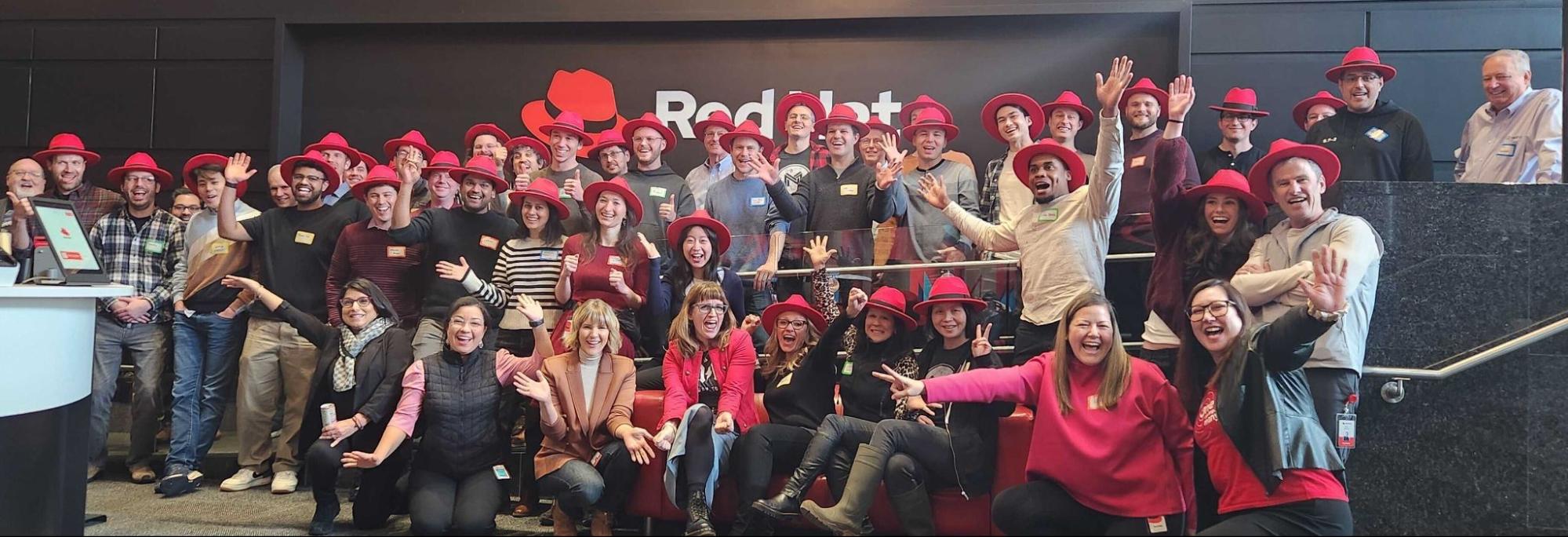
Brian D. is a senior machine learning (ML) engineer on our AI Inference team, which is part of the broader AI Engineering team at Red Hat. Based remotely in Chicago, Brian helps maintain LLM Compressor, a key component of vLLM (an open source inference server originally developed at UC Berkeley, and now supported by a global community).
vLLM is designed to make AI inference—in other words, responses from models—more efficient. Through LLM Compressor, Brian and his team make it possible to optimize and deploy LLMs so they run faster, consume less energy, and operate on fewer GPUs, without compromising performance.
The resulting impact? Lower computational barriers to working with AI—which, in turn, opens the door for more organizations, researchers, and innovators to use these models in meaningful ways. We sat down with Brian to learn more about his journey, his team, and life as a ML engineer.
Tell us about your journey to Red Hat and AI
I joined Red Hat in January through the
My career path has been a gradual shift toward AI. I started out as a computational physicist, then became a full-stack developer, a data scientist, a data engineer, and for the past few years, a ML software engineer. I'm drawn to AI because it's a fun and challenging mix of math and software. I’ve also been able to see firsthand how quickly the field is advancing, which has turned me from a skeptic into a believer.
I’ve worked at a 15-person startup, a 100-person startup, and a large bank with over 200,000 employees. Red Hat has been a really nice sweet spot for me so far. The team is super friendly and down-to-earth, and I’ve really enjoyed the work so far. There’s a lot of opportunity in this space, both in terms of projects and career growth. We have good direction and momentum.
This is also the first job where I’ve worked purely on open source code, and I don’t want to ever go back! Amidst all the hype and fears about AI, we have an opportunity to help democratize it by giving users the means to build their own AI applications, rather than relying on systems that only a select few can afford to create. It’s also a great way to grow our user base and learn from them about any blind spots in terms of documentation, bugs, or missing features.
Describe a typical day on the AI Inference team
We have a daily standup and a weekly meeting with stakeholders to review our sprint goals. We also have weekly deep-dive and design meetings for the engineering team. I have weekly one-on-one meetings with each team member and weekly lunch-and-learns with the research team to discuss new advances. My afternoons are usually kept open for focused work.
Right now, we’re focused on adding new compression algorithms to our suite of compression techniques, based on recent advancements in the research literature so that it is available to users and our research team. Earlier this year, I built a demo integrating LLM Compressor with Red Hat OpenShift AI. My teammates are focused on making LLM Compressor more user-friendly and compatible with the latest models and GPUs, and we recently introduced a new Speculators project that improves throughput by having a small model work in tandem with a larger model—a technique known as “speculative decoding.” I also try to set aside time to review code submissions from teammates and the community, address any issues on our GitHub repository, and check our community Slack channel.

Tell us what makes your role and team unique
It's definitely the mix of machine learning and software engineering. We build software that needs to run on many different platforms and environments. We also have to manage orchestrating data and computations across multiple GPUs. The compression algorithms are also getting more complex as research progresses. These are the kinds of unique challenges you might not encounter as a traditional application developer.
What's been your favorite thing to work on so far?
Given my physics background, I’m most interested in seeing how ideas from quantum machine learning can impact the latest advancements in AI. In a previous role at a quantum computing startup, we were exploring how quantum computing can augment machine learning. While the hardware and applications are still a long way from being fully realized, some quantum-inspired techniques that can run on GPUs are already being used to compress large language models (LLMs). I’m hoping to incorporate it into LLM Compressor as I get more familiar with the codebase.
How do you stay innovative and adaptable in such a rapidly changing field?
That's a great question, and I’m still figuring it out myself! I’m glad to be part of a talented team of engineers and researchers. I learn a lot from them in our lunch-and-learns, through new product features and demos, and by reading the occasional research paper. This is a great place (and a great field) to feel like a beginner and continue learning.
How would you like to see your career progress?
I’d like to slowly move into a product-focused role over time. Part of democratizing AI is demystifying how it works, and I think the role of a product engineer is really important in communicating what’s new and exciting, and how developers can use it to improve their AI applications.
What advice would you give to someone wanting to move into AI/ML at Red Hat?
If you’re looking to make a move into this space, find ways to contribute. All our code is open source on GitHub, and we tag "good first issues" that might be simple enough for a non-expert to tackle. At the very least, you’ll learn something and build a portfolio of contributions you can share with hiring managers to highlight your experience and coding style.
What are you interested in outside of work?
I’m usually mentally tired but physically restless at the end of the day, so you can often find me on a bike trail, at the gym or a yoga studio, or just out for a walk. I also enjoy reading; if a book is recommended to me, I’ll usually pick it up.
Our AI Engineering team is growing, and we’re looking for passionate technologists to join Brian in making AI technology available and accessible to all. Learn more about the team and explore our open roles here.
Teste de produto
Red Hat Learning Subscription | Teste de solução
Sobre os autores
I joined Red Hat in January 2025 to help maintain the LLM Compressor project within vLLM. With a background spanning computational physics, software development, data engineering, and machine learning, and fascinated by the speed at which machine learning has progressed throughout my career, I am really excited by our mission to build open-source tooling that empowers users to build AI applications with fewer hardware resources and less energy consumption.
Holly leads Red Hat’s global talent attraction program, where she is responsible for building and promoting the company's talent brand worldwide. With varied experience spanning digital marketing, employer branding, and program management across professional services and tech, Holly develops and executes creative campaigns that showcase Red Hat as an employer of choice, in close collaboration with partner teams and technical leaders across the business. She also holds a Diploma in Full-Stack Software Development, which helps bring a technical lens to her marketing work.
Holly and the talent attraction team are passionate about amplifying the voices of Red Hat's talented associates and highlighting the unique culture and opportunities that Red Hat offers.
Outside of work, you’ll find her working on various side projects, gaming, thrift shopping, or being bossed around by three cats. Holly is based in Cape Town, South Africa.
Vanshika is currently part of Red Hat's People Team Graduate Program, where she is in her first rotation with the Strategic Workforce Planning team. She previously interned at Red Hat and is passionate about the work she does and continually learning new skills to grow in the HR space.
Outside of work, she enjoys swimming, reading and experimenting with new recipes.
Mais como este
Cinco motivos para não limitar sua estratégia do Lightwell aos patches
Red Hat Learning Subscription Course reinventa o treinamento virtual
Container Roundup | Compiler
Untangling Networks | Compiler
Navegue por canal

Automação
Últimas novidades em automação de TI para empresas de tecnologia, equipes e ambientes

Inteligência artificial
Descubra as atualizações nas plataformas que proporcionam aos clientes executar suas cargas de trabalho de IA em qualquer ambiente

Nuvem híbrida aberta
Veja como construímos um futuro mais flexível com a nuvem híbrida

Segurança
Veja as últimas novidades sobre como reduzimos riscos em ambientes e tecnologias

Edge computing
Saiba quais são as atualizações nas plataformas que simplificam as operações na borda

Infraestrutura
Saiba o que há de mais recente na plataforma Linux empresarial líder mundial

Aplicações
Conheça nossas soluções desenvolvidas para ajudar você a superar os desafios mais complexos de aplicações

Virtualização
O futuro da virtualização empresarial para suas cargas de trabalho on-premise ou na nuvem
