

In a previous introductory article, The software defined programmable logic controller (PLC), our colleague Daniel Fröhlich introduces the concept of "predictable low latency" and how it compares to strict real time.
This article explains how we extended the benchmarking of the Red Hat OpenShift Performance Addon Operator, and underlying Red Hat Enterprise Linux (RHEL), to OpenShift Virtualization to assess whether OpenShift can accommodate latency-sensitive VM workloads.
Investigating network latency
Our focus is on latency and jitter, but our tests also include the network's impact on latency. After all, the workload types we are investigating not only talk to other applications but may also control physical machinery, which makes a "predictable low latency"—with an emphasis on predictable—paramount.
Network latencies are as critical for manufacturing as the jitter introduced by an operating system. We run our test workloads in virtual machines (VMs) on OpenShift, leveraging OpenShift Virtualization, to show that this benchmarking is not limited to cloud-native applications running in containers and that it can also accommodate lift-and-shift use cases.
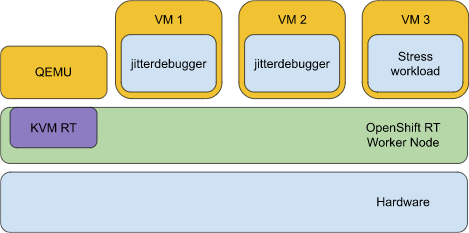
For the sake of cross-validation and to ensure consistency of results with the benchmarking demonstrated in the software-defined PLC article (linked at the top of this article), we started with a jitter test of the system. We deployed two jitterdebugger instances in VMs on a real-time capable worker node within an OpenShift cluster (shown in the figure above). A real-time capable worker node in OpenShift runs RHEL with an optimized kernel designed to maintain low latency, consistent response time, and determinism. We applied performance tuning using the OpenShift Performance Addon Operator.
We deployed an additional stress workload on our OpenShift real-time worker node as noise to make the results more relevant for real-world scenarios. The jitterdebugger measurement was executed for three days to prove that we could achieve and maintain this low latency.
[ Get the eBook Hybrid cloud and Kubernetes: A guide to successful architecture ]
Both jitterdebugger instances demonstrated similar values resulting in maximal latencies of 54 and 55µs, which is consistent with the previous observations when running those workloads directly in containers. That consistency allows us proceed with the goal of this demo: investigating network latencies.
We modified the test setup to assess the networking capabilities. Measuring instances requires access to two independent networking interfaces (NICs). To achieve the maximal performance, both NICs were mounted to guest VMs using PCI passthrough (shown in the figure below).
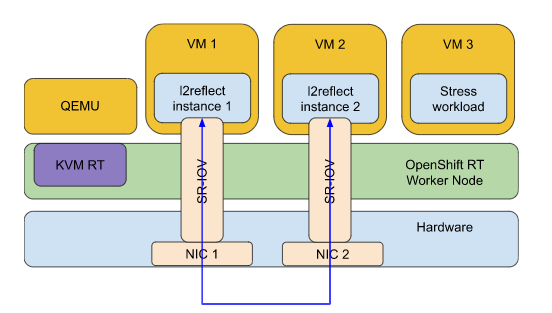
For the measurement, we used the l2reflect test. The l2reflect test is a DPDK application that implements a ping-pong benchmark to estimate latency on the L2 level between two networking devices. The benchmark leader sends a packet to the second instance, and a timestamp is taken. The second instance returns the packet, and a second timestamp is taken. The difference between the first and second timestamps is recorded as the latency.
We executed the l2reflect test for five days to replicate a realistic scenario of a 24/7 deployment, resulting in a maximum latency of 65µs. Compared to 55µs latency measured with the jitterdebugger test, communication over the network caused only 10µs overhead, which is still an acceptable level.
[ Cheat sheet: Kubernetes glossary ]
Wrap up
This benchmarking demonstrates that OpenShift can accommodate latency-sensitive workloads using OpenShift Virtualization in conjunction with the OpenShift Performance Addon Operator. Organizations can expect their latency-sensitive applications to be free from interruptions and suitable for various manufacturing use cases. At the same time, they gain access to all advantages of a modern cloud-native deployment, scaling, and management system such as OpenShift.
저자 소개
Marcelo works as a Principal Sofware Engineer at Red Hat,
in the areas of virtualization and real-time.
Alexander studied theoretical physics. After receiving his Ph.D. in Medical Imaging, he switched to software development and worked for the automotive industry for almost seven years at Tier 1 and Tier 2 suppliers. Today, Alexander's role as a software engineering manager has evolved into different aspects of virtualization, including but not limited to Real-Time and ARM.
Max works as Senior Solution Architect in manufacturing, making things better by bringing the Cloud, Kubernetes, OpenShift, and Linux together to generate business value.
유사한 검색 결과
기업 속도의 새로운 가치 기준
asago 소개: 오픈소스 AI 안전 및 거버넌스 오케스트레이션
Random Acts Of Automation | Compiler
How Red Hat cleared IT debt for scalable AI
채널별 검색

오토메이션
기술, 팀, 인프라를 위한 IT 자동화 최신 동향

인공지능
고객이 어디서나 AI 워크로드를 실행할 수 있도록 지원하는 플랫폼 업데이트

오픈 하이브리드 클라우드
하이브리드 클라우드로 더욱 유연한 미래를 구축하는 방법을 알아보세요

보안
환경과 기술 전반에 걸쳐 리스크를 감소하는 방법에 대한 최신 정보

엣지 컴퓨팅
엣지에서의 운영을 단순화하는 플랫폼 업데이트

인프라
세계적으로 인정받은 기업용 Linux 플랫폼에 대한 최신 정보

애플리케이션
복잡한 애플리케이션에 대한 솔루션 더 보기

가상화
온프레미스와 클라우드 환경에서 워크로드를 유연하게 운영하기 위한 엔터프라이즈 가상화의 미래
