
Last year, we released the automation intelligent assistant (formerly Red Hat Ansible Lightspeed intelligent assistant), a generative AI service accessed through a chatbot embedded within Red Hat Ansible Automation Platform. Using a retrieval augmented generation (RAG) pipeline connected to Red Hat documentation and other trusted resources, the intelligent assistant allows administrators to use natural language prompts to help them manage and troubleshoot Ansible Automation Platform without leaving the platform UI.
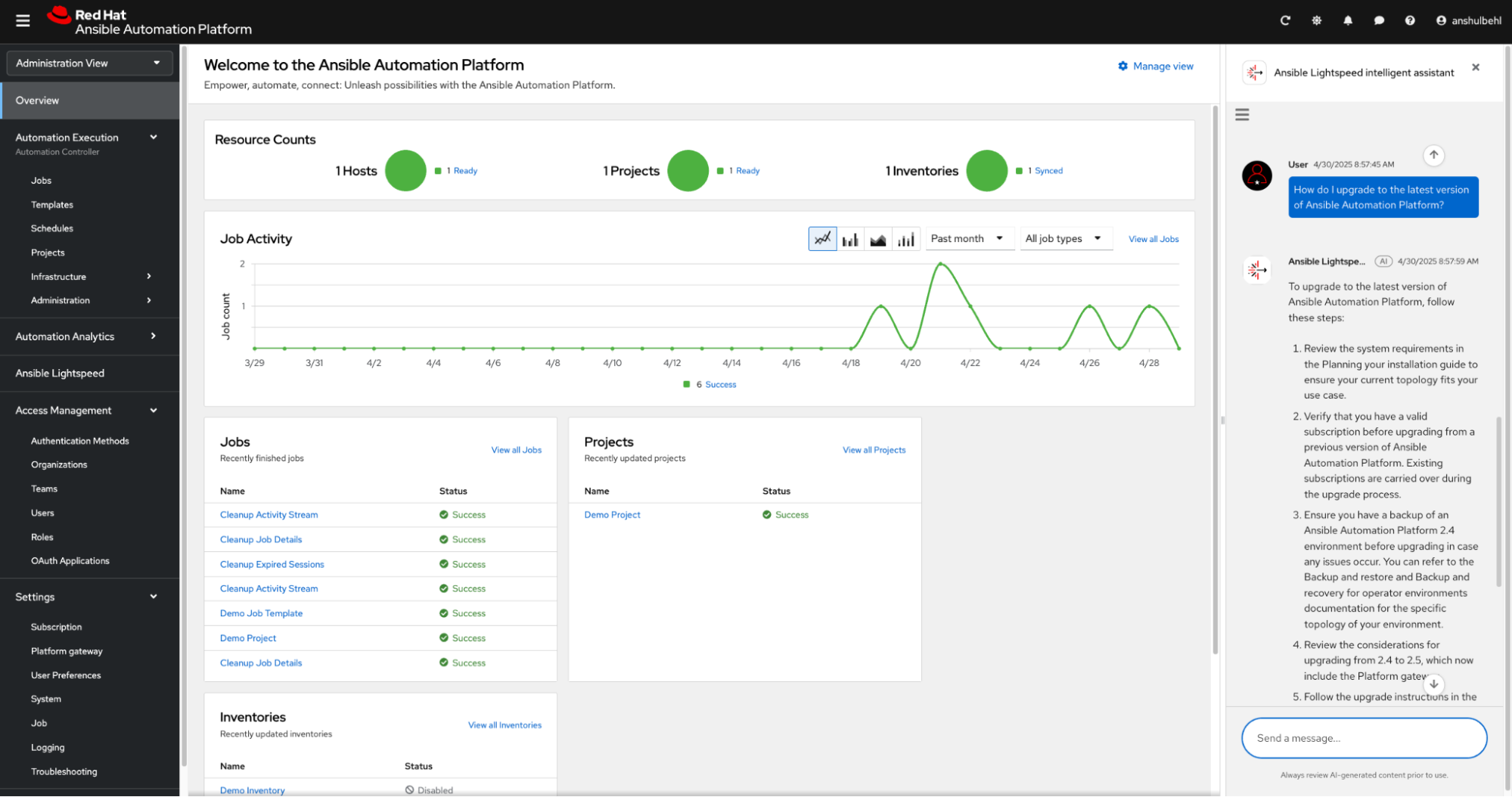
The automation intelligent assistant in the Red Hat Ansible Automation Platform UI
The intelligent assistant can respond with transparency to prompts such as:
- What is an automation execution environment?
- How do I manage user access to Ansible Automation Platform?
- How do I configure Event-Driven Ansible?
- What's in the release notes for Ansible Automation Platform 2.7?
But what happens when your organization's internal policies and procedures require additional steps or actions that are distinct from Red Hat's more generalized recommendations?
Automation intelligence made more relevant
With the release of Ansible Automation Platform 2.7, you can now store proprietary data into the intelligent assistant's RAG pipeline for model responses that reflect your organization's unique operational requirements and best practices. By storing a custom knowledge base, you can prioritize your own documentation (policies, manuals, FAQs) in the models' recommendations. Red Hat's documentation becomes a secondary priority or supplies responses where enterprise specific-guidance is not available.
This ability to apply custom knowledge to the intelligent assistant allows you to centralize critical and trusted documentation in one place, which reduces context switching and encourages adherence to your organization's internal policies and preferences.
Custom knowledge in practice
As part of the release preparation for Ansible Automation Platform 2.7, our engineers ran an internal test-a-thon with scenarios that clearly illustrate the value of storing custom knowledge. In this case, the "bring your own knowledge" image contained documentation for a fictional organization complete with custom naming conventions, approval workflows, and escalation procedures. Here's how the intelligent assistant's responses compared:
Test Prompt | Without custom knowledge | With custom knowledge |
"How should I name my roles?" | Displays Ansible syntax requirements and recommended best practices such as avoiding uppercase letters. | Requires |
"How do I name inventory groups?" | Provides suggestions such as " | Returns the |
"How do I deploy a playbook to production?" | Explains | Platform team approval required. Notify #platform-ops Slack channel. |
"How do I run automation in CI?" | Offers general CI/CD guidance for Ansible such as storing credentials in organizations CI tool of choice. | Returns |
"A production job just failed. What should I do?" | Provides Red Hat- recommended troubleshooting steps. | Details the internal escalation path (Team Lead → Platform Team → On-Call SRE). References the |
"How do I handle secrets in production?" | Suggests using | Points to the |
As you can see, while Red Hat documentation is valuable and even, in many cases, essential, custom knowledge responses add meaningful guidance and context that can bring smoother IT operations, mitigate potential errors and delays, and improve communication between different teams. Customization can also improve your team's overall trust and confidence in the model's recommendations.
Getting started and additional resources
Custom knowledge is currently available as Technology Preview. Ansible Automation Platform 2.7 is required using a containerized installation or on Red Hat OpenShift Container Platform using the Ansible Automation Platform operator. You also need to connect your AI model of choice using Red Hat AI or third-party providers such as IBM watsonx.ai, Open AI, and Azure Open AI. However, it's important to understand that when using cloud-based AI models, portions of the intelligent assistant's prompt context may be exposed to your model provider. If you're in a regulated industry or region of the world, you may want to consider adopting a data protection agreement or exploring on-premise deployment options through a model provider such as Red Hat AI.
To configure the intelligent assistant's service, administrators need to build a custom image containing documentation and policies and deploy it alongside the assistant. To learn more about setting up custom knowledge and Ansible Automation Platform 2.7, please explore the following resources:
저자 소개
Tricia McConnell is Principal Product Marketing Manager, Red Hat Ansible Automation Platform. She brings more than twenty years of experience marketing technical solutions to enterprise IT audiences.
유사한 검색 결과
Red Hat Ansible 올스타: 네트워크 및 인프라 자동화의 미래를 주도합니다
asago 소개: 오픈소스 AI 안전 및 거버넌스 오케스트레이션
Random Acts Of Automation | Compiler
How Red Hat cleared IT debt for scalable AI
자세히 알아보기
E-book: 기업 자동화영어 (English) 버전으로 제공됩니다 (한국어 미지원) - 체험: 자기 주도식 핸즈온 랩으로 구성된 Red Hat Ansible Automation Platform
- Red Hat Ansible Automation Platform: 초보자 가이드
채널별 검색

오토메이션
기술, 팀, 인프라를 위한 IT 자동화 최신 동향

인공지능
고객이 어디서나 AI 워크로드를 실행할 수 있도록 지원하는 플랫폼 업데이트

오픈 하이브리드 클라우드
하이브리드 클라우드로 더욱 유연한 미래를 구축하는 방법을 알아보세요

보안
환경과 기술 전반에 걸쳐 리스크를 감소하는 방법에 대한 최신 정보

엣지 컴퓨팅
엣지에서의 운영을 단순화하는 플랫폼 업데이트

인프라
세계적으로 인정받은 기업용 Linux 플랫폼에 대한 최신 정보

애플리케이션
복잡한 애플리케이션에 대한 솔루션 더 보기

가상화
온프레미스와 클라우드 환경에서 워크로드를 유연하게 운영하기 위한 엔터프라이즈 가상화의 미래
