Introduction
Note: At the time of this writing, MicroShift is Developer Preview software only. For more information about the support scope of Red Hat Developer Preview software, see Developer Preview Support Scope.
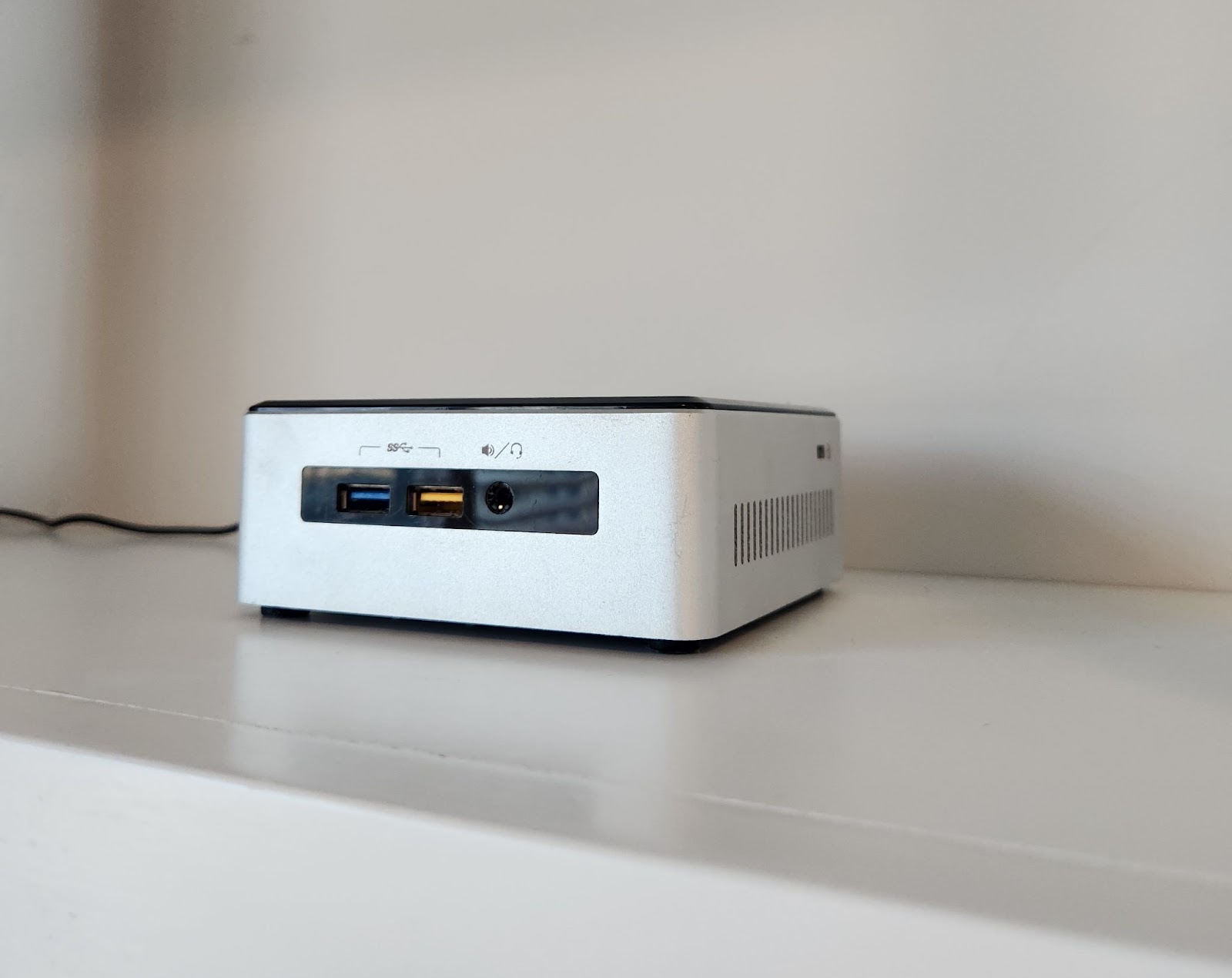
I have an older model 5th generation Intel NUC sitting at home just out of reach from my young kids. The small form factor helps me hide the machine from the kids but at 2 cores and 16 GB RAM, it often limits my ability to run a hypervisor and multiple application workloads. Personally, I wanted to self host Home Assistant on the machine while playing with containers and GitOps, but standing up a minimal Red Hat OpenShift cluster is too resource intensive. Instead, I recently decided to kick the tires on a Developer Preview offering of Red Hat’s build of MicroShift 4.12 on Red Hat Enterprise Linux (RHEL) 8.7. After setting up my MicroShift cluster, I applied GitOps principles by deploying infrastructure as code through lightweight tooling to manage my custom containerized homelab application.
In this article, I will demonstrate the use of MicroShift and GitOps in a homelab environment and explore some of my learnings from this exercise. While this article is intended to be written as a "here's what I did" rather than as step by step instructions, I thought it'd be useful to list the software versions that were used. At the time of this writing, MicroShift is only supported on hardware that supports Red Hat Enterprise Linux (RHEL) 8.7.
- Red Hat build of MicroShift 4.12.9
- Red Hat Enterprise Linux 8.7
- ArgoCD v2.6.7
- Gitea v1.18.5
Installing MicroShift
To begin, Red Hat provides two installation methods of MicroShift: through an RPM package or embedded in a RHEL for Edge image. On my Intel NUC, I host a private DNS server for my home network and require the flexibility to administer the server, so I opted to install a RHEL 8.7 server rather than a RHEL for Edge immutable operating system.
For persistent storage, MicroShift uses the logical volume manager storage (LVMS) Container Storage Interface (CSI) provider. While installing the RHEL OS, I also configured my LVM volume group to leave unused space in which LVMS would be able to create future persistent volumes.
After my server was built and subscribed to Red Hat, I installed MicroShift from an RPM package and configured my client to access the cluster locally.
Deploying my Application with GitOps
With my MicroShift cluster up and running, the next step was to install GitOps tooling in the cluster. I decided to host a private Git server to store sensitive infrastructure as code configurations pertaining to my home network. I selected Gitea as a lightweight Kubernetes deployment with persistent storage. PodSecurityStandards are enforced through a built-in admission controller, so I configured namespace and pod security to match Gitea’s application images which are intended to run as a known user.
$ oc create ns gitea
$ oc config set-context --current --namespace=gitea
$ oc label --overwrite ns gitea pod-security.kubernetes.io/enforce=baseline
$ helm repo add gitea-charts https://dl.gitea.io/charts/
$ helm install gitea gitea-charts/gitea
$ oc adm policy add-scc-to-user anyuid -z default -n gitea
$ oc adm policy add-scc-to-user nonroot-v2 -z gitea-memcached -n gitea
I also created a route to access the web console, and customized Gitea's server configuration.
$ oc create route passthrough gitea-http \
$ oc edit secret gitea-inline-config -n gitea
The next tool to stand up was ArgoCD. This manages my application configuration versioned in Git, automatically syncs to the MicroShift cluster, and detects and self-heals drift between current and desired state. I opted for the non high availability installation to balance lightweight architecture with usability of the web console.
$ oc create ns argocd
$ oc config set-context --current --namespace=argocd
$ oc apply -f https://raw.githubusercontent.com/argoproj/argo-cd/v2.6.7/manifests/install.yaml
$ oc adm policy add-scc-to-user nonroot-v2 -z argocd-redis
I created a route to access the web console, and customized ArgoCD afterwards.
$ oc create route passthrough argocd-server \
  --service argocd-server --insecure-policy='Redirect' --port='https'
$ oc edit cm argocd-cm
I also installed the ArgoCD CLI and configured user administration.
$ oc get secret argocd-initial-admin-secret -o go-template='{{.data.password | base64decode}}'
$ argocd login <server> --username=admin --insecure
$ argocd account update-password \
  --account <name> \
  --current-password <current-user-password>
For my home automation use case, I deployed Home Assistant, an open source application that provides integrations to various smart home devices across a variety of third party vendors. The upstream community provided an application container image, and I wrapped Kubernetes manifests around it to deploy to my MicroShift cluster. As a developer’s note when deploying applications, at the time of writing, MicroShift supports the Kubernetes API and a small subset of the OpenShift APIs. The defined Kubernetes manifests were saved to my Git repository in Gitea and deployed via GitOps through an ArgoCD application.
To put it all together, MicroShift provides a small form footprint for me to host a lightweight container platform and GitOps tooling to deploy and manage my containerized Home Assistant application. In the future, I’m considering deploying other containerized self-hosted applications such as Grafana, Plex, and Portainer.
저자 소개

Kevin Chung is a Principal Architect focused on assisting enterprise customers in design, implementation and knowledge transfer through a hands-on approach to accelerate adoption of their managed OpenShift container platform.
유사한 검색 결과
과거의 운영 방식에서 벗어나 IT의 미래 구축
AI의 다음 변곡점: 에이전트를 엔터프라이즈 슈퍼유저로 전환
Technically Speaking | Taming AI agents with observability
Building A Common Language | Compiler: Stack/Unstuck
채널별 검색

오토메이션
기술, 팀, 인프라를 위한 IT 자동화 최신 동향

인공지능
고객이 어디서나 AI 워크로드를 실행할 수 있도록 지원하는 플랫폼 업데이트

오픈 하이브리드 클라우드
하이브리드 클라우드로 더욱 유연한 미래를 구축하는 방법을 알아보세요

보안
환경과 기술 전반에 걸쳐 리스크를 감소하는 방법에 대한 최신 정보

엣지 컴퓨팅
엣지에서의 운영을 단순화하는 플랫폼 업데이트

인프라
세계적으로 인정받은 기업용 Linux 플랫폼에 대한 최신 정보

애플리케이션
복잡한 애플리케이션에 대한 솔루션 더 보기

가상화
온프레미스와 클라우드 환경에서 워크로드를 유연하게 운영하기 위한 엔터프라이즈 가상화의 미래
