

Organizations must balance the need for fast virtual machine (VM) migrations with predictable, low-risk execution. Red Hat has released the general availability (GA) of storage offload migrations in the migration toolkit for virtualization 2.11, included in Red Hat OpenShift. This update allows you to migrate with speed and confidence.
Migrate with speed: Storage offloading is now generally available
Storage offload migrations are now generally available to help you move critical VM workloads quickly with minimal downtime. This feature uses your existing storage systems for smoother migrations. While traditional migrations move data over the IP network, storage offloading transfers this work to the underlying storage array.
Bypassing the network eliminates the bandwidth constraints that slow migrations. Internal testing conducted by Hitachi shows that these migrations can run up to 10 times faster than traditional network migrations (actual results may vary by environment). A 10-hour migration window can potentially be reduced to just one hour, which preserves your network for production traffic and significantly reduces the migration timeline.
Flexibility and choice throughout your migration
You can still choose how to conduct your migrations through storage offloading. Use a cold migration for non-critical workloads that require simplicity. Use a warm migration to copy data while the VM remains running, with a brief shutdown period to complete the migration. The migration toolkit for virtualization 2.11 also introduces support for additional certified partners like Infinidat and IBM to give you more options for your migration.
How to get started with storage offload migrations
Follow these steps to use storage offloading and kickstart your migrations. For a more detailed view, review the demo walkthrough and interactive experience.
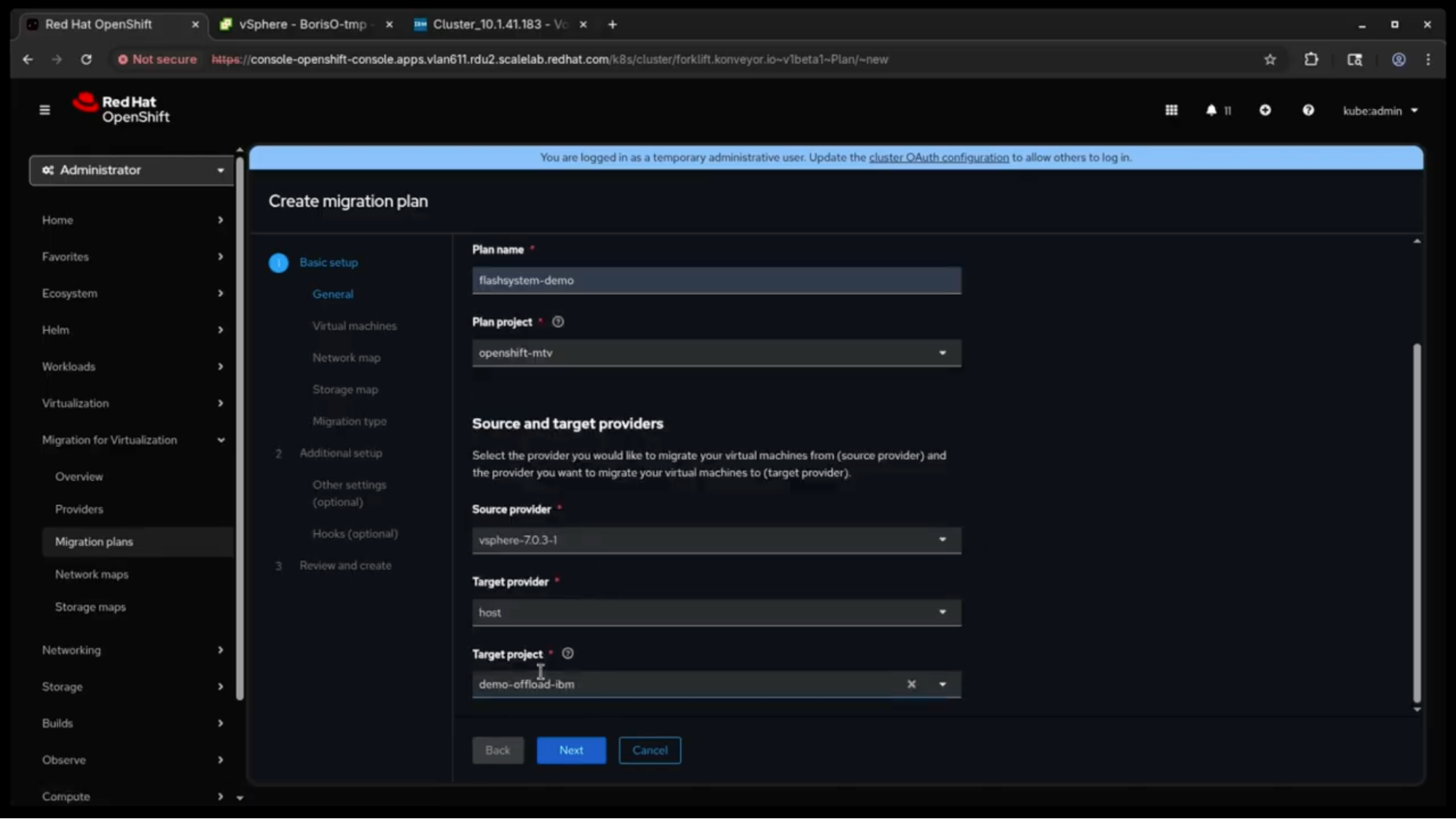
1. Create a migration plan
In the Red Hat OpenShift console, navigate to the Migration plans section. Give your plan a name and select your source provider, such as vSphere, and your target provider (the destination for your VM).
2. Choose your VMs
Select the specific VMs you want to migrate. You can select one or more VMs to move in a single plan.

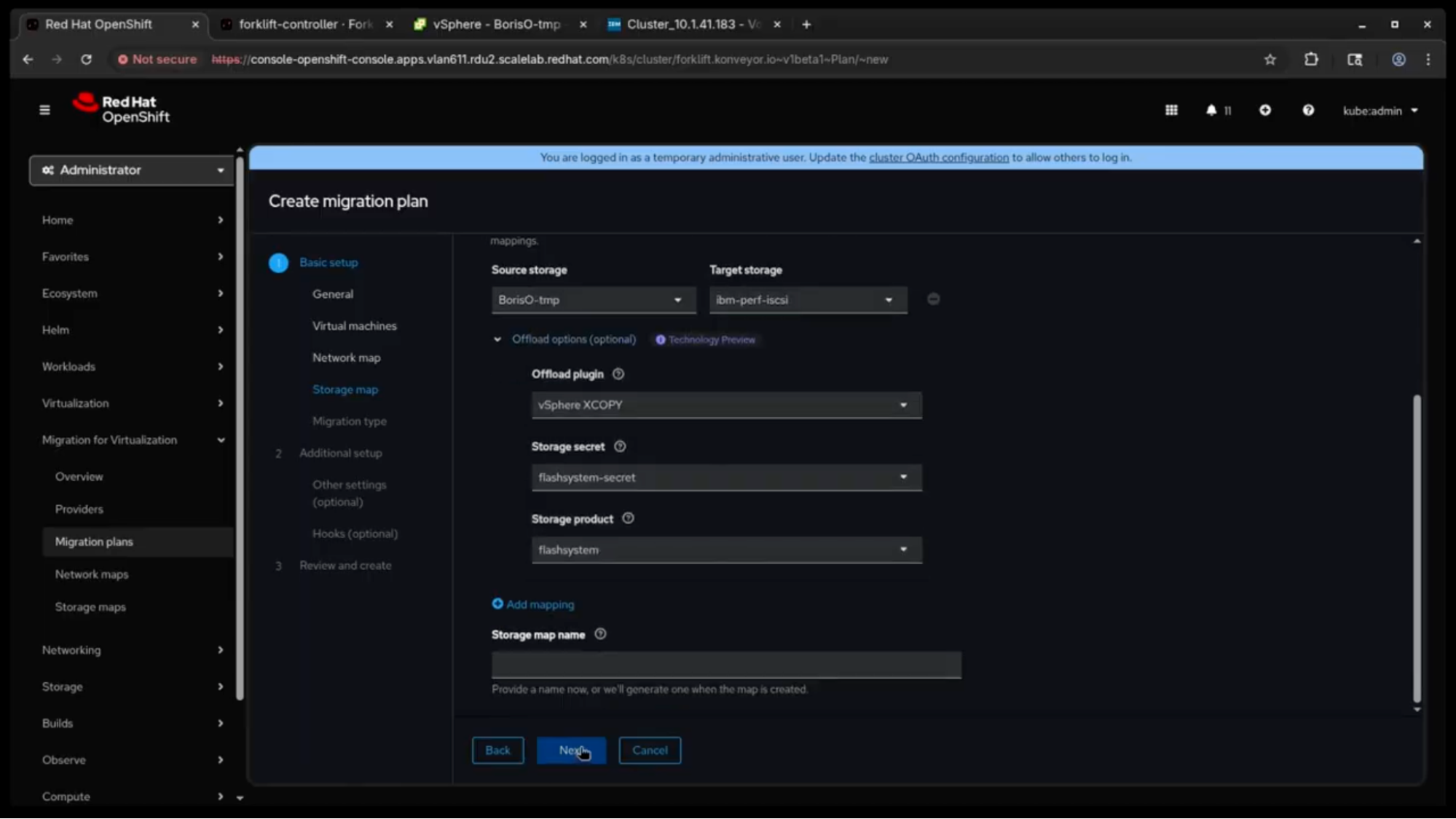
3. Map your networks and storage
This is the most important step for storage offloading.
- Network map: Select the appropriate network map to ensure your VM lands on the correct network in OpenShift.
- Storage map: Map your source datastore to a storage class that supports offloading, such as those from Hitachi, Pure, NetApp and Dell. This tells the migration toolkit for virtualization to trigger an array-level copy instead of a network stream.
4. Execute and complete
Once you create the plan, you can begin the migration. Monitor the status in the UI. When the migration is complete, the VM appears in the Red Hat OpenShift Virtualization console. Storage offloading saves time by using existing resources without overwhelming your network.

Additional updates
The migration toolkit for virtualization 2.11 includes additional updates designed to make your migration journey smoother. For a deep dive, check out the full release notes here.
Enhanced learning experience
The migration toolkit for virtualization helps you learn through research-backed content integration and a guided interaction experience for complex tasks. The Tips and Tricks section of the console expands the migration toolkit 2.10 release with more learning resources and guides for yourmigration journey, accessible directly in the console.
Plan your storage offload migration
Red Hat OpenShift Virtualization and storage offloading provide a faster, more predictable way to modernize your infrastructure or complete active migrations. With Red Hat's migration toolkit for virtualization 2.11, you can use storage from partners such as Hitachi, Pure, NetApp, Dell, and more to move data at the storage layer. This approach reduces your migration windows and preserves network bandwidth for production traffic.
Learn more:
리소스
Red Hat OpenShift Virtualization을 도입해야 하는 15가지 이유
저자 소개
Carolyn May is a Product Marketing Manager at Red Hat, specializing in OpenShift, the leading hybrid cloud application platform powered by Kubernetes. With a background in sales, Carolyn spearheads initiatives aimed at highlighting the value of OpenShift.
Jochen has been working in IT for more than 30 years and has been turning customer problems into technical solutions as a product manager for more than 15 years. For the past 2 years, he has been part of the Virtualization Product Management Team at RedHat.
유사한 검색 결과
Service Mesh를 활용한 Red Hat OpenShift 가상 머신 관리
Red Hat 파트너가 최고의 통신 비즈니스 자산인 이유
Virtualization Is (Still) King | Compiler
자세히 알아보기
초보자를 위한 하이브리드 클라우드 전략영어 (English) 버전으로 제공됩니다 (한국어 미지원) 2023년 Gartner® Magic Quadrant™ 컨테이너 관리 부문 리더로 선정된 Red Hat영어 (English) 버전으로 제공됩니다 (한국어 미지원) - Red Hat OpenShift 체험
채널별 검색

오토메이션
기술, 팀, 인프라를 위한 IT 자동화 최신 동향

인공지능
고객이 어디서나 AI 워크로드를 실행할 수 있도록 지원하는 플랫폼 업데이트

오픈 하이브리드 클라우드
하이브리드 클라우드로 더욱 유연한 미래를 구축하는 방법을 알아보세요

보안
환경과 기술 전반에 걸쳐 리스크를 감소하는 방법에 대한 최신 정보

엣지 컴퓨팅
엣지에서의 운영을 단순화하는 플랫폼 업데이트

인프라
세계적으로 인정받은 기업용 Linux 플랫폼에 대한 최신 정보

애플리케이션
복잡한 애플리케이션에 대한 솔루션 더 보기

가상화
온프레미스와 클라우드 환경에서 워크로드를 유연하게 운영하기 위한 엔터프라이즈 가상화의 미래
