
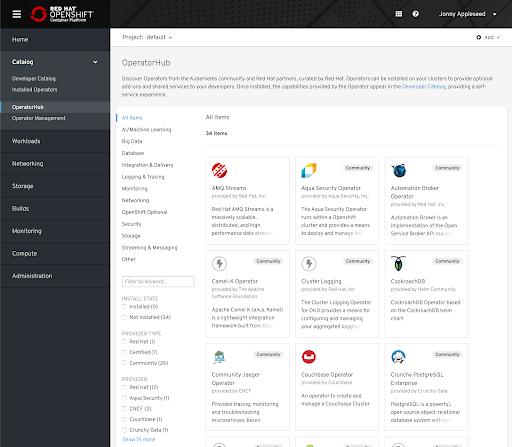
Last week at Red Hat Summit we announced Red Hat OpenShift Operator Certification. We’re excited to be able to offer an ecosystem of certified Operators for enterprise applications embedded in Red Hat OpenShift. Red Hat OpenShift Certified Operators offer consistent packaging, deployment and lifecycle management of applications across all OpenShift 4 footprints. At the time of the announcement, we had already certified 22 Operators. Here's how you can add yours.
OpenShift Certified Operator Benefits for OpenShift Users
OpenShift Certified Operators are monitored and updated to help reduce interoperability failure or security risks and are jointly supported by Red Hat and our partners. For users this can improve time-to-value, by using components that have been pre-tested on OpenShift, empowering them to deploy faster. To get started, learn how to install applications into your OpenShift 4 cluster using Operators from OperatorHub or try out one of the Operator scenarios on learn.openshift.com.
Why Certify Your Operator?
Red Hat OpenShift is the industry’s most comprehensive enterprise Kubernetes platforms with more than a thousand customers. Developers who partner with Red Hat in certifying their Operators on OpenShift can gain broader visibility for their solutions and make them more easily consumable by OpenShift users. By codifying and packaging best practices and business workflows, these partners are able to provide a consistent experience for their users across hybrid cloud platforms. Additionally, they gain access to technical and marketing benefits through the Red Hat Connect Partner Program.
How to Certify
We’re eager to work with new partners to help them through the certification process. At a high level the Operator certification steps include:
- Confirming that the application’s container images and Operator image is Red Hat certified. Certified images must be:
- Built using Red Hat Enterprise Linux or Red Hat Universal Base Image as the base layer.
- Comply with Red Hat Container Certification requirements.
- Submitted to Red Hat to verify and publish.
- Provide product information for publishing in the Red Hat Container Catalog.
- Then the Operator and Application container images are packaged and submitted through the Red Hat Partner Connect website along with additional metadata. The Operator metadata allow it to be deployed using the Operator Lifecycle Manager and to render the Operator’s detail page in OperatorHub.
- The Operator and Application images then undergo a security health check.
- Once they complete the health checks the RH team will post the Operator in the embedded OperatorHub.
For the full set of instructions, check out our detailed guide to OpenShift Operator Certification.
Learn more about Operators at KubeCon in Europe, May 20-23. The Operators in Action panel at the OpenShift Commons Gathering is not-to-miss. Check out a keynote talk from Rob Szumski and learn about the tools at your disposal to build, test and ship an Operator. The Kubernetes Hands-on Workshop at KubeCon is sold out at over 100 attendees but you can meet us at the Red Hat booth for a demo or discussion.
저자 소개
유사한 검색 결과
Service Mesh를 활용한 Red Hat OpenShift 가상 머신 관리
신속한 패치 적용이 어려우신가요? 최후의 방어선, 제로 트러스트
Scaling with Orchestrators | Compiler
Container Roundup | Compiler
채널별 검색

오토메이션
기술, 팀, 인프라를 위한 IT 자동화 최신 동향

인공지능
고객이 어디서나 AI 워크로드를 실행할 수 있도록 지원하는 플랫폼 업데이트

오픈 하이브리드 클라우드
하이브리드 클라우드로 더욱 유연한 미래를 구축하는 방법을 알아보세요

보안
환경과 기술 전반에 걸쳐 리스크를 감소하는 방법에 대한 최신 정보

엣지 컴퓨팅
엣지에서의 운영을 단순화하는 플랫폼 업데이트

인프라
세계적으로 인정받은 기업용 Linux 플랫폼에 대한 최신 정보

애플리케이션
복잡한 애플리케이션에 대한 솔루션 더 보기

가상화
온프레미스와 클라우드 환경에서 워크로드를 유연하게 운영하기 위한 엔터프라이즈 가상화의 미래
