
This blog will highlight the new security features in the most recent release of Red Hat OpenStack Platform. Here are the security features you can expect in Red Hat OpenStack Platform 17.1.
Encrypted memcached
When using memcached, tokens and authentication responses are stored in the cache as raw data. If the cache is compromised, tokens and authentication responses become readable. Encrypting memcached content alleviates this concern. The OpenStack services that support memcached protection include Aodh, Barbican, Cinder, Glance, Gnocchi, Heat, Ironic, Neutron, Nova, and Panko; all services that use keystone middleware for authentication.
Secure Role-Based Access Control (SRBAC)
OpenStack's SRBAC is a security model that enables organizations to secure their OpenStack deployments by imposing strict and granular access control policies. It benefits various use cases, including data center security, compliance and auditing, multi-tenancy, and workload isolation, while providing advantages like granular control, simplified administration, enhanced security, improved workflow, and scalability.
SRBAC expands granular Role-Based Access Control of authorization across OpenStack services, providing increased functionality, improved auditability, and a reduced attack surface. This is a long-desired request for OpenStack, where OpenStack operators often want to provide a read-only view for specific users (such as auditors). Finally, SRBAC provides a read-only role for projects in Red Hat OpenStack Platform 17.1 (note: this is a day-one decision).
Fernet tokens benefits for end users
The benefits of using Fernet tokens may not be immediately apparent, but they confirm that the user's information is protected and that their experience is fast, convenient, and secure. Fernet tokens help provide the security of the Keystone user's sensitive information by encrypting it in transit, protecting it from potential threats.
Fernet tokens can be generated quickly and easily, making it easy for users to access their application without waiting for lengthy authentication processes. A primary advantage of Fernet tokens is that once Keystone generates them, they can be decrypted locally by another service. For other token types, the other service must talk to Keystone to validate the token presented by the user. Fernet tokens save the receiving service that extra round trip to Keystone.
Federation with OpenID Connect
Federation in OpenStack refers to the ability to authenticate and authorize users across different domains or systems. In the context of OpenStack, federation typically involves using an external identity provider (IdP) to manage user authentication and authorization rather than relying solely on the internal OpenStack identity service (Keystone).
One way to implement federation in OpenStack is through OpenID Connect (OIDC), an authentication protocol built on top of the OAuth 2.0 protocol. With OIDC, an external IdP can be used to authenticate users and assign roles based on mapping rules.
Once federation is configured and enabled in OpenStack, users can log into OpenStack using their credentials from the external IdP. Keystone can use the information provided by the IdP to authorize the user's access to resources in OpenStack.
Overall, federation with OpenID Connect in OpenStack can provide a more seamless and secure user authentication and authorization experience by allowing users to log in using their existing credentials and reducing the need for users to manage multiple sets of login credentials.
Federal Information Processing Standards (FIPS)-140 (ISO/IEC 19790) Mode
Enable strong encryption that meets the ISO/IEC 19790 level, also known as FIPS 140-3 in Red Hat OpenStack Platform (this is a day-one decision).
FIPS is a set of cryptographic standards developed by the U.S. National Institute of Standards and Technology (NIST) that is widely recognized as a security benchmark. FIPS mode verifies that cryptographic algorithms and modules used within OpenStack adhere to approved standards, providing a high level of assurance for encryption, digital signatures, and secure communications. This helps protect sensitive data such as user credentials, private keys, and communication channels against unauthorized access and tampering.
Many industries, especially those dealing with sensitive information like healthcare, finance, and government, have specific regulatory requirements that mandate using FIPS-certified cryptographic systems. Running OpenStack in FIPS mode helps organizations meet these compliance obligations, demonstrating that the system follows approved cryptographic standards.
Deploying Red Hat OpenStack Platform in FIPS-140 mode impacts third-party solutions deployed alongside it. Let’s take a look:
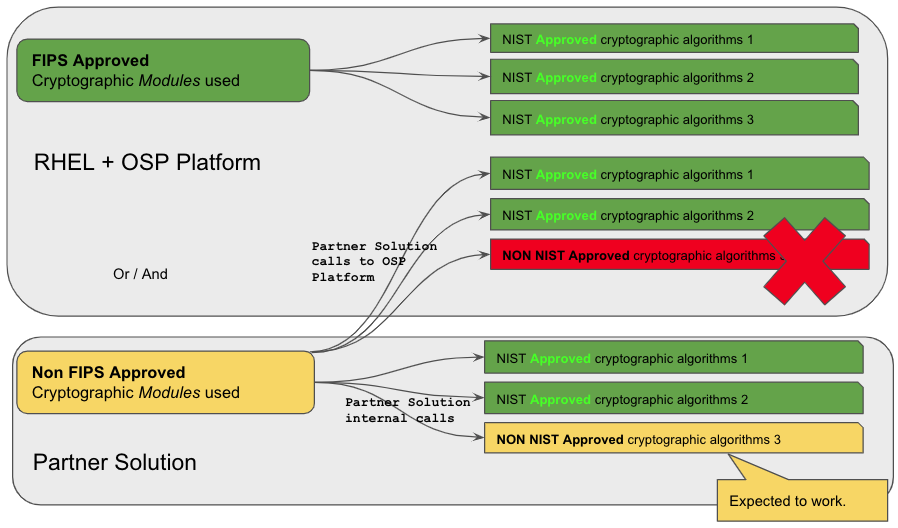
Partners and customers running solutions in or on top of Red Hat OpenStack Platform are impacted by the switch to OpenStack strong encryption. A third-party solution that brings its own security within can be what the customer wants as long as they use their own cryptographic libraries and modules within their solution (the yellow boxes). The moment the third-party solution wants to interact with the platform or operating system by making a cryptographic call, it must use FIPS-level cryptography, or the call will fail.
Delivering FIPS-140 (ISO/IEC 19790) support for Red Hat OpenStack Platform is a part of the overall platform FIPS enablement, but you must carefully test your environment with all its non-Red Hat components to allow smooth operations.
Besides switching the underlying RHEL to use FIPS-approved cryptographic algorithms, as of Red Hat OpenStack Platform 17.1, there are just four OpenStack-related parameter changes that are applied to the deployments in FIPS-140 mode:
 # Set ISCSI Chap algorithms to specifically disallow MD5
 IscsidCHAPAlgorithms: 'SHA3-256,SHA256,SHA1'

 # Set SnmpdReadonlyUserAuthType to not be 'MD5'
 SnmpdReadonlyUserAuthType: 'SHA'

 # Add RabbitAdditionalErlArgs for FIPS
 RabbitFIPS: true

 # Override gcomm_cipher for FIPS
 MysqlGaleraSSLCipher: 'ECDHE-RSA-AES256-GCM-SHA384'
Wrap up
Find more information here about Red Hat Compliance Activities and Government Standards support (Red Hat Enterprise Linux 9 section is relevant to Red Hat OpenStack Platform 17.1).
Here is more information about FIPS-140 in Red Hat Enterprise Linux and its cryptographic profiles.
저자 소개
JP Jung is a technical leader with more than 20 years of experience mixing a background as an infrastructure architect with technical partner management and product management to deliver outstanding business value. JP advocates for "upstream first" development, and is currently focused on post-quantum cryptography (PQC) readiness, Federal Information Processing Standards (FIPS) support, and security across both Red Hat OpenStack Services on OpenShift and the overall Red Hat OpenShift Container Platform ecosystem. He drives cryptographic migration strategy aligned with NIST PQC standards (ML-KEM, ML-DSA) and CNSA 2.0 timelines, working to ensure Red Hat's platforms are quantum-safe before regulatory deadlines close. He also covers confidential computing, to protect data in-use.
유사한 검색 결과
기업 속도의 새로운 가치 기준
오픈소스 방어 계층 강화: Red Hat, NVIDIA와 함께 Open Secure AI Alliance 합류
Can Compliance Be A Piece Of Cake? | Compiler
Collaboration In Product Security | Compiler
채널별 검색

오토메이션
기술, 팀, 인프라를 위한 IT 자동화 최신 동향

인공지능
고객이 어디서나 AI 워크로드를 실행할 수 있도록 지원하는 플랫폼 업데이트

오픈 하이브리드 클라우드
하이브리드 클라우드로 더욱 유연한 미래를 구축하는 방법을 알아보세요

보안
환경과 기술 전반에 걸쳐 리스크를 감소하는 방법에 대한 최신 정보

엣지 컴퓨팅
엣지에서의 운영을 단순화하는 플랫폼 업데이트

인프라
세계적으로 인정받은 기업용 Linux 플랫폼에 대한 최신 정보

애플리케이션
복잡한 애플리케이션에 대한 솔루션 더 보기

가상화
온프레미스와 클라우드 환경에서 워크로드를 유연하게 운영하기 위한 엔터프라이즈 가상화의 미래
