This post describes the technical details of the resources needed for deploying a Red Hat Advanced Cluster Management for Kubernetes high availability and disaster recovery (HA/DR) framework.
You can read part 1 here: Red Hat Advanced Cluster Management for Kubernetes: High availability and disaster recovery (part 1)
Understand Red Hat Advanced Cluster Management HA and DR requirements
Confirm that the standby hub cluster has Red Hat Advanced Cluster Management installed and configured according to the customer's standards. It is also important to verify that any additional operator needs are installed on the same versions.
- The steps described in the next sections are required in all hub clusters (Active/Standby).
Enable the backup and restore operator
The backup and restore operator is not enabled by default when Red Hat Advanced Cluster Management is installed and configured. To enable it on all clusters, you must edit the MultiClusterHub resource on each Red Hat Advanced Cluster Management cluster, setting the cluster-backup field to true. Here is an example:
$ oc edit -n open-cluster-management multiclusterhub

apiVersion: operator.open-cluster-management.io/v1
kind: MultiClusterHub
metadata:
  creationTimestamp: "2023-07-04T16:35:40Z"
  finalizers:
  - finalizer.operator.open-cluster-management.io
  generation: 2
  name: multiclusterhub
  namespace: open-cluster-management
  resourceVersion: "66615"
  uid: e39427a9-dc60-4c2c-9063-8ef6b9d51021
spec:
  availabilityConfig: High
  enableClusterBackup: false
  ingress:
    sslCiphers:
    - ECDHE-ECDSA-AES256-GCM-SHA384
    - ECDHE-RSA-AES256-GCM-SHA384
    - ECDHE-ECDSA-AES128-GCM-SHA256
    - ECDHE-RSA-AES128-GCM-SHA256
  nodeSelector:
    node-role.kubernetes.io/infra: ""
  overrides:
    components:
    - enabled: true
      name: console
    - enabled: true
      name: insights
    - enabled: true
      name: grc
    - enabled: true
      name: cluster-lifecycle
    - enabled: true
      name: volsync
    - enabled: true
      name: multicluster-engine
    - enabled: true
      name: search
    - enabled: true
      name: app-lifecycle
    - enabled: true
      name: cluster-backup
  separateCertificateManagement: false
Deploy object storage
If you do not have an object storage solution, you can deploy a Noobaa-based Standalone Object Gateway. You can also use Minio or any S3-compatible solution you want.
Warning: In a production environment, object storage must reside on resilient infrastructure (the cloud, for example) so that it does not become a single point of failure.
Set the S3 storage secret
A secret containing the S3 storage access credentials is required for the operator to store backup data.
- For example, if you are using Minio and the credentials used to access the Minio console are admin/redhat123, the file must contain this information.
Create a file containing the S3 storage credentials with contents similar to the one below:
$ cat credentials

[backupStorage]
aws_access_key_id=admin
aws_secret_access_key=redhat123
You must create the secret in the open-cluster-management-backup namespace:
$ oc create secret generic cloud-credentials --namespace open-cluster-management-backup --from-file cloud=<CREDENTIALS_FILE_PATH>
Check if the secret was created:
$ oc get secrets -n open-cluster-management-backup cloud-credentials -o yaml
Note: The name of the profile created in the credentials file (backupStorage in the example above) can be set to any value suitable for the client's environment. This name will be referenced later. You can add multiple profiles to the same credential file if needed.
Configure the ManagedServiceAccount
This feature automatically connects managed clusters (clusters that already exist and were manually imported into Red Hat Advanced Cluster Management) to the new hub cluster. The ManagedServiceAccount is available with the backup and restore component as of Red Hat Advanced Cluster Management 2.7.
The backup controller available with Red Hat Advanced Cluster Management 2.7 uses the ManagedServiceAccount component on the main hub cluster to create a token for each of the managed clusters that were manually imported.
See below for more details.
Edit the MultiClusterEngine
Enable the ManagedServiceAccount component on the MultiClusterEngine by editing the MultiClusterEngine resource and setting the enable: true value for the managedserviceaccount-preview component. See the following example:
$ oc edit -n open-cluster-management multiclusterengine

apiVersion: multicluster.openshift.io/v1
kind: MultiClusterEngine
metadata:
  creationTimestamp: "2023-07-04T16:37:56Z"
  finalizers:
  - finalizer.multicluster.openshift.io
  generation: 2
  labels:
    installer.name: multiclusterhub
    installer.namespace: open-cluster-management
    multiclusterhubs.operator.open-cluster-management.io/managed-by: "true"
  name: multiclusterengine
  resourceVersion: "63543"
  uid: a0711500-5db9-40da-85f5-dacfc5bc3637
spec:
  availabilityConfig: High
  nodeSelector:
    node-role.kubernetes.io/infra: ""
  overrides:
    components:
    - enabled: true
      name: local-cluster
    - enabled: true
      name: assisted-service
    - enabled: true
      name: cluster-lifecycle
    - enabled: true
      name: cluster-manager
    - enabled: true
      name: discovery
    - enabled: true
      name: hive
    - enabled: true
      name: server-foundation
    - enabled: true
      name: cluster-proxy-addon
    - enabled: true
      name: hypershift-local-hosting
    - enabled: true
      name: managedserviceaccount-preview
    - enabled: false
      name: hypershift-preview
    - enabled: true
      name: console-mce
  targetNamespace: multicluster-engine
  tolerations:
  - effect: NoSchedule
    key: node-role.kubernetes.io/infra
    operator: Exists
Confirm it was enabled:
$ oc get -n open-cluster-management MultiClusterEngine -o yaml | grep -B1 managedserviceaccount-preview
      - enabled: true
        name: managedserviceaccount-preview
Confirm the cluster backup operator
Verify that the cluster-backup operator is active on the hub cluster. See the following example:
$ oc get -n open-cluster-management multiclusterhub -o yaml | grep -B1 cluster-backup$
      - enabled: true
        name: cluster-backup
Attention: If you have not already enabled the backup-operator, editing the above component installs the OpenShift APIs for Data Protection (OADP) operator in the open-cluster-management-backup namespace. Make sure you are using a supported version as described at the beginning of this document.
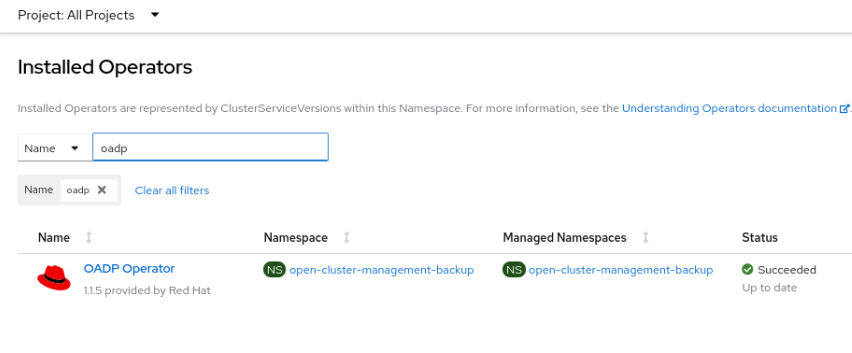
OADP Version 1.1.5 is suitable for Red Hat Advanced Cluster Management
Backup configuration on the hub cluster
You need to create a resource named Data Protection Application on your hub clusters.
Set the DataProtectionApplication
The DataProtectionApplication (DPA) provides all necessary settings for performing backups and restores. The following is an example of DPA using S3 storage:
$ cat dpa.yaml

apiVersion: oadp.openshift.io/v1alpha1
kind: DataProtectionApplication
metadata:
  name: dpa
  namespace: open-cluster-management-backup
spec:
  configuration:
    velero:
      defaultPlugins:
      - openshift
      - aws
    restic:
      enable: false
  backupLocations:
    - name: default
      velero:
        provider: aws
        default: true
        objectStorage:
          bucket: acm-backup
          prefix: hubcluster2
        config:
          s3Url: "http://192.168.15.133:9000"
          s3ForcePathStyle: "true"
          region: homecloud
          profile: "backupStorage"
        credential:
          name: cloud-credentials
          key: cloud
Verify that the DPA settings are correct:
$ oc get -n open-cluster-management-backup dataprotectionapplications.oadp.openshift.io -o yaml
Setup details
- objectStorage.bucket must be set to the bucket created on S3 storage.
- objectStorage.prefix is an optional parameter, but it can help with cluster identification.
- config.s3Url must be set to the S3 storage access URL. If necessary, also include the TCP port number for the connection.
- config.s3ForcePathStyle is needed in some cases, like Minio and Noobaa object storage. On some object storage solutions this parameter may be unnecessary.
- config.region must reflect the region configured on the object storage bucket. It can also be your on-premises cluster name.
- config.profile should reflect the name of the profile created earlier in the secret for S3 storage.
Important: The name parameter in the DPA needs to be relatively short as a route (expose) will be created as part of the provisioning process. Long cluster names may exceed the 63-character limit, which will prevent the solution from working correctly.
Finish the setup
That's it for this process. The next part demonstrates dealing with backup tasks, such as scheduling and restoration.
저자 소개

Andre Rocha is a Consultant at Red Hat focused on OpenStack, OpenShift, RHEL and other Red Hat products. He has been at Red Hat since 2019, previously working as DevOps and SysAdmin for private companies.
채널별 검색

오토메이션
기술, 팀, 인프라를 위한 IT 자동화 최신 동향

인공지능
고객이 어디서나 AI 워크로드를 실행할 수 있도록 지원하는 플랫폼 업데이트

오픈 하이브리드 클라우드
하이브리드 클라우드로 더욱 유연한 미래를 구축하는 방법을 알아보세요

보안
환경과 기술 전반에 걸쳐 리스크를 감소하는 방법에 대한 최신 정보

엣지 컴퓨팅
엣지에서의 운영을 단순화하는 플랫폼 업데이트

인프라
세계적으로 인정받은 기업용 Linux 플랫폼에 대한 최신 정보

애플리케이션
복잡한 애플리케이션에 대한 솔루션 더 보기

가상화
온프레미스와 클라우드 환경에서 워크로드를 유연하게 운영하기 위한 엔터프라이즈 가상화의 미래
