
Samba is a widely used open source software suite that provides file and print services for Microsoft Windows clients using Linux and Unix. It enables users to share files and printers over a network, regardless of their operating system. Samba is often used in enterprise environments to provide shared file storage. For example, Samba can be combined with Red Hat Enterprise Linux Resilient Storage (which includes GFS2) to provide a highly available and scalable clustered file system.
GFS2 is a shared-disk file system designed for use in a clustered environment. It allows multiple bare metal or virtual servers to access the same file system simultaneously. It enables them to share a block device exported by an on-premises SAN (Storage Area Network) architecture or one that uses a public cloud-shared block store. With GFS2, users can create, mount, and manage a shared file system accessible to multiple Samba servers.
[ Build a resilient IT culture ]
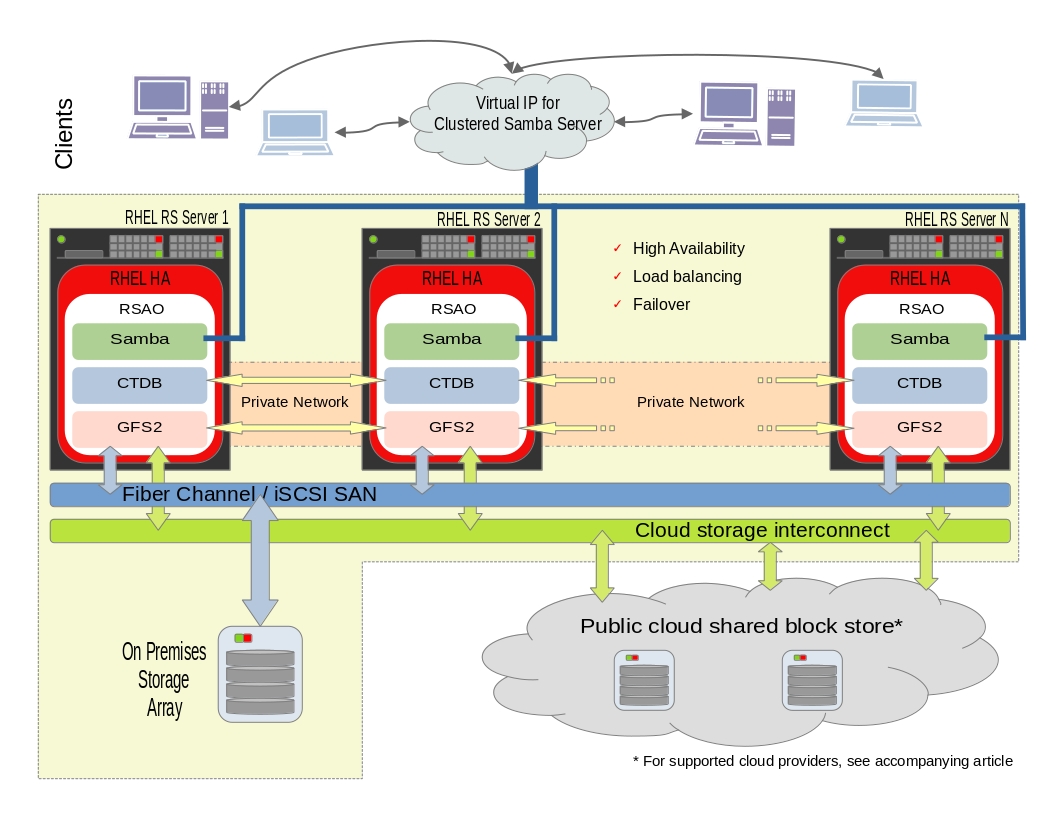
Active/active clustered Samba on GFS2 is a powerful solution that can help organizations achieve high availability and scalability for their file-sharing needs. This configuration allows multiple Samba servers to simultaneously access the same shared storage, providing users with seamless access to their files, even in the event of a server failure.
RHEL's Resilient Storage Add-on includes GFS2 and clustered Samba.
Benefits
There are several benefits to deploying a highly available clustered Samba-over-GFS2 solution:
- Active/active: With multiple Samba servers accessing the same shared storage via GFS2, if one server fails, the others can continue to provide access to files without interruption.
- Load balancing: By spreading the load across multiple servers, organizations can achieve better performance and scalability.
- Redundancy: By eliminating single points of failure using redundant hardware components, organizations can tolerate hardware failure and keep services running.
- Simplified management: After the initial configuration, the software manages the cluster, GFS2, and Samba services automatically. Any service migration due to load balancing or failover is handled without system administrator intervention. Configuration changes and package updates can often be performed node by node, without taking down the service..
Considerations
There are 2 important considerations for organizations looking to implement this solution:
- Hardware and redundancy: in addition to having sufficient hardware resources like CPU, RAM, and storage on the cluster servers, it is also essential to keep redundancy in mind when it comes to power, networking, and shared storage components. Redundant NICs, switches, power supplies, and multipathing shared storage vastly improve the system's availability by avoiding single points of failure.
- Configuration: setting up clustered Samba on GFS2 can be complex, and organizations must carefully configure each server and the shared storage to ensure proper operation. The Red Hat Enterprise Linux Documentation provides instructions on setting up and configuring active/active clustered Samba with RHEL Resilient Storage.
Wrap up
This solution provides high availability and scaling to Samba use cases, including cross-platform file, print, and media servers, homedir server users, Active Directory integration for centralized authentication and resource access, and more.
저자 소개
Abhi is a File Systems and Storage Engineer at Red Hat with over 17 years of experience designing and developing cluster and storage solutions for the enterprise.
유사한 검색 결과
Ansible Automation Platform 2.7: 시각적 실행 환경 빌더 및 콘텐츠 검색 가이드
Red Hat Ansible 올스타: 네트워크 및 인프라 자동화의 미래를 주도합니다
Random Acts Of Automation | Compiler
Untangling Networks | Compiler
채널별 검색

오토메이션
기술, 팀, 인프라를 위한 IT 자동화 최신 동향

인공지능
고객이 어디서나 AI 워크로드를 실행할 수 있도록 지원하는 플랫폼 업데이트

오픈 하이브리드 클라우드
하이브리드 클라우드로 더욱 유연한 미래를 구축하는 방법을 알아보세요

보안
환경과 기술 전반에 걸쳐 리스크를 감소하는 방법에 대한 최신 정보

엣지 컴퓨팅
엣지에서의 운영을 단순화하는 플랫폼 업데이트

인프라
세계적으로 인정받은 기업용 Linux 플랫폼에 대한 최신 정보

애플리케이션
복잡한 애플리케이션에 대한 솔루션 더 보기

가상화
온프레미스와 클라우드 환경에서 워크로드를 유연하게 운영하기 위한 엔터프라이즈 가상화의 미래
