In a previous blog post, I discussed the Kyverno policy engine and how it could be used to validate your Kubernetes resources by left-shifting your security and policy enforcement.
Another feature that Kyverno offers, which at the time of writing is alpha, is image verification that uses the cosign component from the sigstore project.
The aim of this blog post is not to explain what Kyverno or Cosign are but how they can be used together on OpenShift to provide image verification. If you are new to Kyverno, I would suggest reading my previous blog post and if you are new to the sigstore project, give this blog post a read and this press release.
At the end of this blog post, you should have the knowledge and tools to:
- deploy Kyverno to a Kubernetes cluster.
- create
ClusterPolicythat uses theverifyImagesstanza that targets your image. - build and sign a container image which is pushed to a
sigstorecompatible registry. - have the knowledge that you have improved your software supply chain security process by only allowing images that have been signed by your pipeline to run on your cluster.
Before we start to have a look at the policies to verify images, let's first remind ourselves what the architecture of Kyverno looks like:
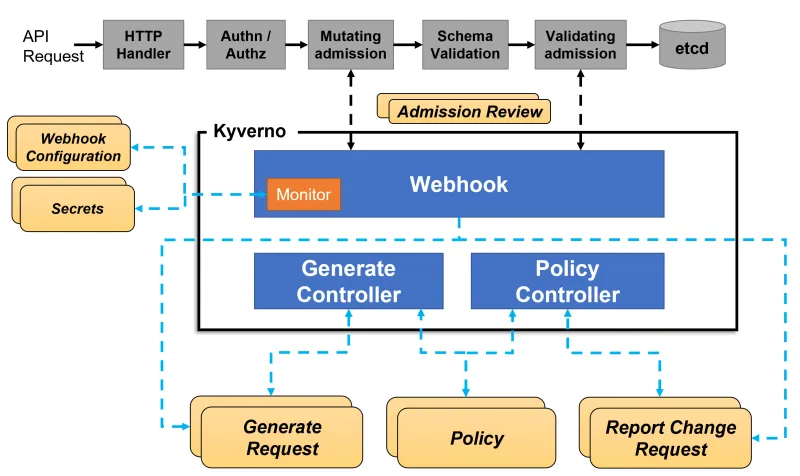
OK, Let's Take a Look at a Sample Policy
1	apiVersion: kyverno.io/v1
2	kind: ClusterPolicy
3	metadata:
4	  name: check-image
5	  annotations:
6	    policies.kyverno.io/owner: Red Hat CoP
7	    policies.kyverno.io/category: Workload Management
8	    policies.kyverno.io/description: Check pod is using signed image
9	spec:
10	  validationFailureAction: enforce
11	  background: false
12	  rules:
13	    - name: check-image-signed
14	      match:
15	        resources:
16	          kinds:
17	            - Pod
18	      verifyImages:
19	        - image: ghcr.io/garethahealy/kyverno-signed:*
20	          key: |-
21	            -----BEGIN PUBLIC KEY-----
22	            MFkwEwYHKoZIzj0CAQYIKoZIzj0DAQcDQgAEe318Ki+bLHDsSOipamI4bhQnU6Jy
23	            6c+ys0jPFVuNYtNIq8N6rC6YJsfn3WXHb3AZHc0/nan3a9LN9pJG1mTYtw==
24	            -----END PUBLIC KEY-----
Hopefully, the above is easy to understand if you are comfortable with Kubernetes resources. Let's go line by line and explain what each bit is doing:
- line 1 to 2: declares what type of resource it is, which in this example is cluster-wide
- line 3 to 8: is defining the metadata about the policy
- line 10: states what action should be taken when the policy is triggered, which in this case is denied
- line 13 to 17: is defining the resources, which this policy should match against
- line 19: is the image that policy matches, which has a wildcard for all tags
- line 20 to 24: is the public key generated by
cosign
Cool, How Do I Run That?
To run the above policy, it is expected the following tools are installed:
- cosign, which is used to sign our container image.
- bats-core, which is a testing framework that will execute
oc. - jq, which is used by the BATS framework to process JSON files.
- yq, which is used by the BATS framework to process YAML files.
You can execute the above policy by running the below commands. NOTE: A user with cluster-admin permissions is required to deploy Kyverno.
git clone https://github.com/garethahealy/kyverno-verifyimages-blog.git
cd kyverno-verifyimages-blog

echo "Firstly, we'll need to fill in some properties which are used to push the image/keys to ghcr.io..."
echo "1. GHCR_TOKEN : PAT GitHub token to push our images to ghcr.io"
echo "2. GHCR_USERNAME : GitHub username"
echo "3. REGISTRY_URL : Registry to push images to, we'll default to: ghrc.io"
export GHCR_TOKEN=replace_me
export GHCR_USERNAME=replace_me
export REGISTRY_URL=ghrc.io

echo "OK, let's update the registry reference for the test data..."
yq --yaml-output --in-place --arg GHCR_USERNAME "${GHCR_USERNAME}" --arg REGISTRY_URL "${REGISTRY_URL}" '.items[0].spec.template.spec.containers[0].image |= ($REGISTRY_URL + "/" + $GHCR_USERNAME + "/kyverno-signed:latest")' policy/check-image/test_data/unit/accept.yml
yq --yaml-output --in-place --arg GHCR_USERNAME "${GHCR_USERNAME}" --arg REGISTRY_URL "${REGISTRY_URL}" '.items[0].spec.template.spec.containers[0].image |= ($REGISTRY_URL + "/" + $GHCR_USERNAME + "/kyverno-unsigned:latest")' policy/check-image/test_data/unit/reject.yml

echo "Let's have a look at the test data..."
cat policy/check-image/test_data/unit/accept.yml
cat policy/check-image/test_data/unit/reject.yml

echo "OK, let's update the registry reference for the policy..."
yq --yaml-output --in-place --arg GHCR_USERNAME "${GHCR_USERNAME}" --arg REGISTRY_URL "${REGISTRY_URL}" '.spec.rules[].verifyImages[0].image |= ($REGISTRY_URL + "/" + $GHCR_USERNAME + "/kyverno-signed:latest")' policy/check-image/src.yaml
yq --yaml-output --in-place --arg GHCR_USERNAME "${GHCR_USERNAME}" --arg REGISTRY_URL "${REGISTRY_URL}" '.spec.rules[].verifyImages[1].image |= ($REGISTRY_URL + "/" + $GHCR_USERNAME + "/kyverno-unsigned:latest")' policy/check-image/src.yaml

echo "Let's have a look at the policy..."
cat policy/check-image/src.yaml

echo "Let's have a look at the BATS tests..."
cat test/kyverno-integrationtests.sh

echo "Let's have a look at the script which is going to build and sign our image..."
cat test/build-and-sign.sh

echo "Now, let's build and sign our image..."
test/build-and-sign.sh

echo "Now, let's deploy kyverno (cluster-admin permissions required with a valid session)..."
test/deploy-kyverno.sh deploy_kyverno

echo "Now, let's deploy the kyverno policies..."
test/deploy-kyverno.sh deploy_policy

echo "Now, let's check the policy is active for our namespace but as a dry-run..."
bats test/kyverno-unittests.sh

echo "Finally, let's check the policy is active for our namespace..."
bats test/kyverno-integrationtests.sh
So what did the above do?
- You executed
test/build-and-sign.sh, which usedpodmanto build and push two images toghcr.ioandcosignto sign one of those images. - You executed
test/deploy-kyverno.sh deploy_kyverno, which deployed Kyverno onto your cluster in thekyvernonamespace. - You executed
test/deploy-kyverno.sh deploy_policy, which applied aClusterPolicyKyverno CR to your cluster. - You executed
test/kyverno-unittests.sh, which usedBATSto runoc create --dry-run=serverwhich validated the policy worked as expected on-cluster. - You executed
test/kyverno-integrationtests.sh, which usedBATSto runoc createwhich validated the policy worked as expected on-cluster, by deploying the signed image and being rejected to deploy the unsigned.
If you are unable to install the software required, you can fork my GitHub repository which contains an action that runs the above on commit. So why not have a tinker in your own little playground.
OK, But How Do I Fit Image Verification Into My CI/CD Pipeline?
The following example presumes you are using a Jenkins deployed onto your cluster via:
oc new-project jenkins
oc process jenkins-persistent -p DISABLE_ADMINISTRATIVE_MONITORS=true -p MEMORY_LIMIT=2Gi -n openshift | oc create -n jenkins -f -
oc rollout status dc/jenkins --watch=true -n jenkins
If you are using another CI/CD tool, the key point is that we want to execute cosign and oc before deploying to the cluster. To be able to execute the commands, you will need to replicate the same functionality from this Dockerfile.
Firstly, we need to build a Jenkins agent which can execute cosign and oc in our Jenkins project:
oc import-image quay.io/redhat-cop/jenkins-agent-python:v1.0 --confirm -n jenkins
oc create -f jenkins/CosignBuildConfig.yaml -n jenkins
oc start-build cosign-docker-build -n jenkins -w
Once the build is complete, let's allow the jenkins service account to create Kyverno policies:
oc adm policy add-cluster-role-to-user kyverno:admin-policies system:serviceaccount:jenkins:jenkins
Now, let's give Kyverno permissions to pull images from the internal registry:
oc create secret docker-registry regcred --docker-server=$(oc registry info) --docker-username=jenkins --docker-password=$(oc whoami --token) --docker-email=jenkins@ocp.com -n kyverno
oc patch Deployment/kyverno --type json -p='[{"op":"add","path":"/spec/template/spec/containers/0/args","value":["--imagePullSecrets=regcred"]}]' -n kyverno
oc rollout status Deployment/kyverno -n kyverno --watch=true
Next, let's open Jenkins and create two new pipeline jobs. The first is for our cluster-admin who controls the policies:
node ("jenkins-agent-cosign") {
    stage("Clone blog") {
        sh "git clone https://github.com/garethahealy/kyverno-verifyimages-blog.git"
    }

    stage("Deploy ClusterPolicy") {
        dir("kyverno-verifyimages-blog") {
            echo "Let's first tweak the test data to match our OCP env..."
            sh "oc registry login"
            sh """yq --yaml-output --in-place --arg GHCR_USERNAME "jenkins" --arg REGISTRY_URL "\$(oc registry info)" '.spec.rules[].verifyImages[0].image |= (\$REGISTRY_URL + "/" + \$GHCR_USERNAME + "/kyverno-signed:latest")' policy/check-image/src.yaml"""
            sh """yq --yaml-output --in-place --arg GHCR_USERNAME "jenkins" --arg REGISTRY_URL "\$(oc registry info)" '.spec.rules[].verifyImages[1].image |= (\$REGISTRY_URL + "/" + \$GHCR_USERNAME + "/kyverno-unsigned:latest")' policy/check-image/src.yaml"""

            sh "cosign generate-key-pair k8s://jenkins/cosign"

            sh "oc delete clusterpolicy --all"
            sh "test/deploy-kyverno.sh deploy_policy"
        }
    }
}
Which once triggered should give you similar output to:

The second is for our developers who will be creating resources that might trigger the policies:
node ("jenkins-agent-cosign") {
    stage("Clone blog") {
        sh "git clone https://github.com/garethahealy/kyverno-verifyimages-blog.git"
    }

    stage("Build our images") {
        dir("kyverno-verifyimages-blog") {
            sh "oc import-image registry.access.redhat.com/ubi8/ubi-micro:8.4 --confirm"
            sh "oc apply -f jenkins/DevAppsBuildConfig.yaml"

            sh "oc start-build unsigned-docker-build -w"
            sh "oc start-build signed-docker-build -w"
        }
    }

    stage("Sign our built image") {
        dir("kyverno-verifyimages-blog") {
            sh "oc registry login"

            // NOTE: COSIGN_DOCKER_MEDIA_TYPES=1 is required for OCP < 4.7
            sh "cosign sign -key k8s://jenkins/cosign \$(oc registry info)/jenkins/kyverno-signed:latest"
        }
    }

    stage("Deploy resources") {
        dir("kyverno-verifyimages-blog") {
            echo "Let's first tweak the test data to match our OCP env..."
            sh """yq --yaml-output --in-place --arg GHCR_USERNAME "jenkins" --arg REGISTRY_URL "\$(oc registry info)" '.items[0].spec.template.spec.containers[0].image |= (\$REGISTRY_URL + "/" + \$GHCR_USERNAME + "/kyverno-signed:latest")' policy/check-image/test_data/unit/accept.yml"""
            sh """yq --yaml-output --in-place --arg GHCR_USERNAME "jenkins" --arg REGISTRY_URL "\$(oc registry info)" '.items[0].spec.template.spec.containers[0].image |= (\$REGISTRY_URL + "/" + \$GHCR_USERNAME + "/kyverno-unsigned:latest")' policy/check-image/test_data/unit/reject.yml"""

            sh "oc create -f policy/check-image/test_data/unit/accept.yml --dry-run=server"
            sh "oc create -f policy/check-image/test_data/unit/reject.yml --dry-run=server"
        }
    }
}
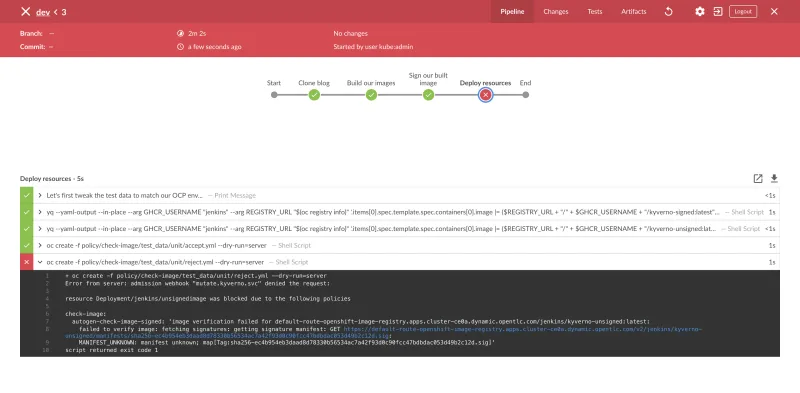
This should give you a similar output to the below, which shows our signed image being accepted but the unsigned image being rejected:
But, I've got multiple clusters...
Most customers I speak with typically have multiple clusters that look similar to:
- sandbox
- development and test
- production like
- production
So how can they control the deployment of Kyverno policies across multiple clusters? I would suggest they make use of Red Hat Advanced Cluster Management for Kubernetes. Firstly, it helps with cluster sprawl which can become a problem with the above environment setup. Secondly, it offers the ability to replicate Kyverno policies and report back to the Hub cluster when a policy is in violation which greatly improves the DevEx.
What next?
Hopefully, you've seen how easy it is to verify images on your cluster. As the feature is still alpha, it needs users to start trying it out in anger and finding issues so that it can be promoted to GA.
The Kyverno community on slack are friendly and most importantly, super active. So if you hit any issues or have any suggestions, head over and get involved.
Other use cases for cosign are also being adopted by open-source projects, such as Tekton Chains which shows that sigstore and software supply chain security are hot topics currently.
저자 소개

Gareth Healy has extensive experience developing enterprise applications on both desktop and web systems, working in a variety of market sectors such as ecommerce, procurement, utilities, banking and finance. Healy is currently specialising in middleware integrations based on Red Hat Fuse running on a container platform based on Red Hat OpenShift Container Platform.
유사한 검색 결과
What’s new in post-quantum cryptography in RHEL 10.1
Introducing OpenShift Service Mesh 3.2 with Istio’s ambient mode
Data Security And AI | Compiler
Data Security 101 | Compiler
채널별 검색

오토메이션
기술, 팀, 인프라를 위한 IT 자동화 최신 동향

인공지능
고객이 어디서나 AI 워크로드를 실행할 수 있도록 지원하는 플랫폼 업데이트

오픈 하이브리드 클라우드
하이브리드 클라우드로 더욱 유연한 미래를 구축하는 방법을 알아보세요

보안
환경과 기술 전반에 걸쳐 리스크를 감소하는 방법에 대한 최신 정보

엣지 컴퓨팅
엣지에서의 운영을 단순화하는 플랫폼 업데이트

인프라
세계적으로 인정받은 기업용 Linux 플랫폼에 대한 최신 정보

애플리케이션
복잡한 애플리케이션에 대한 솔루션 더 보기

가상화
온프레미스와 클라우드 환경에서 워크로드를 유연하게 운영하기 위한 엔터프라이즈 가상화의 미래
