



Disasters that affect companies can take many forms: public health, terrorism and war, and extreme weather. They can also affect companies in different ways, including needing to shut down offices, helping affected employees and regaining access to networks and computers. It’s a multifaceted challenge but, for the purposes of this blog, we’re going to focus on anticipating and responding to supply chain challenges due to natural disasters such as hurricanes, typhoons, floods, earthquakes, wildfires and droughts.
These are not unusual challenges. In 2020, there were 22 separate billion-dollar weather and climate disasters in the U.S. alone. It’s easy to see why modeling the risk from weather is so critical to supply chain and store operations. At the same time, according to the Business Continuity Institute, 72% of suppliers who dealt with a breakdown in their supply chain lacked the full, real-time visibility needed to devise a fast and simple solution.
Business problem
There are a wide range of possible supply chain effects. Events could result in a variety of situations such as:
- physical damage to properties
- limitations on store operating hours
- the temporary closure of warehouses, depots, manufacturing or home office facilities
- the temporary lack of an adequate workforce
- disruptions to our IT systems
- the temporary or long-term disruption in the supply of products from some local or overseas suppliers
- the temporary disruption in the transport of goods to or from overseas
- delays in the delivery of goods to our warehouses or depots
- the temporary reduction in the availability of products in warehouses
A central metric is time to recover (TTR), the time it would take for a particular node—a supplier facility, a distribution center, or a transportation hub—to be restored to full functionality after a disruption.
The second metric is risk exposure, an assessment of exposure to risk based on a model that applies suppliers' TTR to estimate the performance impact, including operational (lost production) and financial (lost revenue and profit).
How to prepare
Later in this blog, we’ll take you through a detailed technical architecture that can help you deal with weather disruption preparation. We’ll also consider the scenario where a store is open but disconnected from a company’s datacenter.
First, however, let’s take a high-level look at how companies can prepare their supply chains for weather-related disasters:
1. Identify potential risks
The first step is to identify the potential weather risks that could disrupt your supply chain. Depending upon where a company and its primary suppliers are located, the risks may vary—though keep in mind that upstream supply chain effects of a disruption may be far removed from your region.
2. Assess your vulnerabilities
Once you have identified the potential risks, you need to assess your vulnerabilities. This means understanding how a disruption could impact your supply chain and what steps you can take to mitigate that impact. This includes making a list of your most critical suppliers, those that provide you with the most important products or services. Consider your suppliers' locations, their track record with weather-related disruptions and their disaster preparedness plans.
3. Develop a plan
Once you have assessed your vulnerabilities, you need to develop a plan to mitigate the impact of a disruption. This plan should include steps to identify and communicate with suppliers, to develop alternative sources of supply and to have contingency plans in place for different scenarios. You should also plan for rerouting shipments, communicating with customers and managing inventory. All stages of the supply chain should be part of the plan.
4. Test your plan
Like any backup or contingency plan, it is important to test your plan and recheck its inputs and assumptions regularly to make sure that it is up-to-date and that it works as intended. This will help you to identify any gaps in your plan and to make necessary adjustments.
Solution overview
The solution uses the following technologies, which can be grouped into three main categories as shown in the diagram below:
- Core application systems. These are often customer-provided technologies, such as order management and facilities management. These systems can include standalone applications, on-premises and cloud services, and databases.
- Foundational infrastructure. The Red Hat/IBM solution is built on Red Hat OpenShift with data routed through API management and events routed through business automation tools such as Business Automation Workflow.
- Supply chain optimization platform. This consists of a Supply Assurance Control Panel, Fulfillment Optimization, and Inventory Analysis and AI.
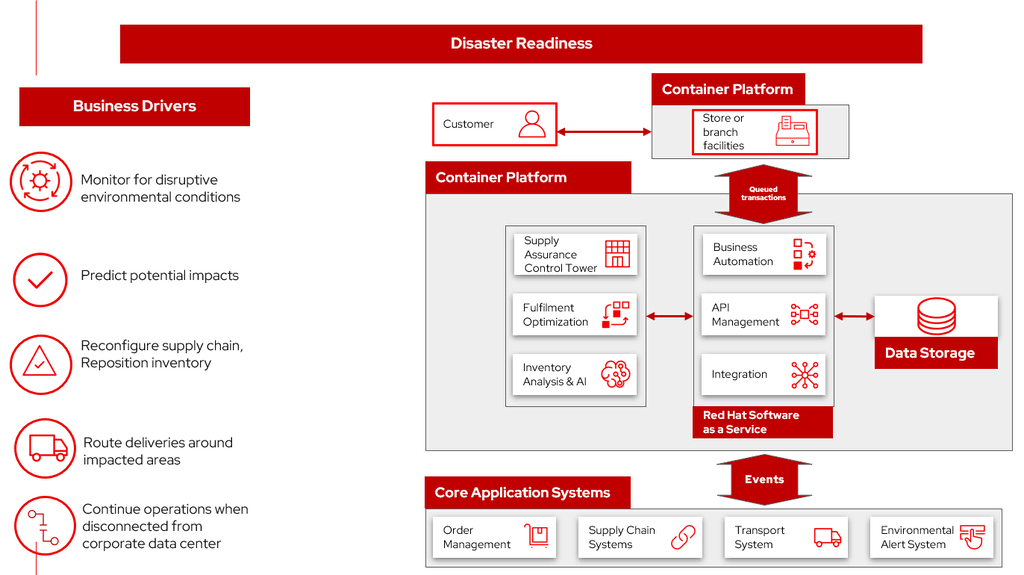
Architecture
The illustrations in this section show the interaction of customer systems with supply chain optimization platform systems in the context of a retail scenario with branch stores. We consider both preparation for weather disruption and the workflows associated with an operating store that becomes disconnected from the datacenter.
Weather disruption preparation

Preparation starts with external data feeds, such as IBM Environmental Intelligence Suite, anticipating disruptive environmental conditions.The Demand Intelligence system is then alerted to the potential disruption.
Inventory Analysis anticipates potential low stock levels and predicts demand levels. Control Tower collects current inventory positions from stores, in-transit and warehouses plus future inventory positions, and then alerts a human in the loop with a set of work queues to mitigate the disruption. That person starts the remediation by selecting actions provided by the Control Tower.
Control Tower triggers Business Automation to remediate stock levels using a combination of options, including:
- Ordering more stock in nearby and affected areas
- Adjusting stock positions within the existing supply chain
- Planning transport around the affected area
- Coordinating with suppliers and vendors to position inventory
Disconnected store
The following scenario shows how data can be transmitted from a store to the datacenter as part of an overall solution to setting up and maintaining the computer facilities in a store or branch office.

When the store is disconnected, point of sale devices send information to in-store servers that collect transactions. Then, once the connection is restored, the store server queues the events and plays them back.
The transaction events are now read and Business Automation workflows are triggered to update corporate systems. Data is updated through Business Automation to:
- Adjust stock position data for the affected stores
- Update replenishment system
- Setup store operations data
- Consolidate data to update the work queue in the supply chain Control Tower
Summary
Extreme weather events, public health, terrorism and war can overtake a company and its supply chain quickly. The statistical likelihood of certain types of events, such as blizzards, in a given area, may make them seem routine, but they can snarl supply chains nonetheless. Nor can the company ignore the possibility of major weather events such as hurricanes just because they’re rare. Planning is essential, together with your suppliers in all cases, as is constantly updating your assumptions and the list of partners you’ll need to work with.
At a high level, there are several main steps your organization can take to drive innovation and modernize your supply chain relating to categories such as automation, modernization and sustainability. For specific steps on this approach, see The Action Guide details in Own your transformation survey of 1500 CSCOs across 24 industries.
If you are interested in more solutions built with these and other products in Red Hat's portfolio visit the Portfolio Architecture website and the Handling Returns Portfolio Architecture, in particular.
Supply chain blog series
- Supply chain optimization imperative blog
- Supply chain optimization blog and portfolio architecture
- Demand risk blog and portfolio architecture
- Loss and waste management blog and portfolio architecture
- Product timeliness blog and portfolio architecture
- Perfect order blog and portfolio architecture
- Intelligent order blog and portfolio architecture
- Sustainable supply chain blog and portfolio architecture
- Supply chain challenges: handling returns blog and portfolio architecture
- Protect your supply chain from disasters portfolio architecture
References
- Supply chain planning and analytics
- MIT Sloan Management Review Three Scenarios to Guide Your Global Supply Chain Recovery
- Harvard Business Review Managing Unpredictable Supply-Chain Disruptions
- IBM The missing link: Why visibility is essential to creating a resilient supply chain
- IBM How to create more sustainable operations – one asset at a time
Contributors
- Iain Boyle, Chief Architect, Red Hat
- Anthony Giles, Business Automation Technical Specialist, IBM
- Eric Singsaas, Account Technical Lead, IBM Technology
- Bruce Kyle, Sr Solution Architect, IBM Client Engineering
- Mahesh Dodani, Principal Industry Engineer, IBM Technology
- Mike Lee, Principal Integration Technical Specialist, IBM
- Thalia Hooker, Senior Principal Specialist Solution Architect, Red Hat
- Lee Carbonell, Senior Solution Architect & Master Inventor, IBM
저자 소개
Anthony joined IBM as a Technical Specialist focusing on travel & transportation and distribution sectors in the industry market in 2022. As a member of the Data, AI and Automation team at IBM, he focuses on Business Automation. He has a passion for assisting large clients in identifying areas for automation and assisting architecture of solutions to real-world problems.
Karl joined Red Hat in 2021 as a Chief Architect focused on the Distribution sector. Prior to Red Hat, Karl was with IBM for over twenty-five years and served as the Chief Architect for the Retail and Consumer Industry in addition to other assignments. He is also an IBM Master Inventor.
Bruce joined IBM as a Solutions Architect focusing on distribution and communication sectors in the industry market in 2021 in Client Engineering. Bruce has been a solutions architect since 2001. He led the initial cloud migrations to Microsoft Azure, managed research compute resources at Microsoft Research and built out Kubernetes implementations.
Lee joined IBM in 2004 and has worked on various client opportunities in global industries – including Retail, Consumer Packaged Goods, Government and Healthcare. He worked on developing use cases and on mapping these to potential technology solutions. With this, he developed technical architectural approaches to fulfill prioritized requirements. Lee is currently a Senior Solution Architect in IBM Client Engineering dedicated to a large banking client to demonstrate the value of IBM’s Hybrid Cloud and Data and AI solutions. In addition, Lee is active with technology innovations as an IBM Master Inventor.
유사한 검색 결과
기업 속도의 새로운 가치 기준
asago 소개: 오픈소스 AI 안전 및 거버넌스 오케스트레이션
Random Acts Of Automation | Compiler
How Red Hat cleared IT debt for scalable AI
채널별 검색

오토메이션
기술, 팀, 인프라를 위한 IT 자동화 최신 동향

인공지능
고객이 어디서나 AI 워크로드를 실행할 수 있도록 지원하는 플랫폼 업데이트

오픈 하이브리드 클라우드
하이브리드 클라우드로 더욱 유연한 미래를 구축하는 방법을 알아보세요

보안
환경과 기술 전반에 걸쳐 리스크를 감소하는 방법에 대한 최신 정보

엣지 컴퓨팅
엣지에서의 운영을 단순화하는 플랫폼 업데이트

인프라
세계적으로 인정받은 기업용 Linux 플랫폼에 대한 최신 정보

애플리케이션
복잡한 애플리케이션에 대한 솔루션 더 보기

가상화
온프레미스와 클라우드 환경에서 워크로드를 유연하게 운영하기 위한 엔터프라이즈 가상화의 미래
