
At KubeCon North America 2019 we highlighted what it means to deliver a mature Kubernetes Operator. A Kubernetes Operator is a method of packaging, deploying and managing a Kubernetes application. The key attribute of an Operator is the active, ongoing management of the application, including failover, backups, upgrades and autoscaling, just like a cloud service.
These capabilities are ranked into five levels, which are used to gauge maturity. We refer to this as the Operator Capability Model, which outlines a set of possible capabilities that can be applied to an application. Of course, if your app doesn’t store stateful data, a backup might not be applicable to you but log processing or alerting might be important. The important user experience that the Operator model aims for is getting that cloud-like, self-managing experience with knowledge baked in from the experts.
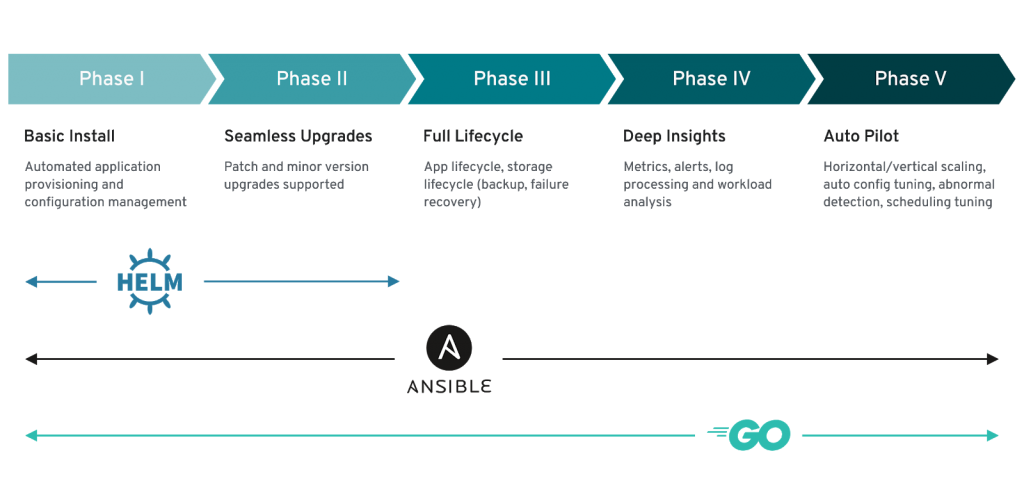
Several community Operators have shown us what can be possible when advancing across this capability model which we wanted to recognize as a goal for the rest of the community.
Couchbase
Couchbase has an extremely advanced Operator that handles data rebalancing, rack/zone awareness and auto recovery for a swath of operational events that can happen to your NoSQL cluster. Integrated metrics and dashboards for deep insight into your Couchbase clusters pushes the Operator strongly into Phase IV of the Capability Model.
But that’s not all, Couchbase also integrates itself natively into the OpenShift Console, so Couchbase users that are using the Operator to self-service their clusters can easily reconfigure clusters and check on its health. Read more about using Couchbase on OpenShift in the technical implementation guide.
Dynatrace
The Dynatrace OneAgent Operator allows users to easily deploy full-stack monitoring for Kubernetes clusters. The Dynatrace OneAgent automatically monitors the workload running in containers down to the code and request level. Stay tuned for additional Operator features coming from Dynatrace.
This entire Operator can help OpenShift cluster administrators reach Phase IV for their own applications running on the cluster. Read more in the Dynatrace product brief.
MongoDB
The MongoDB Enterprise Kubernetes Operator enables easy deploys of MongoDB into Kubernetes clusters, using MongoDB’s management, monitoring and backup platforms, Ops Manager and Cloud Manager.
The Operator allows developers a self-service model to get three different types of MongoDB databases, following the best practices for developer environments, replicated high availability clusters for production, and sharded clusters for horizontal scaling. As you can imagine, configuring each of these environments requires the expertise of MongoDB’s engineers which is already built into the Operator. Find out more in the MongoDB on OpenShift product brief.
Portworx
Portworx Enterprise is a cloud-native storage solution for production workloads and provides high-availability, data protection and security for containerized applications. Portworx Enterprise enables you to migrate entire applications, including data, between clusters in a single data center or cloud, or between clouds, with a single kubectl command.
Storage is a critical part of your clusters running on the cloud or on premises. The Portworx Operator exports metrics which can be used in conjunction with the Prometheus Operator to collect, alert and show Grafana dashboards of this data. Robust monitoring brings this Operator up to capability Phase IV. Portworx has a handy config generator for the Operator and more detailed instructions for using Portworx on OpenShift.
StorageOS
StorageOS is a cloud native, software-defined storage platform that transforms commodity server or cloud based disk capacity into enterprise-class persistent storage for containers. StorageOS is ideal for deploying databases, message busses, and other mission-critical stateful solutions, where rapid recovery and fault tolerance are essential.
The StorageOS Operator installs and manages StorageOS within a cluster. Cluster nodes may contribute local or attached disk-based storage into a distributed pool, which is then available to all cluster members via a global namespace. StorageOS also comes with out of the box support for Prometheus to make sure your cluster is healthy as Day 2 actions are taken, such as pinning the Nodes used for the storage cluster into a specific Node Pool. This Operator reaches Phase IV. Read the product brief for more information.
All available in OperatorHub
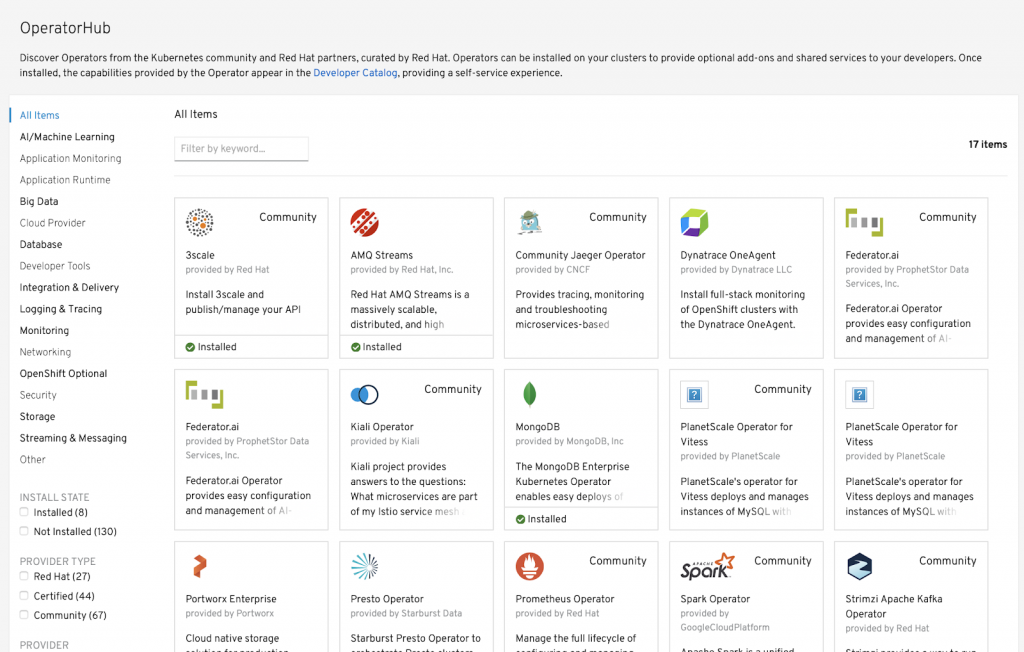
Check out all of these great Operators and more at OperatorHub.io. If you’re browsing from within your OpenShift 4 cluster, you can filter for Phase IV “Deep Insights” and Phase V “Auto Pilot.”
If you’re working on an Operator for OpenShift, find out more about our Operator Certification program.
저자 소개
Product manager & experience designer with a passion for taming technical systems. Rob Szumski has expertise in producing and shipping open source software as part of a holistic product experience.
유사한 검색 결과
Service Mesh를 활용한 Red Hat OpenShift 가상 머신 관리
신속한 패치 적용이 어려우신가요? 최후의 방어선, 제로 트러스트
Scaling with Orchestrators | Compiler
Container Roundup | Compiler
채널별 검색

오토메이션
기술, 팀, 인프라를 위한 IT 자동화 최신 동향

인공지능
고객이 어디서나 AI 워크로드를 실행할 수 있도록 지원하는 플랫폼 업데이트

오픈 하이브리드 클라우드
하이브리드 클라우드로 더욱 유연한 미래를 구축하는 방법을 알아보세요

보안
환경과 기술 전반에 걸쳐 리스크를 감소하는 방법에 대한 최신 정보

엣지 컴퓨팅
엣지에서의 운영을 단순화하는 플랫폼 업데이트

인프라
세계적으로 인정받은 기업용 Linux 플랫폼에 대한 최신 정보

애플리케이션
복잡한 애플리케이션에 대한 솔루션 더 보기

가상화
온프레미스와 클라우드 환경에서 워크로드를 유연하게 운영하기 위한 엔터프라이즈 가상화의 미래
