Red Hat OpenShift Pipelines is a cloud-native, continuous integration and continuous delivery (CI/CD) solution based on Kubernetes resources. It uses Tekton building blocks to automate deployments across multiple platforms by abstracting away the underlying implementation details. Tekton introduces a number of standard custom resource definitions (CRDs) for defining CI/CD pipelines that are portable across Kubernetes distributions.
Red Hat OpenShift Pipelines 1.8 is now Generally Available on OpenShift Container Platform 4.10, and is planned to be available on OpenShift Container Platform 4.11 and 4.12.
New Features and Enhancements:
- Red Hat OpenShift Pipelines on Arm: With this release, you can run Red Hat OpenShift Pipelines 1.8 and later on an OpenShift Container Platform cluster that is running on Arm architecture.
- Tekton Hub enhancements:
- As an administrator, you can configure Tekton Hub to use a custom database rather than the default database.
- As an administrator, if you enable Tekton Hub, it periodically updates the catalog with the current information. You can configure the length of this period.
- As an administrator, you can install Tekton Hub with minimal input because it has better default configuration settings. You can start running Tekton Hub and work with your teams to decide what customizations they need.
- Pipelines as code enhancements:
- Add Git repository via webhook: You can add your Git repository to Pipelines as Code by using the webhook mechanism. This way, you can use Pipelines as Code even if GitHub Apps is not feasible.
- Trigger multiple pipelines for one Git event: You can trigger multiple pipeline runs for one git event e.g. PR.
- Manual and third party triggers: You as a developer will be able to trigger pipelinerun directly without being tightened up to a code flow.
- Support for additional git providers like Gitlab and Bitbucket
- Bootstrapping via dev console:
- You can create a Github application from the dev console. (Figure 1)
- You can configure the git provider (GitHub, GitLab and BitBucket) by adding repositories to enable pipeline as code. (Figure 2)

Figure 1
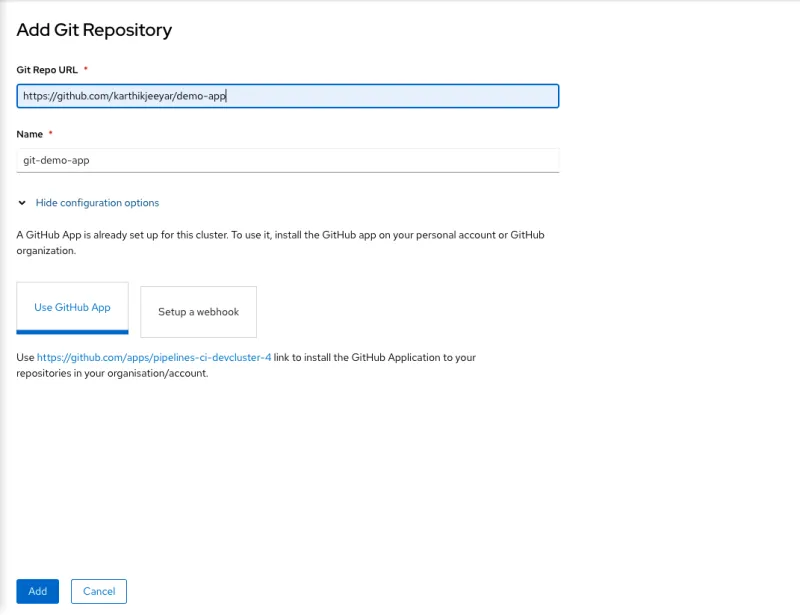 Figure 2
Apart from the features mentioned above, support for the PipelineResource custom resource (CR) and Condition custom resource (CR) have been removed as we are deprecating the tekton.dev/v1alpha1 API version.
For a full list and detailed information about each item in this release, please check out the Release Notes section of the OpenShift Documentation.
Where to next?
You can install Red Hat OpenShift Pipelines using the Operator listed in the OpenShift Container Platform OperatorHub and start using pipelines.
For more detailed understanding of Openshift Pipelines, check out Understanding OpenShift Pipelines.
저자 소개

유사한 검색 결과
Dell Technologies modernizes the developer experience with Red Hat OpenShift Dev Spaces
Red Hat OpenShift and Oracle’s 5G Core: Streamlining global deployments
The Ground Floor | Compiler: Tales From The Database
Bad Bosses | Compiler: Tales From The Database
채널별 검색

오토메이션
기술, 팀, 인프라를 위한 IT 자동화 최신 동향

인공지능
고객이 어디서나 AI 워크로드를 실행할 수 있도록 지원하는 플랫폼 업데이트

오픈 하이브리드 클라우드
하이브리드 클라우드로 더욱 유연한 미래를 구축하는 방법을 알아보세요

보안
환경과 기술 전반에 걸쳐 리스크를 감소하는 방법에 대한 최신 정보

엣지 컴퓨팅
엣지에서의 운영을 단순화하는 플랫폼 업데이트

인프라
세계적으로 인정받은 기업용 Linux 플랫폼에 대한 최신 정보

애플리케이션
복잡한 애플리케이션에 대한 솔루션 더 보기

가상화
온프레미스와 클라우드 환경에서 워크로드를 유연하게 운영하기 위한 엔터프라이즈 가상화의 미래
